Trump Threatens Iran Power Plants, Bridges; Experts Warn of War Crimes
Trump vowed to destroy every Iranian power plant and bridge by Tuesday night; a former JAG officer called the threat itself a war crime.
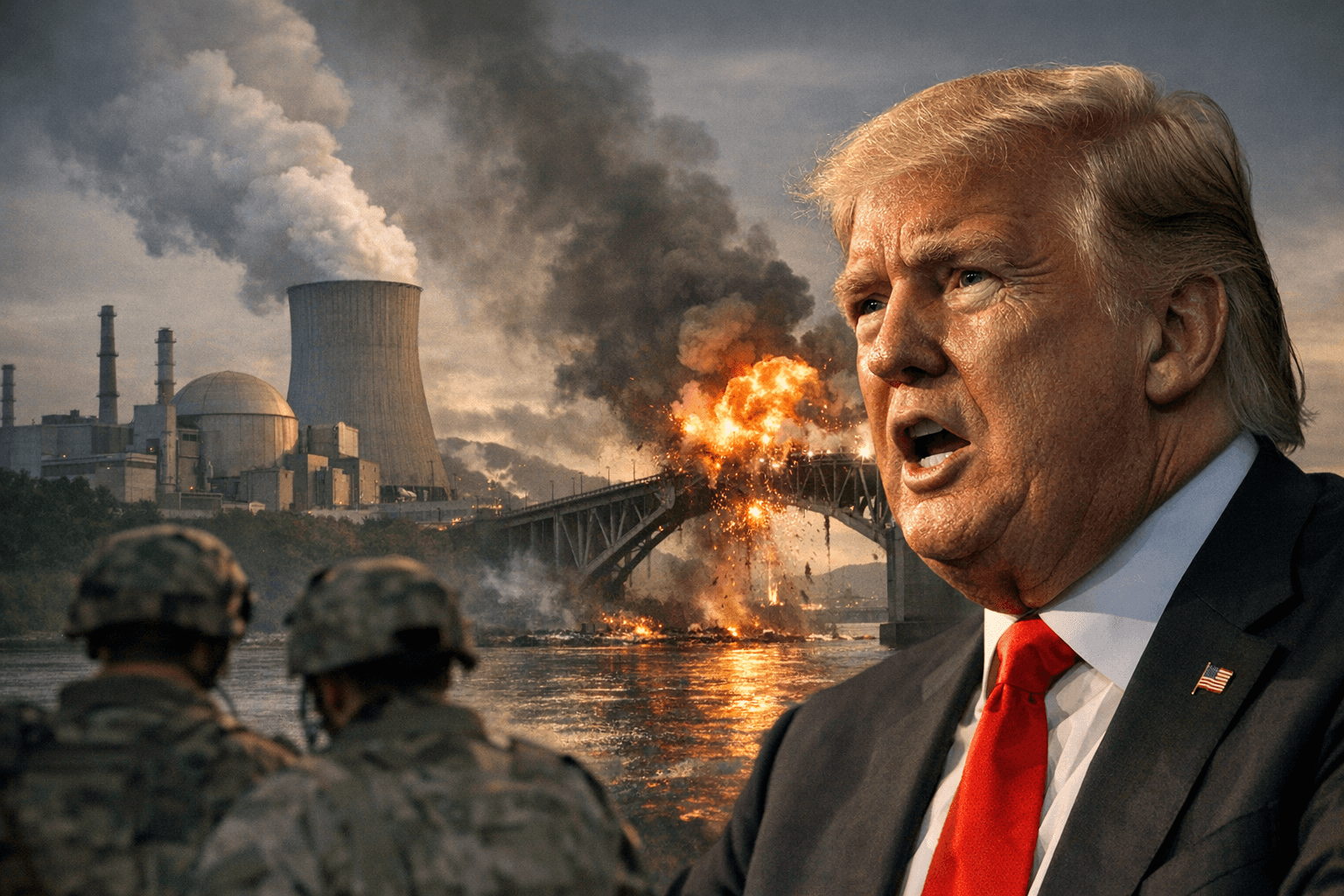
President Donald Trump's vow to destroy every power plant and bridge in Iran by Tuesday night drew immediate condemnation from international legal experts, with a former U.S. military judge advocate calling the threat itself a war crime.
"Every bridge in Iran will be decimated by 12 o'clock tomorrow night, where every power plant in Iran will be out of business, burning, exploding and never to be used again," Trump said, setting an 8 p.m. ET deadline of April 7 for Iran to reopen the Strait of Hormuz. The warning followed an expletive-laden Truth Social post on Easter Sunday, April 5, in which Trump declared: "Tuesday will be Power Plant Day, and Bridge Day, all wrapped up in one, in Iran."
Lt. Col. Rachel VanLandingham (ret.), a former military JAG officer, was unequivocal. "He's both threatening a war crime and he's engaging in a war crime through that rhetoric itself," she said, noting that the law of war is not merely international but domestic U.S. law binding on American service members.
The threats come five weeks into Operation Epic Fury, the joint U.S.-Israeli military campaign Trump authorized on February 28. The opening salvo killed Iranian Supreme Leader Ali Khamenei, triggering hundreds of retaliatory missiles and thousands of drones across the Middle East. Iran closed the Strait of Hormuz, and approximately 1,900 people have been killed in Iran since hostilities began, with the Iranian government no longer publishing updated casualty figures.
Under international humanitarian law, deliberately attacking civilian infrastructure fails four foundational legal tests: distinction between military and civilian targets, proportionality, military necessity, and the prohibition on collective punishment. CNN's Fareed Zakaria noted that targeting energy infrastructure "has traditionally been considered a war crime" and is "certainly on plain reading a violation of the Geneva Convention."
More than 100 international law experts signed an open letter on April 3 calling the February 28 strikes a "clear violation of the United Nations Charter." The letter cited a school strike in Minab, Iran, on the first day of the war that killed at least 175 people, most of them children. UN experts separately documented a girls' school strike that killed at least 180 girls. ICRC President Mirjana Spoljaric Egger, speaking on March 23, declared: "War on essential infrastructure is war on civilians." UN spokesman Stéphane Dujarric added that if there is an attack on clearly civilian infrastructure, "that is not allowed under international humanitarian law."
Sen. Chris Murphy (D-Conn.) urged Republican leaders to intervene, accusing Trump of planning mass war crimes. GOP leadership remained largely silent in support. White House Press Secretary Karoline Leavitt countered that the administration "will always act within the confines of the law." Trump rejected the war crimes accusations outright. "I hope I don't have to do it," he said, framing his goal as preventing Iran from obtaining a nuclear weapon and forcing the Strait to reopen.
Iran submitted a 10-clause peace proposal covering safe passage through the Strait of Hormuz, sanctions relief, and reconstruction provisions. Trump rejected it as insufficient. Pakistan and two other countries separately offered a 45-day ceasefire proposal. The Islamic Revolutionary Guard Corps called the bridge and power plant threats "baseless."
Legal accountability faces structural barriers: neither the U.S. nor Iran belongs to the International Criminal Court, and a 2024 Supreme Court ruling on presidential immunity for official acts complicates domestic prosecution of Trump himself, though non-presidential officials could potentially face charges under U.S. war crimes law. Human Rights Watch, which documented violations by all parties on March 26, called the conflict a "critical stress test for the international legal order.
This article was produced by Prism’s automated news system from verified source data, official records, and press releases, then run through automated quality and moderation checks before publishing. The system is built and supervised by the people who set the standards it runs under. Read our full AI policy.
Did this article answer your question?