NBC News Reporter Details F-15 Shot Down by Shoulder Missile in Iran
An Iranian shoulder-fired missile downed a U.S. F-15E over Iran on April 3, exposing limits to claims of total air dominance despite a massive 150-aircraft rescue.
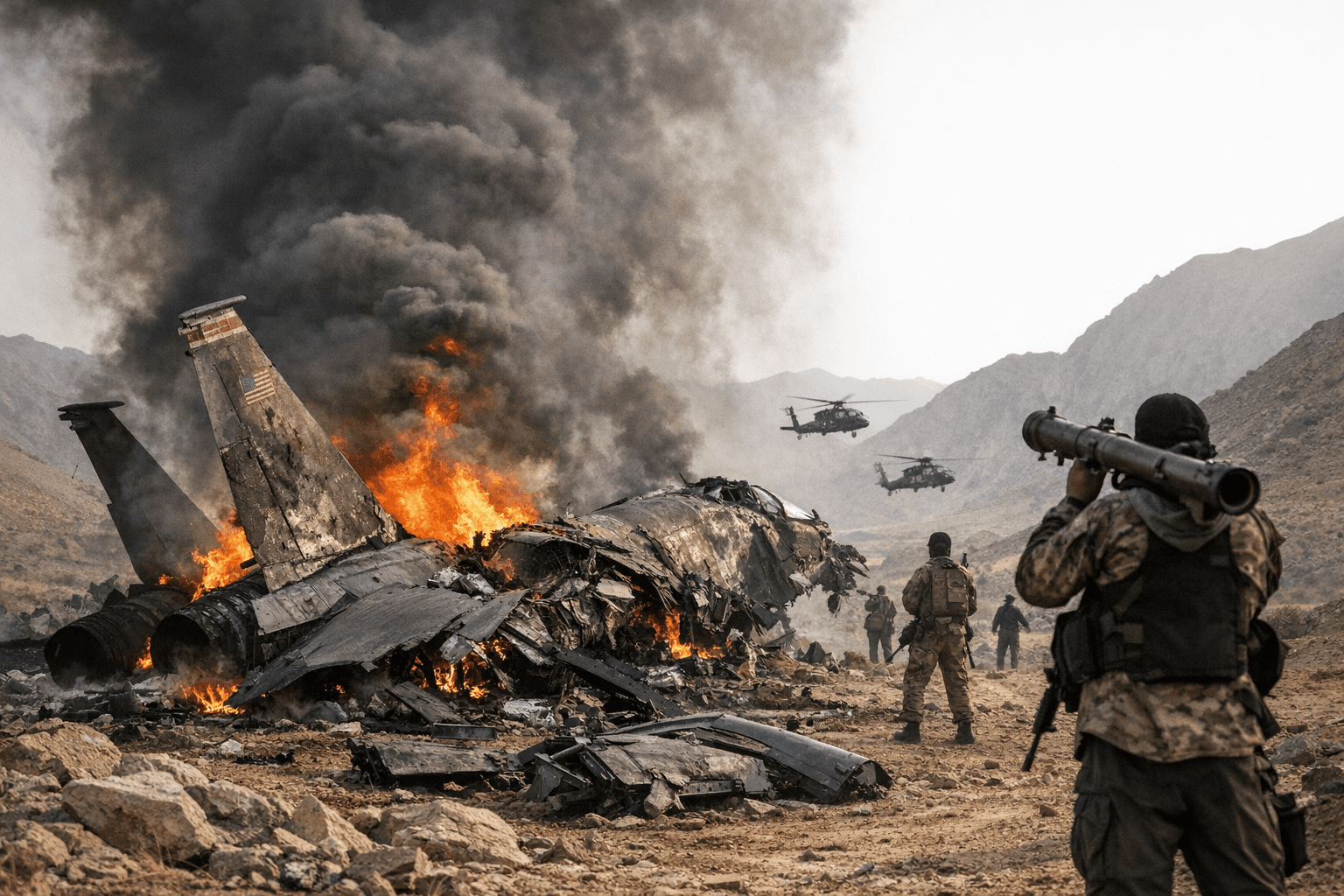
The shoot-down of an American F-15E Strike Eagle over Iran on April 3 exposed a gap between the Trump administration's confident declarations of air superiority and the enduring, ground-level threat still posed by Iranian forces, NBC News national security correspondent Courtney Kube explained in a discussion on "Here's the Scoop."
The F-15E, bearing the call sign "Dude 44" and belonging to the 494th Fighter Squadron of the 48th Fighter Wing based at RAF Lakenheath in Suffolk, England, went down at approximately 4:40 a.m. local time in Iran. Both crew members ejected and landed in Iranian territory, triggering one of the most complex rescue operations of the conflict. President Trump confirmed the jet was brought down by a shoulder-fired, heat-seeking missile, describing the weapon as one that "got sucked right in by the engine." Trump said the Iranian who fired it "got lucky," noting that U.S. forces had already eliminated anti-aircraft defenses in the area.
The timing of the disclosure proved difficult for the White House. Just days before the shoot-down, Trump addressed the nation and declared that Iran had "no anti-aircraft equipment," that its radar was "100% annihilated," and that U.S. forces were "unstoppable." Defense Secretary Pete Hegseth had also claimed the United States had achieved "total air dominance" over the country. The loss of Dude 44 marked the first time during Operation Epic Fury, launched February 28, that a manned U.S. aircraft was brought down by enemy fire. It was also the first U.S. combat aircraft lost in combat in more than 20 years.
The rescue operation that followed drew more than 150 aircraft, including A-10 Thunderbolts, drones, and other tactical aircraft tasked with "violently suppressing and engaging the enemy." One crew member was recovered quickly; the second was not rescued until Easter Sunday. During the operation, an A-10 was also lost, and two C-130 Hercules transport aircraft were intentionally destroyed to prevent capture. The Iranian Army later announced that four of its officers, including Brigadier General Masoud Zare, were killed by a U.S. airstrike in Mahyar, Isfahan, in connection with the rescue.
The weapon itself illustrated what defense analysts have long warned about: even a degraded adversary retains asymmetric lethality. Portable shoulder-fired systems, or MANPADS, are far harder to neutralize than fixed radar installations or missile batteries. A senior analyst quoted in reporting on the shoot-down noted that such weapons reflect how Iran remains "weak but still lethal," particularly as American planes have been flying at lower altitudes that increase their exposure to ground-based fire. U.S. officials also acknowledged that roughly half of Iran's ballistic missile launchers remain intact and that thousands of one-way attack drones are still in Tehran's arsenal.
Trump, who called the rescue "very historic" and predicted it would "go down in the books," acknowledged the contradiction in his own framing: the United States had dismantled much of Iran's conventional air defense architecture, yet a single soldier with a handheld missile was sufficient to bring down a frontline fighter jet. Kube's analysis, grounded in her reporting on the Pentagon and Operation Epic Fury, placed the incident within the broader reality that asymmetric warfare can negate even the most technologically advanced air campaign.
This article was produced by Prism’s automated news system from verified source data, official records, and press releases, then run through automated quality and moderation checks before publishing. The system is built and supervised by the people who set the standards it runs under. Read our full AI policy.
Did this article answer your question?


