Trump Warns Iran Faces Total Destruction If No Deal Reached by Tomorrow
Trump threatened to demolish every bridge and power plant in Iran within four hours if no deal is reached by 8 p.m. ET tonight, as Tehran rejected a U.S. ceasefire proposal.
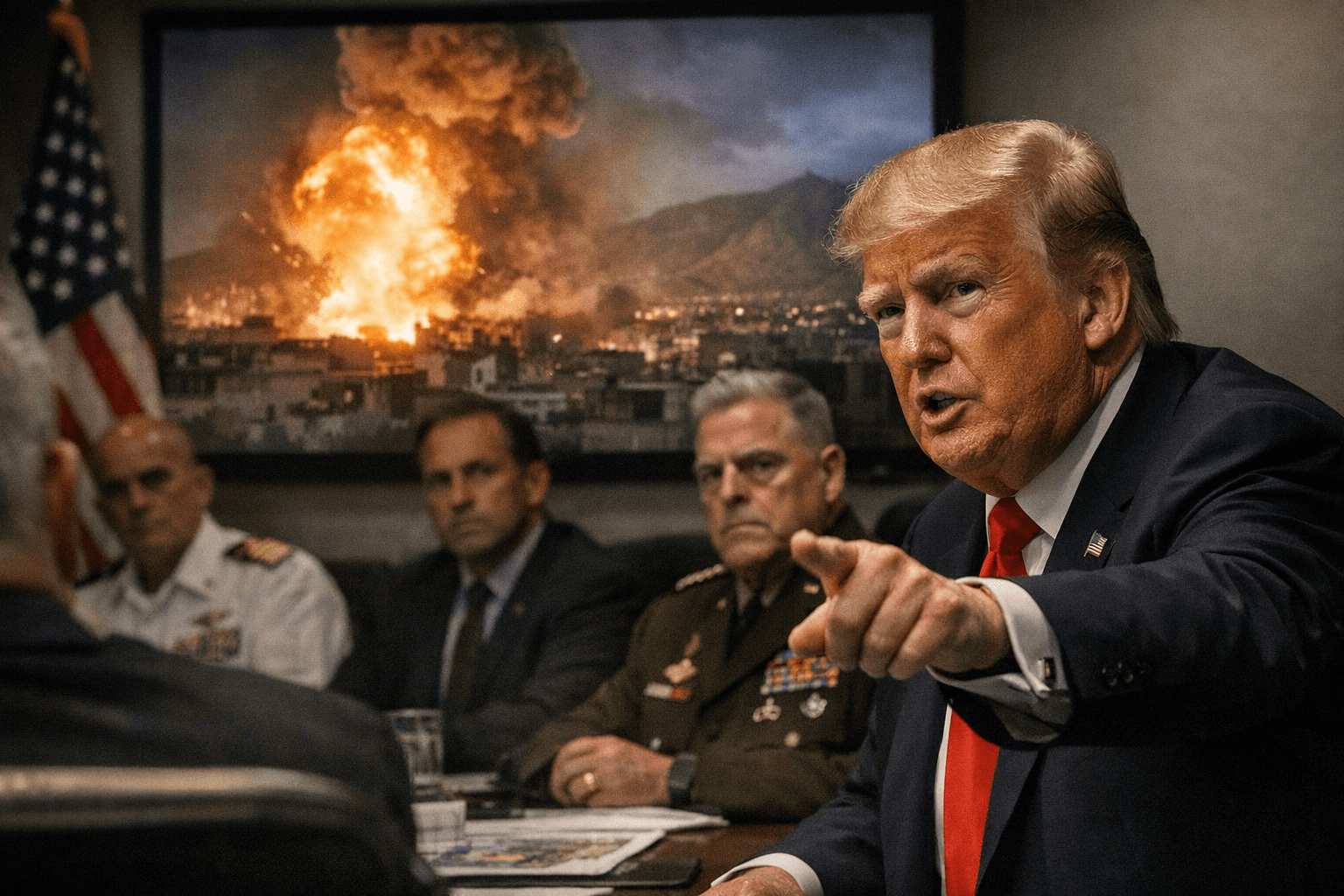
With his self-imposed 8 p.m. ET deadline bearing down on Tuesday, President Donald Trump delivered his most explicit military threat yet, describing in graphic detail the destruction he says awaits Iran if the Strait of Hormuz remains closed.
"Every bridge in Iran will be decimated by 12 o'clock tomorrow night, where every power plant in Iran will be out of business, burning, exploding, and never to be used again," Trump told reporters. "I mean, complete demolition by 12 o'clock, and it will happen over a period of four hours if we want it to. We don't want that to happen." In a separate interview with Axios, he framed the choice more bluntly: "There is a good chance [of a deal], but if they don't make a deal, I am blowing up everything over there."
The deadline is an extension of a 10-day ultimatum Trump issued March 26 via Truth Social, threatening that "all Hell will reign down" if Tehran did not reopen the waterway. He pushed the cutoff 24 hours past its original expiration, posting the revised 8 p.m. Eastern hour on Truth Social. On Monday he described Iran's latest proposal as "significant" but "not good enough," while confirming that intermediaries "are negotiating now." In an eight-minute interview with The Wall Street Journal, he characterized the standoff as calling Iran's bluff.
Tehran's response has been unambiguous rejection. Iran's Foreign Ministry spokesperson Esmail Baghaei stated, "We are determined to defend our national security and sovereignty with all might," and the ministry condemned Trump's threats against power plants and bridges as war crimes, saying that "negotiation can in no way be compatible with ultimatums, crimes, or threats to commit war crimes." Atomic Energy chief Mohammad Eslami separately declared that no country can strip Iran of its right to nuclear enrichment. Iran's presidential spokesman Seyyed Mehdi Tabatabai dismissed Trump's threats as "sheer desperation and anger," and insisted on social media that the Strait would only reopen once war damages were compensated under a new legal regime.
Diplomatic activity has nonetheless intensified in the final hours. Pakistan, Egypt, and Turkey are pushing to secure a potential 45-day ceasefire, and Pakistan has reportedly handed a ceasefire proposal directly to Iran. The structure of any deal would require Tehran to reopen the Strait, a condition Trump has made non-negotiable. Trump also floated the unprecedented concept of charging passage tolls through the Strait, saying "We have a concept where we'll charge tolls."
The stakes could hardly be larger. The Strait of Hormuz, 104 miles long and 60 miles wide, handles more than one-quarter of total global seaborne oil trade and roughly one-fifth of global oil consumption, according to the U.S. Energy Information Administration. Its current closure, the first full closure in history, represents an oil supply disruption three to five times larger than any prior shock, dwarfing the crises of 1973, 1979, 1980, and 1990, each of which removed only 4 to 6 percent of global supply. This closure threatens roughly 20 percent. The Federal Reserve Bank of Dallas warned on March 20 that if the closure persisted through June, global economic growth could be cut by 2.9 percentage points annualized in the second quarter. WTI crude has climbed to roughly $97 to $98 per barrel, Brent jumped 15 percent to $83 per barrel by early March, and U.S. gasoline prices rose 7.5 percent to $3.20 per gallon. Bloomberg analysts have raised the prospect of prices surging to an unprecedented $200 per barrel.
Markets have been whipsawed by the uncertainty. The S&P 500 gained 3.4 percent last week, its best performance since November 2025, as investors priced in the possibility of a deal. The Cboe Volatility Index, below 20 before the war began, has since climbed to around 24.
Defense Secretary Pete Hegseth said the Pentagon was giving Trump "maximum options" and characterized the conflict as decidedly not an "endless" war. The war, known as Operation Epic Fury, began February 28, 2026, when U.S. and Israeli forces launched coordinated airstrikes targeting Iran's nuclear facilities, military infrastructure, and regime leadership. On Tuesday, Hegseth said U.S. forces were conducting more strikes inside Iran than on any previous day of the conflict.
Saudi Arabia, Iraq, the UAE, Iran, and Kuwait together account for 93.6 percent of all crude oil exported through the Strait, meaning a prolonged closure reshapes energy economics far beyond the Persian Gulf. With eight hours left on the clock and no breakthrough confirmed, the distance between Trump's demolition threat and a diplomatic exit remains the most consequential gap in international politics.
Sources:
Know something we missed? Have a correction or additional information?
Submit a Tip