Paris Catacombs Curators Balance Modernization With Six Million Souls' Eerie Legacy
Reopening April 8 after a five-month, 5.5 million euro overhaul, the Paris Catacombs face a defining question: how do you modernize a site built on six million souls without erasing what makes it haunt you.
The Paris Catacombs have temporarily closed their doors as the site undergoes major renovation works, set to reopen on April 8, 2026. The timing is deliberate and the stakes are real: this site, which has been open to the public for over 200 years, has inevitably deteriorated over time and is in need of modernization. What curators are navigating, however, is not simply a construction project. It is a test of whether a site defined by its rawness, its chill, and the sheer weight of mortality can be upgraded without being sanitized into something entirely unrecognizable.
How six million people ended up beneath a city
The Paris Catacombs are underground ossuaries which hold the remains of more than six million people. Built to consolidate Paris's ancient stone quarries, they extend south from the Barrière d'Enfer, or "Gate of Hell," former city gate.
The origins are as pragmatic as they are macabre. In 1774, a massive sinkhole in the Rue de l'Enfer engulfed houses, carts, and people, who fell over 84 feet to their death. Multiple sinkholes over the next few years caused panic and outrage. In response, King Louis XVI created the Inspection Générale des Carrières, or IGC, in 1777 to map and maintain the quarries. The quarries needed reinforcing; the cemeteries were overwhelmed. Both crises found a single solution underground.
The ossuary was created as part of the effort to eliminate the effects of the city's overflowing cemeteries, and from 1788, nightly processions of covered wagons transferred remains from most of Paris's cemeteries to a mine shaft opened near the Rue de la Tombe-Issoire. April 7, 1786 marked the benediction and consecration of the Tombe-Issoire quarries, which became the municipal ossuary known as the "Catacombs." Between 1787 and 1814, bones from the parochial cemeteries of Paris were transferred there.
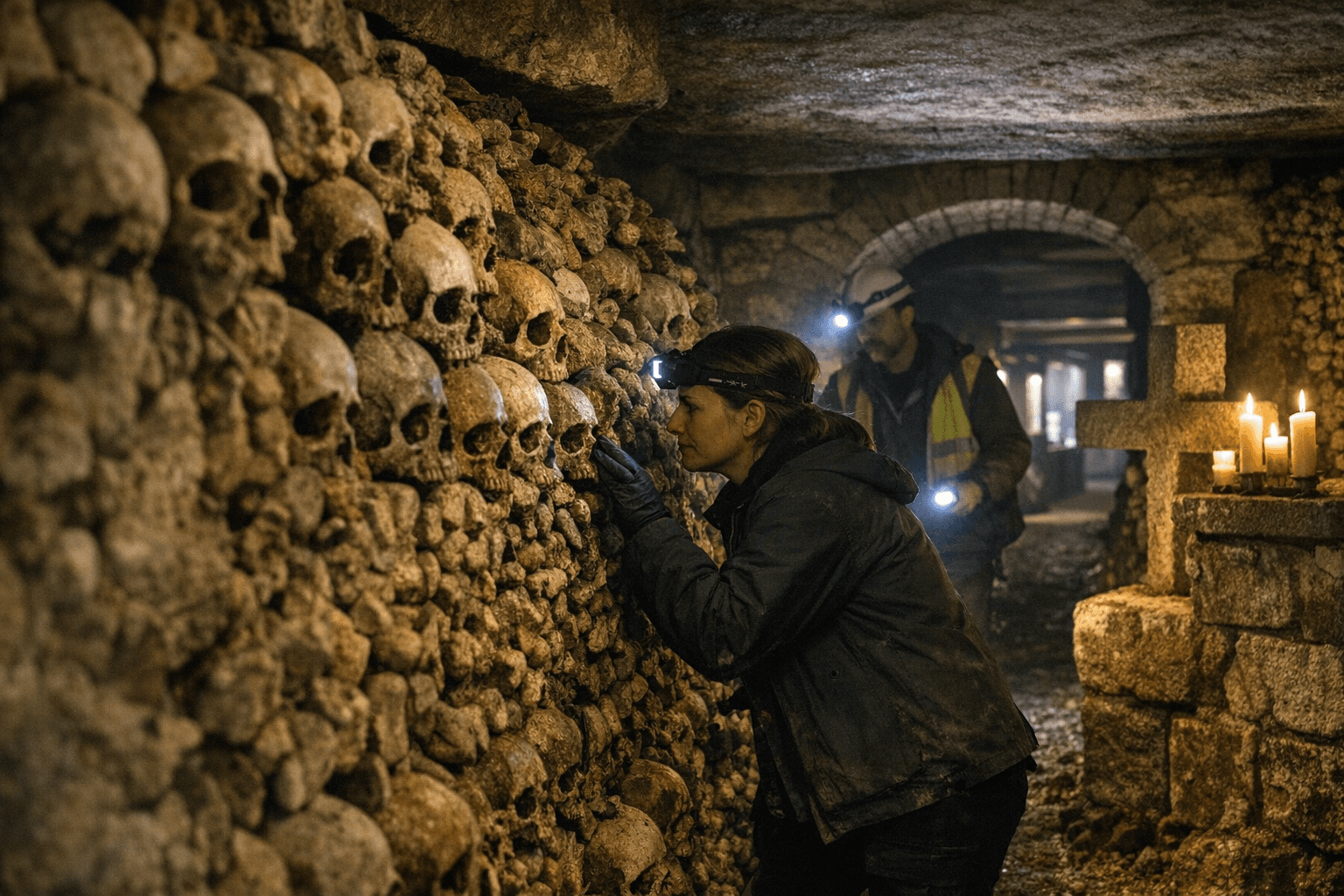
The bones from over six million bodies were shaped into archways, tunnels, and walls. One 19th-century visitor described the result in terms that still hold: "Bones bend into arcs [and] rise into columns, an artistic hand created a kind of mosaic out of these final remains of humanity, whose ordered regularity only adds to the profound contemplation."
The democratic symbolism has never been lost on historians. As Dr. Erin-Marie Legacey, author of *Making Space for the Dead: Catacombs, Cemeteries, and the Reimagining of Paris, 1780-1830*, observes: "The catacombs are a space of equality. You have the bones of nobles next to a pauper and you can't tell the difference. Equality in death had long been a Christian message, but in the wake of the French Revolution, it also has resonant political undertones."
A preservation crisis 20 meters underground
The site's greatest long-term threat is invisible to most visitors. The moisture build-up in the catacombs, which drips into puddles on the ground and on visitors, "is bad for the preservation of bones," according to site administrator Isabelle Knafou. That humidity allows bacteria to settle and grow on the piled-up skeletal remains.
Bones have been weakened by the very high humidity, which sits at almost 90%, and the CO2 generated by visitors throughout the year. The consequences compound: with every breath of 600,000 annual visitors cycling through the galleries, the microclimate shifts fractionally but cumulatively in ways that accelerate the biological degradation of centuries-old remains.
Isabelle Knafou, director of the Paris Catacombs, says the human bones on display are a key part of the capital's history, many dating from deaths between the 10th and 18th centuries. Twenty metres underground, the renovation has been both structural and visual, according to architect Camille Guérémy.
The 5.5 million euro overhaul
The works cost 5.5 million euros ($6.4 million) and are designed to improve the experience for the 600,000 annual visitors to the ossuary museum, and to help preserve the remains held there. The project was launched by the City of Paris in 2023 as a major restoration program, scheduled to run until spring 2026.
The renovation scope is extensive. In the fall of 2025, major renovation works on the technical installations were carried out to improve the site's conservation conditions and adapt to the 2,000 daily visitors. The electrical system has been completely upgraded, while the air handling units and fire and safety systems have been replaced. This work, expected to last five months, constitutes an exceptional underground operation, with project management entrusted to Artemis architectes as lead architect.
The visitor experience is also being redesigned from the ground up. A new scenography will highlight the bone walls and reveal previously invisible details, while an audio guide in the form of a high-quality headset will enrich the tour by making it more immersive. Since September 2023, visitors have also benefited from new explanatory panels, improved signage, and interactive digital devices, alongside a multilingual audio guide through the 1.5 km historical and geological trail.
Knafou has been careful to insist the site's atmosphere will not be engineered away. Renovations will restructure the near 800-metre path visitors follow while aiming to keep the "authentic" spirit of the place. Graffiti will be cleaned off, though much of the writing found on the gallery walls was left by visitors in the 19th century and "almost" contributes to the place's history.
This is the biggest investment in the catacombs since they first opened to the public by appointment in 1809.
The ethical weight of the world's largest ossuary
No amount of upgraded lighting changes the fundamental reality that the Paris Catacombs is a public attraction built entirely around human remains, and that tension has surfaced repeatedly throughout its history. A flow of visitors degraded the ossuary to a point where the permission-only rule was restored from 1830, and the catacombs were closed completely from 1833 because of church opposition to exposing human remains to public display.
The contemporary debate has shifted but not resolved. There is a growing debate about how to balance tourism with respect for the dead. The bones represent real individuals whose descendants, in many cases, had no say in how their ancestors' remains would ultimately be displayed. The arrangement of skulls into decorative patterns, however historically sanctioned, occupies an uneasy space between solemnity and spectacle.
As Legacey observes, "Since they've been opened to the public, people thought about the catacombs as a space out of time." That removal from ordinary time is central to the site's power, and to the curatorial dilemma: visitors are drawn by the strangeness and the silence, by proximity to death on a scale that defies comprehension. The renovation must preserve exactly that quality, or risk producing something that functions merely as an elaborate underground exhibit rather than a genuine encounter with history.
The 300 kilometers nobody tours
The ossuary that visitors walk through represents only a fraction of what lies beneath Paris. Only 1.5 km of the 300 km of tunnels that form the Paris Catacombs are filled with bones. The rest have been used for everything from subterranean mushroom farming to beer storage to serving as a bomb raid shelter and meeting place for the French Resistance during World War II.
Since 1955, it has been illegal to enter the catacombs without permission, though explorers known as "cataphiles" descend into the darkness. A special branch of the Paris police, dubbed "cataflics" by locals, patrols beneath the city streets. In 2004, officers uncovered an illegal underground cinema and bar.
The catacombs also contain specific chambers dense with historical significance. The "Hague des Martyrs de Septembre" is a poignant witness to the French Revolution, recalling the tragedies of September 1792 when many political prisoners were executed.
What to expect when the doors reopen
The April 8, 2026 reopening marks both an ending and a beginning: the conclusion of a three-year, multi-phase restoration program and the launch of a remade visitor experience. The fragile historic site undertakes this major renovation project to restore and maintain its unique heritage and pass it on to future generations. Online booking is strongly recommended.
The renovation's central wager is that structural integrity, humidity control, and narrative clarity can coexist with the darkness that has drawn visitors since 1809. What curators cannot afford, and what no amount of new air-handling equipment can manufacture, is the irreplaceable chill of standing 20 meters underground, surrounded by the arranged remains of six million people, in a city that built itself, quite literally, on top of its dead.
This article was produced by Prism’s automated news system from verified source data, official records, and press releases, then run through automated quality and moderation checks before publishing. The system is built and supervised by the people who set the standards it runs under. Read our full AI policy.
Did this article answer your question?