Fuel Tanker Explosion Near Panama Canal Bridge Kills One, Injures Several
A single tanker truck dispensing fuel at Panama City's Balboa depot ignited Monday afternoon, killing one person and sending a fireball visible across the city toward the Bridge of the Americas.
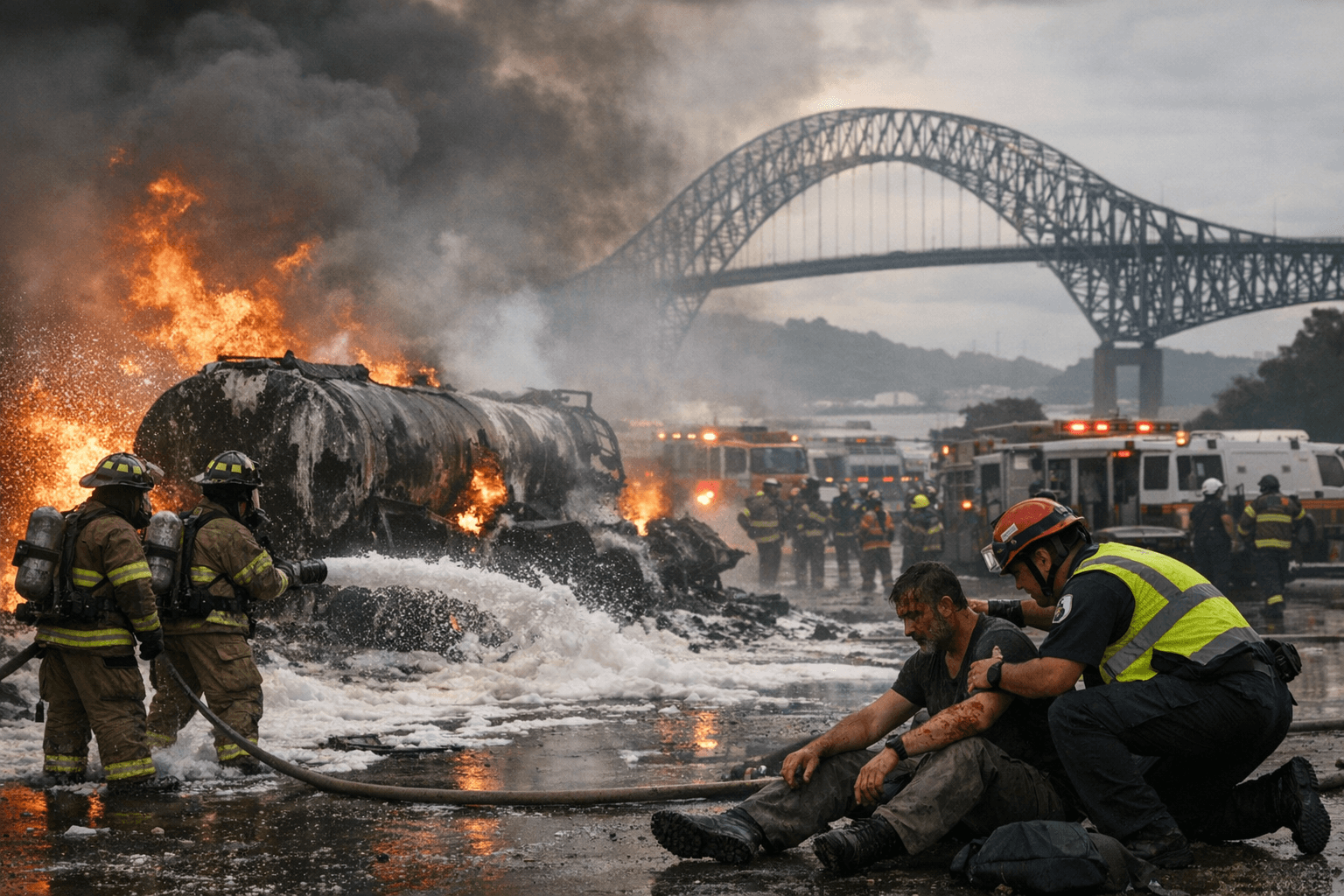
A massive fireball erupted at the Balboa oil tank facility in Panama City's La Boca neighborhood on April 6, killing at least one person and injuring four others after a fuel tanker truck ignited while dispensing fuel and flames rapidly spread to two additional tanker units. The blast was first reported at 4:12 p.m. local time.
Firefighters arriving at the scene found three tanker trucks fully engulfed, with a third reportedly mid-load when the initial detonation occurred and nearby storage tanks also under threat. At least five emergency vehicles responded under the command of Colonel Ángel Delgado of the Cuerpo de Bomberos de Panamá.
The blast claimed one life. Firefighter chief Victor Álvarez confirmed that a person presumed to be a worker at the complex had died. Among the injured, two civilians suffered second-degree burns and were rescued from the scene; two firefighters sustained first- and second-degree burns and were hospitalized. A fifth individual had been reported missing before being identified as the confirmed fatality.
The force of the explosion and the thick black smoke rising over the site prompted authorities to close the Bridge of the Americas in both directions as a precautionary measure. Panama's Ministry of Public Works explained the decision in a formal statement: "This preventive measure is taken to ensure the safety of drivers while specialised teams conduct technical inspections to verify the bridge's condition." Structural engineers subsequently confirmed no major damage to the span, and the crossing reopened to traffic after inspections cleared it.
The Bridge of the Americas, known in Spanish as Puente de las Américas, sits directly above the Pacific entrance to the Panama Canal and is one of Panama's most critical transport corridors. Built by the United States between 1959 and 1962 at a cost of $20 million, the 1,654-metre span served as the sole fixed crossing of the canal from its completion until the Centennial Bridge opened in 2004. It provides 61.3 metres of clearance above the waterway at high tide, a threshold every vessel transiting the canal must meet.
The Panama Canal Authority confirmed the explosion had no immediate impact on canal transits and issued no traffic advisory. That assurance carried particular weight given the waterway's current strategic context: the canal handled approximately 13,404 vessel transits in fiscal year 2025, a 19.3% rebound following a drought-disrupted prior year, generating roughly $5.7 billion in total revenues. Reuters reported in March 2026 that some U.S. crude cargoes had been rerouted to Asia through the canal amid Iran-related tensions around the Strait of Hormuz, reflecting the waterway's growing role in global energy logistics.
Investigators were examining the scene to determine the precise sequence of events that caused the initial ignition. Authorities found no evidence of deliberate sabotage; the incident is being treated as an industrial fire. Colonel Delgado reported the blaze fully contained with no further risk to surrounding storage installations or the bridge structure.
Security camera footage of the explosion circulated widely online, showing the initial fireball and subsequent secondary blasts as additional tankers ignited. The incident focused renewed attention on industrial safety standards and emergency preparedness at fuel handling facilities clustered near one of the world's most consequential stretches of maritime infrastructure.
This article was produced by Prism’s automated news system from verified source data, official records, and press releases, then run through automated quality and moderation checks before publishing. The system is built and supervised by the people who set the standards it runs under. Read our full AI policy.
Did this article answer your question?


