Trump's First Iran Address Fails to Calm Rattled Financial Markets
Trump's prime-time Iran address sent Dow futures down 310 points and oil to $107 a barrel, as markets found more escalation than exit in his words.
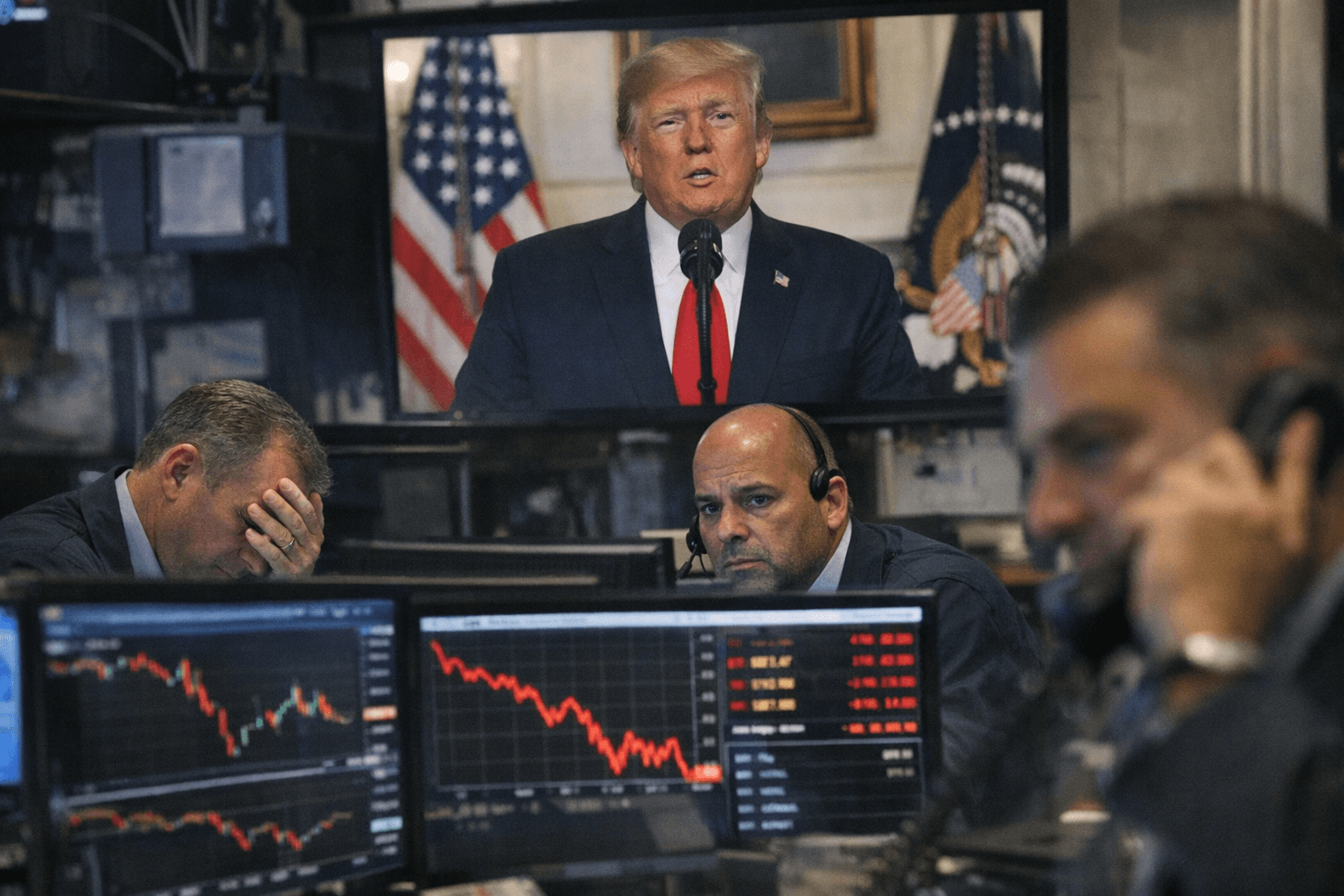
President Donald Trump's first prime-time address on the war with Iran, delivered from the White House Cross Hall on April 1, ended with a declaration that military objectives were "nearing completion." Markets around the world heard something else entirely.
"We are on track to complete all of America's military objectives shortly, very shortly, we are going to hit them extremely hard over the next two to three weeks," Trump said, offering a two-to-three-week window as his closest approximation of an end state. He named four benchmarks the White House says define success: obliterating Iran's missiles and production facilities, annihilating its navy, severing its support for terrorist proxies, and ensuring Iran never acquires a nuclear weapon. What he did not provide was a measurable definition of when any of those benchmarks would be met, or what the U.S. posture in the region looks like once they are.
The credibility gap between "nearing completion" and the speech's actual content was immediately priced in. S&P 500 futures slid 0.75%, Nasdaq futures sold off by 1%, and Dow futures dropped more than 310 points as Trump addressed the nation. S&P 500 futures slid a further 0.14% in early morning trading, after the index had risen 0.72% the previous day. Markets in Asia and Europe declined across the board as oil rose again, hitting $107 per barrel.
The Asian session amplified the damage. Japan's Nikkei 225 fell 2.1%, South Korea's Kospi dropped 2.82%, and the small-cap Kosdaq was down 3%. The price of Brent crude, the global oil benchmark, spiked in the minutes following the speech.
The Strait of Hormuz remained the sharpest source of market anxiety. The strait carries around 20% of the world's oil consumption, according to the International Energy Agency, and Trump offered no concrete plan for restoring free navigation. One regional analyst warned that the idea of the U.S. stepping away and leaving Iran in control of the Strait of Hormuz, in the hope that Tehran would naturally relinquish that leverage, "is going to be very worrying for people here in the Middle East." Trump also claimed "great progress" in talks with Tehran but warned he would target Iranian power plants, oil facilities, and possibly desalination sites if negotiations failed.
The congressional authorization question received no acknowledgment in the address, reinforcing concerns among lawmakers that the now 33-day-old conflict, known as Operation Epic Fury, is proceeding without a formal war authorization vote. Senate Minority Leader Chuck Schumer did not wait for morning to deliver his verdict. Schumer slammed the address, saying "Donald Trump's actions in Iran will be considered one of the greatest policy blunders in the history of our country," and criticized Trump for failing to articulate objectives and alienating allies.
Trump's primetime address failed to provide clarity or reassurance, leaving his approval ratings at their lowest point of the conflict. With oil above $107 and futures markets registering discontent in real time, the gap between the White House's declared progress and the conditions investors can actually observe is now itself a market variable, one that promises to complicate every subsequent statement from the administration about how close the end really is.
This article was produced by Prism’s automated news system from verified source data, official records, and press releases, then run through automated quality and moderation checks before publishing. The system is built and supervised by the people who set the standards it runs under. Read our full AI policy.
Did this article answer your question?