Trump's Iran Speech Sends Futures Sliding After Wall Street's Two-Day Rally
Trump's Iran speech erased a $1 trillion tech rally, sending futures down 1.3% as oil spiked to $104 and he threatened to pull the U.S. from NATO.
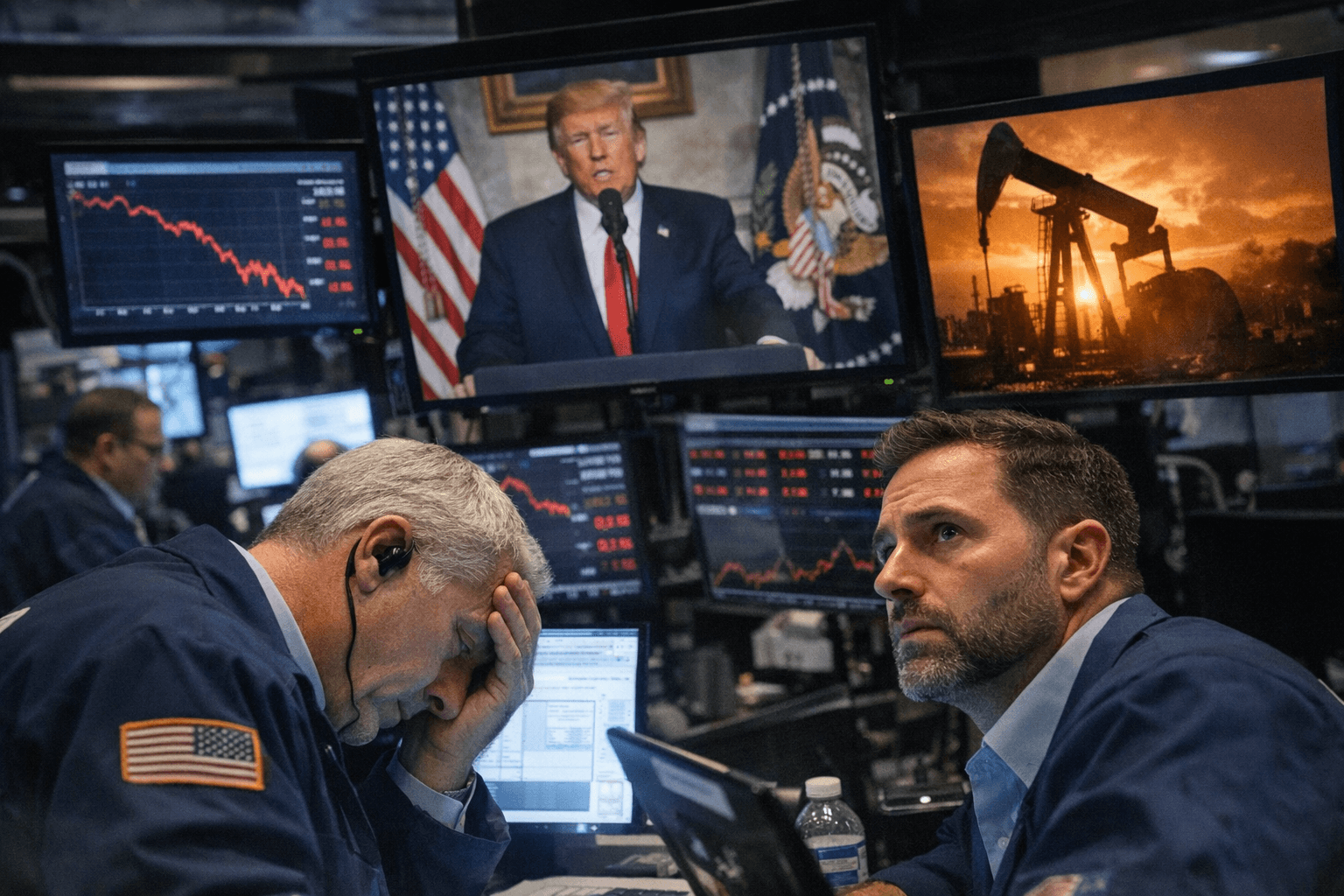
A primetime address meant to clarify America's endgame in the Middle East instead wiped out two days of hard-won gains. S&P 500 futures slid between 0.75% and 1.1% after President Donald Trump spoke Wednesday night, Nasdaq 100 futures sank 1.3%, and Dow Jones futures dropped more than 310 points. Hours earlier, those same markets had been celebrating the S&P 500's best two-day run since May 2025.
The whipsaw unfolded five weeks into the U.S.-Israeli military campaign against Iran, which began February 28. The S&P 500 had surged 3.7% over Tuesday and Wednesday as ceasefire speculation swept trading floors, and the Magnificent Seven technology stocks collectively added more than $1 trillion in market capitalization. The Dow Jones Industrial Average closed Wednesday at 46,575, up 234 points.
Trump's speech, titled "an important update on Iran," diverged sharply from the optimism his earlier remarks had seeded. He declared the war "nearing completion" while warning he would hit Iran "extremely hard" in coming weeks, and renewed threats to withdraw the United States from NATO, rattling European allies.
Oil registered the sharpest immediate verdict. WTI crude for May delivery, which had briefly touched $98.34 on ceasefire hopes, surged 4.1% to $104.21 per barrel during the address. Brent crude for June jumped 5% to $106.42 from an earlier $99.81. The reversal underscored how tightly energy markets track every signal about the Strait of Hormuz.
Iran has effectively shuttered the strait since the war began, cutting off a waterway that normally handles roughly 20% of global oil and gas flows. Oxford Analytica political risk analyst Giles Alston said tanker traffic has "effectively ground to a halt." Iran has charged vessels up to $2 million per passage in what traders call the "Tehran toll booth," pushing U.S. gas prices above $4 per gallon for the first time since 2022.
IEA Executive Director Fatih Birol has warned the conflict has removed approximately 12 million barrels per day from global supply, a disruption exceeding the 1973 and 1979 oil shocks combined. Oil executives have identified mid-April as a hard deadline: if the Strait does not reopen, disruptions could worsen sharply. EU Energy Commissioner Dan Jorgensen urged energy ministers ahead of an emergency meeting to prepare for a "potentially prolonged disruption."
Earlier Wednesday, Trump had appeared to offer a ceasefire framework, saying the U.S. would stand down "when the Strait of Hormuz is open, free, and clear" with forces potentially departing Iran within two to three weeks. During the primetime address he pivoted, suggesting the U.S. did not "need" the strait and that other nations should confront Tehran directly. Iran denied having requested a ceasefire.
The S&P 500 entered Thursday already down roughly 4% for the year after March produced its steepest monthly decline in 12 months. For 401(k) investors benchmarked to the index, the post-speech futures slide put Wednesday's relief rally in immediate jeopardy. What could shift the narrative is a narrow set of triggers: verifiable Strait reopening, a ceasefire framework both governments acknowledge, or evidence that IEA emergency reserves can meaningfully offset Birol's 12-million-barrel daily shortfall. Without one of those catalysts, the mid-April deadline becomes the market's next defining test.
Know something we missed? Have a correction or additional information?
Submit a Tip

