UAE-Backed Southern Leader Secretly Extracted, Saudi Coalition Says
The Saudi-led coalition alleges Southern Transitional Council chief Aidarous al-Zubaidi fled Aden on the night of January 7 and was covertly removed from Yemen with assistance from the United Arab Emirates, deepening a public rift between two Gulf allies. The episode threatens to fracture coordination in the anti-Houthi campaign, raises questions about sovereignty and extraterritorial operations, and complicates emergency talks called by Riyadh.
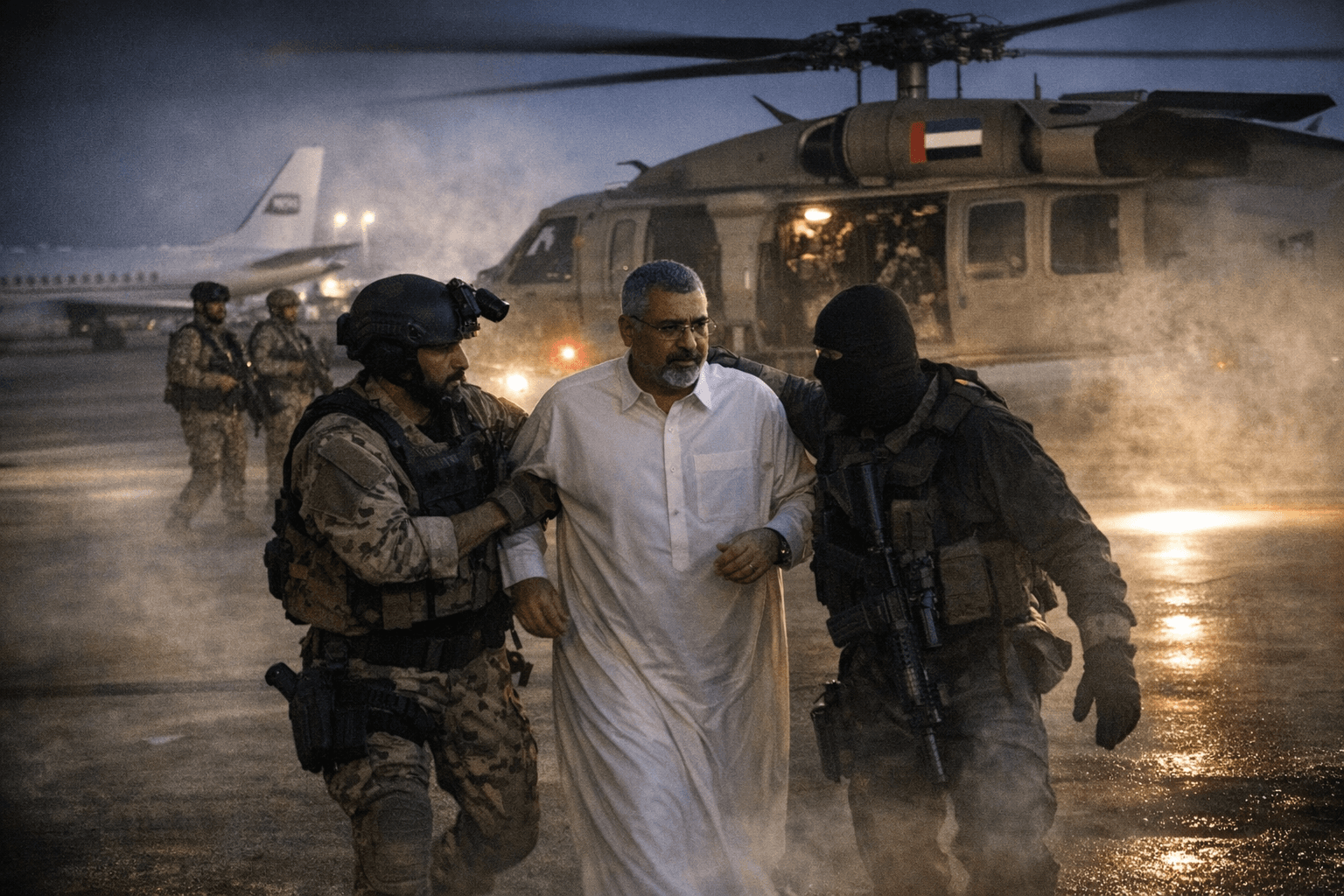
The Saudi-led coalition announced on January 8 that Aidarous al-Zubaidi, leader of the UAE-backed Southern Transitional Council, departed Aden late on January 7 and was extracted from Yemeni territory with alleged help from the United Arab Emirates. The coalition said intelligence tracking recorded Zubaidi and several aides boarding a vessel named BAMEDHAF and sailing under cover of darkness to the port of Berbera in Somaliland before he boarded an aircraft that ultimately landed at a military airport in Abu Dhabi.
Major General Turki al-Maliki, the coalition spokesperson, provided the chronology to reporters and said the disappearance was recorded late on January 7. The coalition has said it is continuing to monitor associates who reportedly met Zubaidi prior to his departure, naming figures whose contacts were lost during the movement, including former Aden governor Ahmed Hamid Lamlas and Security Belt Forces commander Mohsen al-Wali. Some accounts vary over whether an intermediate flight to Mogadishu occurred before the plane arrived in Abu Dhabi; the coalition’s consistent claim remains that Zubaidi left Aden by sea and reached Abu Dhabi by air.
STC spokespeople and allied sources have offered a different portrayal, saying Zubaidi had been summoned to crisis talks in Riyadh but did not appear. The separatists say the invitation carried threats, and some reports said Zubaidi feared detention if he travelled to the Saudi capital. Other reports assert that authorities aligned with Yemen’s internationally recognised government and the Saudi-led coalition have levelled charges of high treason against Zubaidi, though those allegations and assertions of Emirati involvement have not been independently verified by neutral observers or UAE authorities.
The incident sharpens a diplomatic and military rupture between Saudi Arabia and the UAE, two dominant partners in the coalition fighting the Iran-aligned Houthi movement. Tensions have escalated over the past month after STC forces advanced through much of southern Yemen, at times approaching the Saudi border, prompting Riyadh to call emergency talks. The coalition’s recently disclosed kinetic responses include air strikes on the port of Mukalla on December 30, which it described as targeting a weapons shipment tied to Emirati-linked activity, and public backing for calls by the internationally recognised Yemeni government for Emirati withdrawals from certain areas.
Beyond immediate recriminations, the alleged extraction raises sensitive questions under international law about extraterritorial operations and the treatment of political opponents in a fragmented conflict zone. If proven, covert removals of a political leader by a foreign partner would further complicate legal and diplomatic ties, not only between Saudi Arabia and the UAE but also with regional intermediaries such as Somaliland, whose port at Berbera is named in the coalition account.
As of January 8 the coalition said it continued to track movements of senior STC figures and to investigate the sequence of events. Independent confirmation of Zubaidi’s precise whereabouts and any official response from Abu Dhabi had not been presented. The episode underscores how competing Gulf priorities in Yemen are now jeopardising the fragile unity of a coalition whose coherence is central to the region’s wider security calculus.
This article was produced by Prism’s automated news system from verified source data, official records, and press releases, then run through automated quality and moderation checks before publishing. The system is built and supervised by the people who set the standards it runs under. Read our full AI policy.
Did this article answer your question?


