Uber and WeRide Expand Robotaxi Partnership to 15 Cities Worldwide
Uber took a 5.82% stake in WeRide as the pair launched fully driverless robotaxis in Abu Dhabi and Dubai, with a commitment to reach 15 cities worldwide over five years.

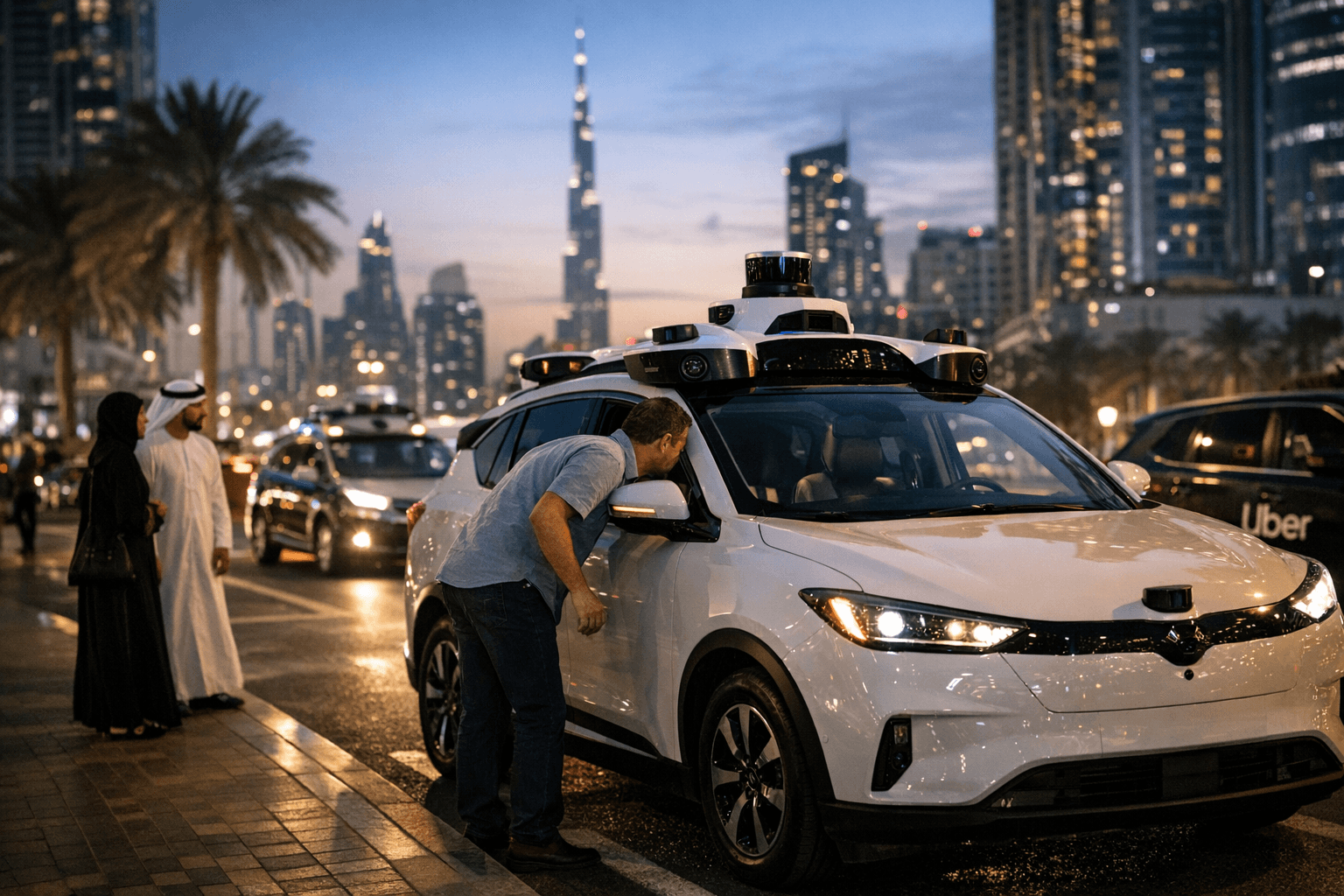
Fully driverless WeRide robotaxis began operating on the Uber platform in Dubai and Abu Dhabi, extending a commercial service that has grown to more than 100 vehicles across the Middle East. Alongside the expansion, Uber has acquired a 5.82% equity stake in WeRide, and the two companies committed to carrying the model to 15 additional cities worldwide over the next five years.
The UAE established the regulatory template that makes both cities possible. WeRide secured a national license in 2023, the first company in the country to receive authorization covering all types of self-driving vehicles on public roads. In October 2025, WeRide secured a federal permit for fully driverless commercial robotaxi operations, and Abu Dhabi's Integrated Transport Centre followed with the world's first city-level fully driverless robotaxi permit outside the United States. No comparable unified federal pathway exists for robotaxi operators across American cities, where approvals proceed state by state and municipality by municipality. That structural gap is precisely what makes the UAE the faster-moving laboratory for the commercial model Uber and WeRide are working to prove.
The fully driverless Abu Dhabi service opened on Yas Island, home to the Abu Dhabi Grand Prix circuit, before expanding in July 2025 to cover roughly half of the city's core area, including Al Reem and Al Maryah. WeRide and Uber launched their Abu Dhabi partnership in December 2024, billing it as the largest commercial robotaxi service outside the U.S. and China. Fleet operator Tawasul handles vehicle operations on the ground, working alongside the Integrated Transport Centre.
Riders access the service through Uber Comfort or UberX, or via a new in-app "Autonomous" category that Uber calls its first dedicated autonomous ride option globally. WeRide, which listed on Nasdaq in October 2024, reported full-year 2025 revenue of RMB 685 million, up 90% year-over-year, with fourth-quarter revenue of RMB 314 million, up 123%. Net loss for the year narrowed by 34% to RMB 1.65 billion, reflecting the persistent cost of scaling an autonomous fleet even as commercial receipts accelerate.
Uber's 5.82% equity stake transforms the relationship from a platform deal into a shared financial interest. As a marketplace partner, Uber collects a fee on rides booked through its app; as a shareholder, it gains from WeRide's valuation if the fleet expansion delivers. That distinction matters when evaluating whether this is a viable business or an expensive pilot: Uber is now paying for the answer.
WeRide currently develops, tests and operates autonomous vehicles in 30 cities across 10 countries. The 15-city commitment covers several new markets per year outside the U.S. and China, with Europe and the broader Middle East named as the first target regions. Han Xu, WeRide's founder and chief executive, framed the rollout as central to the company's mission "to make self-driving solutions more affordable and accessible to users around the world."
WeRide has operated in Abu Dhabi since 2021. Four years of mapping, permitting, and fleet operations built the foundation that Dubai now inherits, and that 15 other cities are waiting to test.
This article was produced by Prism’s automated news system from verified source data, official records, and press releases, then run through automated quality and moderation checks before publishing. The system is built and supervised by the people who set the standards it runs under. Read our full AI policy.
Did this article answer your question?
%3Amax_bytes(150000)%3Astrip_icc()%2FCertificate-of-deposit-2301f2164ceb4e91b100cb92aa6f868a.jpg&w=1920&q=75)