UBS profit jumps 80% to $3 billion, beats forecasts on strong trading
UBS’s first-quarter profit surged 80% to $3 billion as trading, client inflows and steadier rate expectations lifted results. The bank still faces a flat interest-income outlook and a fresh Swiss capital fight.

UBS Group AG posted a first-quarter net profit of $3.0 billion, up 80% from a year earlier and above the $2.8 billion analysts had expected, as stronger market activity, wealth-management inflows and a resilient trading backdrop lifted results in Zurich.
The bank’s numbers point to more than a one-off beat. Global Wealth Management drew $37 billion of net new assets, Asset Management brought in $14 billion in net new money, and transaction-based income in wealth management rose 17% from a year earlier. Investment Bank revenue climbed 27%, helped by record Global Markets and higher Global Banking, a sign that clients were active across equities, rates and advisory businesses as interest-rate expectations shifted and volatility kept markets moving.
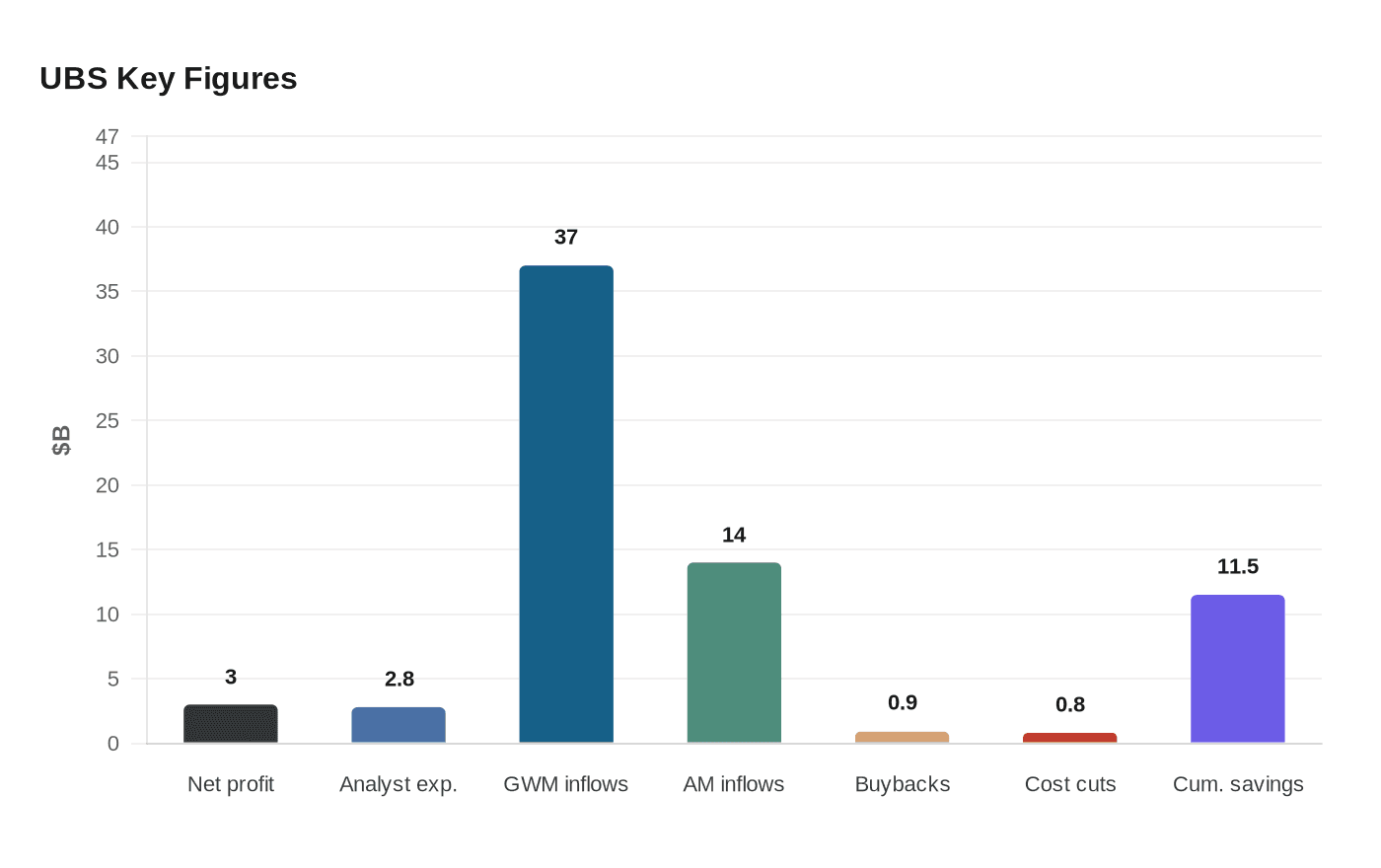
UBS said its reported return on CET1 capital was 16.8%, with underlying RoCET1 at 17.0%. Its CET1 ratio rose to 14.7% from 14.4% in the previous quarter, and the bank repurchased $900 million of shares during the quarter while staying on track for $3 billion in buybacks before its next quarterly report. Management also said it had accrued for mid-teens percentage growth in the dividend and intended to do more buybacks later in the year, although any extra repurchases will depend on financial performance, the outlook, a CET1 ratio of around 14% by year-end and clarity on parliamentary deliberations over foreign participations.
Even with the strong quarter, UBS is not assuming the good times will run in a straight line. The bank warned that second-quarter net interest income in Global Wealth Management and Personal & Corporate Banking is likely to be “broadly flat,” underscoring that the current lift is still tied to market conditions rather than a simple earnings rerating. UBS said it had continued to help clients navigate a volatile and unpredictable geopolitical and market environment, and noted that global markets remained resilient even as the backdrop stayed tense.
The integration of Credit Suisse is also still a key test of whether this is a durable turnaround. UBS said all Swiss-booked client account migrations had been completed onto its platforms and that it remains on track to substantially complete the integration by year-end 2026. The bank also said it delivered another $0.8 billion in cost reductions in the quarter, taking cumulative savings to $11.5 billion, and granted or renewed about CHF 40 billion in loans to Swiss businesses and households, reinforcing its role in the domestic economy.
That progress comes with a major policy overhang. On April 22, the Swiss Federal Council published its final Capital Adequacy Ordinance and sent Banking Act amendments to parliament, and UBS said it strongly disagrees with the package. The final rules keep deferred tax asset treatment unchanged but require prudential valuation changes from January 1, 2027 and a three-year amortization schedule for capitalized software by January 1, 2029. For UBS, the question now is whether this quarter marks the start of a longer re-rating or just a strong moment in a still-unsettled year.
This article was produced by Prism’s automated news system from verified source data, official records, and press releases, then run through automated quality and moderation checks before publishing. The system is built and supervised by the people who set the standards it runs under. Read our full AI policy.
Did this article answer your question?
%3Amax_bytes(150000)%3Astrip_icc()%2FCertificate-of-deposit-2301f2164ceb4e91b100cb92aa6f868a.jpg&w=1920&q=75)