UK and Norway Led Weeks-Long Operation to Deter Russian Submarines in North Atlantic
A month-long UK-Norway operation tracked three Russian submarines suspected of surveying undersea pipelines and cables north of Britain, Defence Secretary John Healey disclosed.
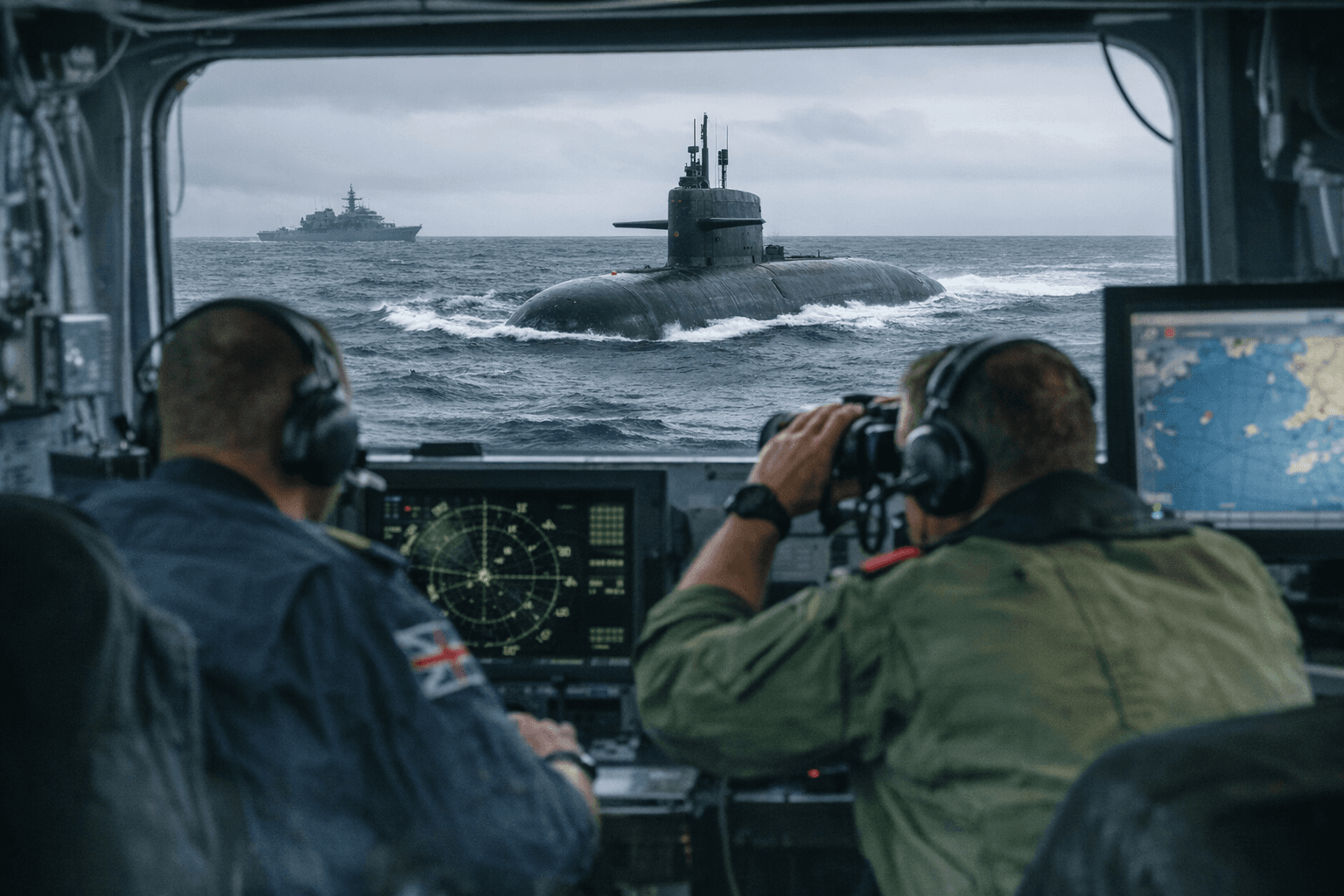
Three Russian submarines spent weeks hovering over critical undersea infrastructure north of Britain before a joint British-Norwegian operation tracked and exposed their movements, forcing all three vessels to retreat, Defence Secretary John Healey disclosed Thursday at a press conference in Downing Street.
The operation, which lasted more than a month and has now concluded, targeted a Russian Akula-class nuclear-powered attack submarine and two specialist vessels belonging to GUGI, Russia's Main Directorate for Deep-Sea Research. Healey described the Akula as "a likely decoy to distract us from the GUGI submarines" as the spy submarines "spent time over critical infrastructure relevant to us and our allies in the North Atlantic," including undersea pipelines and communications cables.
"In response to the Russian submarines, I can confirm that I deployed our armed forces to track and to deter any malign activity by these vessels," Healey said. "A Royal Navy warship and Royal Air Force P-8 aircraft alongside allies ensured that the Russian submarines were monitored 24/7." The frigate covered several thousand nautical miles during the operation, British aircraft flew more than 450 hours, and 500 British personnel were involved in the response.
The outcome was unambiguous. The Akula retreated first, having been closely tracked throughout. The two GUGI submarines lingered longer in and around UK waters before also withdrawing. "Our armed forces left them in no doubt that they were being monitored, that their movements were not covert, as President Putin planned, and that their attempted secret operation had been exposed," Healey said.
The GUGI submarines operate from the Olenya Guba naval base on Russia's Kola Peninsula. The UK Ministry of Defence released satellite imagery of the base and the vessels for the first time Thursday, disclosing what Healey said were assets "designed to survey underwater infrastructure during peacetime, and sabotage it in conflict." He had first publicly flagged GUGI's threat to critical undersea infrastructure last November, citing the spy ship Yantar as a vessel directed by President Putin to conduct hybrid warfare against the UK and its allies.
The disclosure came alongside a bilateral defence agreement signed at 10 Downing Street by Healey and his Norwegian counterpart, Tore O. Sandvik. The agreement, described by the Norwegian Ministry of Defence as the most comprehensive in modern times, will establish a combined fleet of at least 13 warships to patrol the strategically vital gap between Greenland, Iceland, and the United Kingdom. Norwegian Prime Minister Jonas Støre joined UK Prime Minister at RAF Lossiemouth to meet troops involved in the joint operation.
Healey also announced an additional £100 million for P-8 submarine-hunting aircraft and the launch of the Atlantic Bastion programme, which aims to integrate autonomous technologies with warships and aircraft into what he called a British-built hybrid naval force. The investment underscores the severity with which London views Russian undersea activity, which British officials say has intensified markedly since Moscow launched its full-scale invasion of Ukraine in 2022.
This article was produced by Prism’s automated news system from verified source data, official records, and press releases, then run through automated quality and moderation checks before publishing. The system is built and supervised by the people who set the standards it runs under. Read our full AI policy.
Did this article answer your question?


