UK borrowing falls, but Iran conflict threatens fiscal outlook
Borrowing fell to £125.9 billion, but a Middle East oil shock could quickly wipe out the improvement. Analysts warn Iran-driven energy prices may hit the budget before autumn.

Britain’s improving public finances may already be under pressure from a risk that has nothing to do with domestic tax receipts or spending restraint. Borrowing fell in the financial year to February 2026, but analysts say the conflict in the Middle East could quickly reverse the gains if oil and gas prices stay elevated or rise further, feeding through to inflation, interest rates and the Treasury’s debt bill.
The Office for National Statistics said borrowing in the 11 months to February reached £125.9 billion, down £11.9 billion, or 8.7%, from a year earlier. Even so, it was still the fourth-highest April-to-February borrowing figure on record. The current budget deficit for the same period was £62.1 billion, down £16.7 billion year on year, while public sector net debt excluding public sector banks stood at 93.1% of GDP at the end of February, a level last seen in the early 1960s.
February itself was another reminder that the improvement remains fragile. Public sector borrowing that month came in at £14.3 billion, £2.2 billion higher than in February 2025 and the second-highest February borrowing since records began in 1993. The ONS said the rise was largely driven by the timing of central government debt interest payments, a sign that the monthly path to lower borrowing remains lumpy even before any fresh external shock is counted.
That shock is already visible in energy markets. The House of Commons Library said the Israel and United States campaign of strikes against Iran, which began on 28 February, disrupted oil and gas flows through the Strait of Hormuz, affecting around 20 million barrels of oil a day. It estimated Gulf oil production was cut by at least 10 million barrels a day, roughly 10% of global production. Brent crude, which had been near $70 a barrel before the conflict, briefly moved above $100, while UK wholesale natural gas prices rose by about 75% between late February and 23 March.
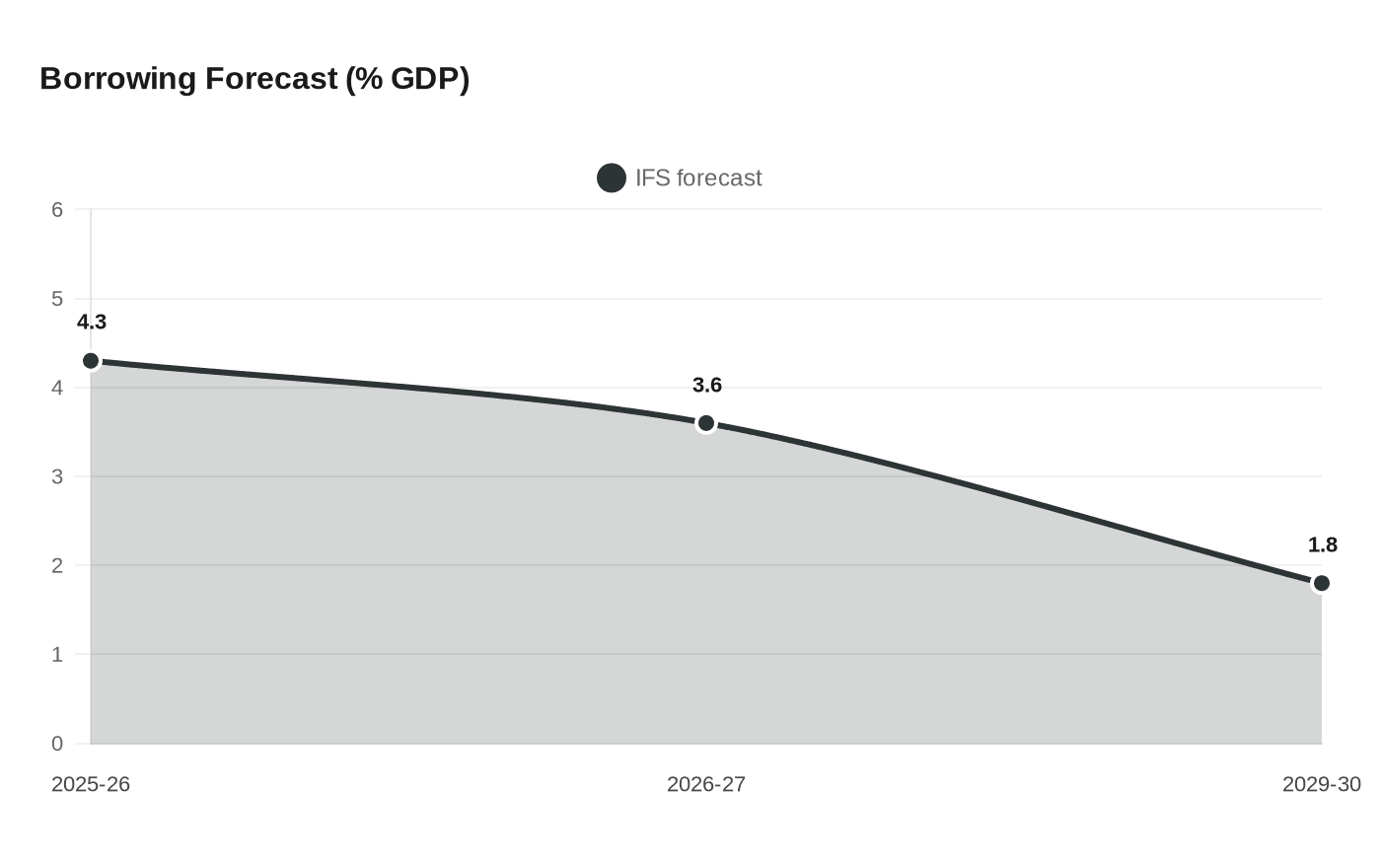
The Institute for Fiscal Studies said the official borrowing forecast had improved only slightly because of strong tax receipts, but warned that the outlook could change materially before the autumn Budget. Its projections still show borrowing falling from 4.3% of GDP in 2025-26 to 3.6% in 2026-27 and 1.8% by 2029-30, but the IFS said the Middle East conflict had already upended some of the assumptions behind that path.
A Resolution Foundation analysis cited by Bloomberg on 21 April went further, saying the war in Iran could wipe out almost three-quarters of Rachel Reeves’s fiscal headroom and deliver a £16 billion hit to Britain’s public finances under a severe but plausible scenario. The Office for Budget Responsibility, in its March 2026 Economic and Fiscal Outlook, said its forecast was built on the current position of the public finances but carried significant risks and uncertainties. For the Treasury, the lesson is stark: a better borrowing number can vanish quickly when a conflict reaches the energy market.
This article was produced by Prism’s automated news system from verified source data, official records, and press releases, then run through automated quality and moderation checks before publishing. The system is built and supervised by the people who set the standards it runs under. Read our full AI policy.
Did this article answer your question?

