UK election maps show winners and losers across the country
Labour’s landslide masks a map full of local swings, boundary quirks and small-party distortions that show where UK politics is moving next.
How to read the election map
The fastest way to understand the 2024 UK general election is not just to look at who won, but to compare where the biggest swings landed. Labour’s 412 seats and majority of 174 made the result look decisive at Westminster, while the Conservative Party’s collapse marked its worst seat result in modern history. Yet the maps and charts tell a more layered story: they show momentum, turnout pressure, tactical voting and the limits of reading raw seat totals on their own.
That is why the House of Commons Library’s results dataset matters. It is built on verified official declarations from each local authority, which gives the map a firm factual base. It also means the early picture is not just a projection or a narrative about who is ahead on the night. It is a constituency-by-constituency record of how the country actually voted.
Why boundary changes change the story
Any serious reading of the 2024 map has to account for boundaries. Some comparison charts use notional 2019 results adjusted to 2024 boundaries, which makes the change story more accurate but also more nuanced. A simple before-and-after comparison can exaggerate or understate movement if a constituency’s lines changed, so the best maps do more than show winners and losers. They help separate genuine political movement from the effect of redraws.
That matters because election maps can otherwise give a false sense of certainty. A seat that looks like a dramatic gain may partly reflect new boundaries, while a seat that appears static may actually have shifted substantially underneath the surface. For readers trying to understand national momentum, that distinction is essential.
Labour’s scale, the Conservatives’ retreat
Labour’s 412-seat total was not just a parliamentary win, it was a geographic one. The party’s spread across the map showed breadth as well as depth, with enough gains to turn a large number of marginal contests and enough defensive strength to protect the scale of the majority. In practical terms, that meant the party was not relying on a few dramatic urban surges alone. It was assembling a broad coalition across England, Wales and beyond.

The Conservative result tells the opposite story. The party’s worst seat outcome in modern history reflected a combination of lost support in places that had previously been reliable, weaker performance in battlegrounds, and a sense that anti-incumbent voting had sharpened rather than faded. On the map, that kind of retreat usually shows up not as one dramatic regional collapse, but as a pattern of scattered losses that add up to a national landslide.
What the smaller parties reveal
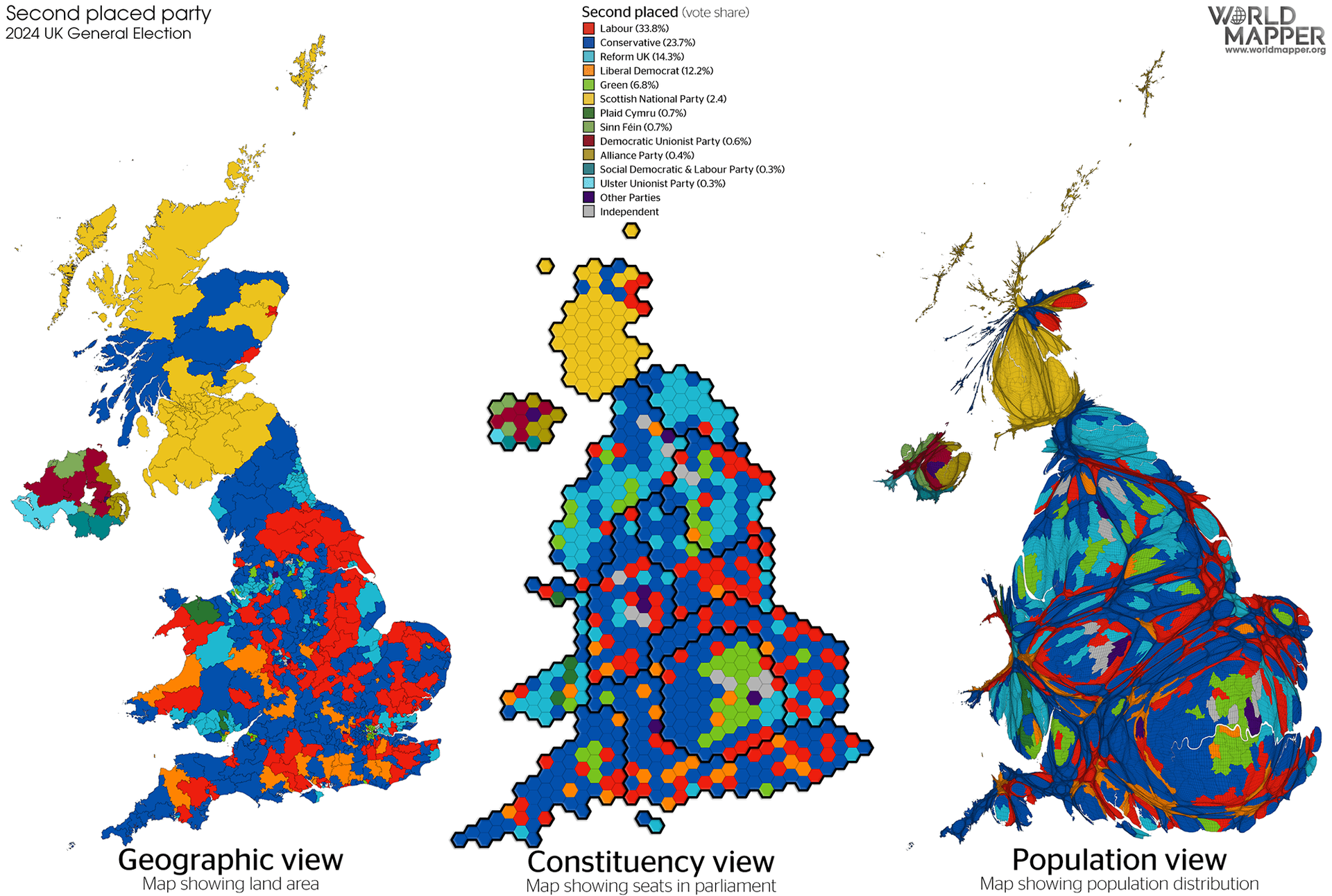
The 2024 election was also notable for what happened below the major-party headline. Reform UK won five seats, took 609 candidates into the contest and secured 14.3% of the vote. The Green Party won its highest-ever number of seats and recorded a 6.7% vote share with 629 candidates. Those figures point to a deeper change in the political market: the vote is no longer distributed in a way that maps neatly onto seat totals.
The House of Commons Library says the gap between Reform and Green vote share and seat share was the most disproportionate on record. That is one of the clearest signs that the electoral map is now doing two jobs at once. It is showing where support is concentrated enough to produce representation, and where support is broad enough to matter politically even when it does not translate efficiently into seats.
For Reform UK, the map suggests a party with measurable national reach but uneven geographic conversion. For the Greens, the stronger seat total points to a sharper ability to concentrate support in places where local conditions, candidate strength and tactical choices line up. In both cases, the headline numbers matter less than the shape of the support behind them.
Turnout, tactical voting and local momentum
Maps are most useful when they are read as movement rather than scorecard. Large swings can indicate turnout shifts as much as persuasion, especially when a party’s national message lands differently across regions or when voters coordinate tactically against a candidate they want to block. The 2024 charts are especially valuable because they let readers see where change was concentrated, not just where victories were recorded.
That is why the interplay between Labour gains, Conservative losses and smaller-party performance is so important. In some places, the story is one of opposition consolidation. In others, it is fragmentation, where a vote that once flowed mainly between two parties now disperses across several. The map does not just record outcomes, it hints at whether voters were choosing change, hedging their bets or voting strategically to shape the result.
Putting 2024 in historical context
The Commons Library’s long-run election statistics stretch from 1918 to 2019, giving analysts a long frame for comparison. Its 2019 general election analysis already showed how maps, charts and tables can break results down by region and constituency, which makes the 2024 cycle part of a much longer statistical story rather than a one-off shock. That historical perspective matters because landslides, party realignments and third-party surges all look different when set against a century of voting patterns.
Seen that way, 2024 was not only about Labour’s victory or Conservative decline. It was also about the changing geometry of British politics. The spread of vote shares, the inefficiency of some parties’ support, and the impact of boundary adjustments all suggest a system in which national opinion and parliamentary representation are increasingly pulled apart in specific places.
What the administration of the election says
The Electoral Commission’s post-election report adds a final layer to the map story. It said the May 2024 elections and the July 2024 parliamentary election were overall well-run, but it also identified significant improvements needed to support participation and trust in future elections. It specifically warned against scheduling polling during major holiday periods where possible.
That finding matters because turnout is part of the election map too. If participation shifts because of timing, convenience or confidence, the geographic pattern of results can move with it. The administrative side of the election therefore feeds directly into the political story: how many people vote, where they vote strongly, and how evenly participation is spread across the country.
The result is a map that should be read as a live record of change. Labour’s majority, Conservative weakness, Reform’s vote share, the Greens’ seat gains and the boundary-adjusted comparisons all point to the same conclusion: the 2024 election was not just a verdict on one government, but a snapshot of a system in motion.
This article was produced by Prism’s automated news system from verified source data, official records, and press releases, then run through automated quality and moderation checks before publishing. The system is built and supervised by the people who set the standards it runs under. Read our full AI policy.
Did this article answer your question?

