UN panel launches global study on AI's non-military impacts
UN panel of 40 experts met in Geneva on April 11 to launch a global study of AI’s non-military effects, with the first annual report slated for presentation at the Global Dialogue on July 6-7, 2026.

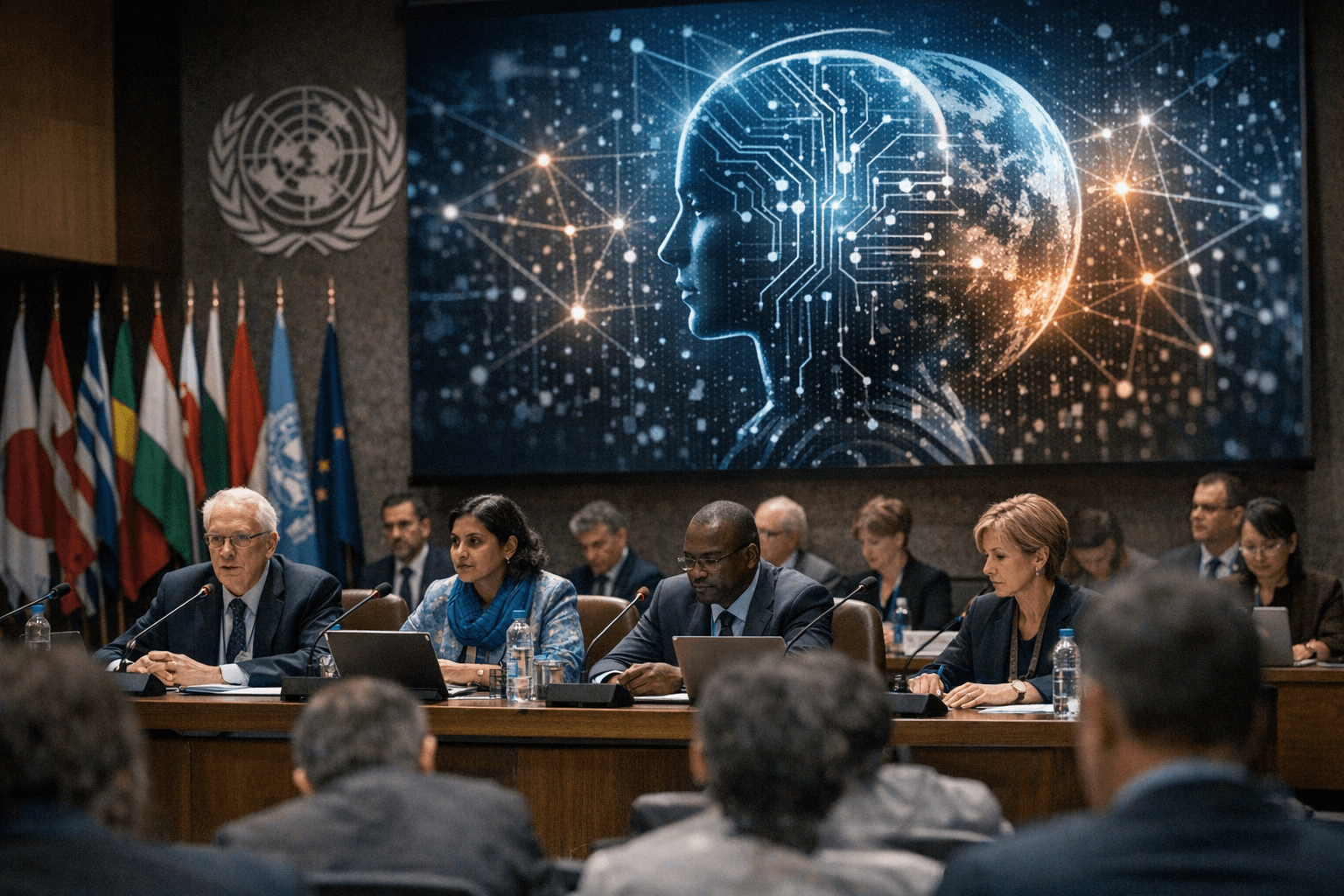
A 40-member Independent International Scientific Panel on Artificial Intelligence convened in Geneva on April 11 and formally launched a wide-ranging global study into AI’s societal, economic and ethical impacts. The body, created by United Nations General Assembly Resolution A/RES/79/325 adopted by consensus on August 26, 2025, was assembled from a field of thousands of nominations and is tasked to deliver annual, evidence-based assessments aimed at informing the Global Dialogue on AI Governance.
The resolution frames the IISPAI as a multidisciplinary panel whose members serve in their personal capacity for three-year terms and explicitly limits the mandate to the non-military domain. A/RES/79/325 directs the panel to produce one annual “policy-relevant but non-prescriptive” scientific assessment, with thematic briefs as needed, and requires the panel to elect two co-chairs, one from a developed country and one from a developing country, with up to three vice-chairs to reflect geography and gender balance.
Menna El-Assady of ETH Zurich, one of the 40 appointees and recommended by the Secretary-General António Guterres, framed the panel’s human-centered remit at the Geneva session. “We are not just focusing on AI as a mathematical or algorithmic field: we are also looking at ensuring that humans are central to decision‑making,” she said, and identified early priorities including public digital infrastructure, the interplay between automation and labor markets, health systems impacts, and technical baselines to assess model capabilities and risks.
The IISPAI’s public timeline lists a first virtual plenary meeting on March 3, 2026 and the first in-person meeting for April 22-24, 2026, while United Nations officials in Geneva issued press materials on April 11 describing the panel as “gearing up” and announcing the global impact study. The Global Dialogue on AI Governance, which the panel will advise, is opening a written submissions portal with an inputs deadline of April 30 at 11:59 PM EDT; the IISPAI plans to present its first annual report at the Global Dialogue in Geneva on July 6-7, 2026.
Modeled in part on the Intergovernmental Panel on Climate Change, the IISPAI is designed to supply shared scientific baselines that governments with limited domestic AI research capacity can use in cross-border rulemaking. The panel’s technical assessments could shape U.S. regulatory design, trade and data governance discussions, investment decisions in digital public goods, and corporate compliance expectations by increasing pressure on firms to disclose model capabilities, training-data provenance and safety testing to independent reviewers. Yet the panel’s reports are nonbinding, and their influence will depend on political uptake by national governments and multistakeholder bodies.
The IISPAI traces to the Global Digital Compact embedded in the Pact for the Future at the September 2024 Summit of the Future, a process co-facilitated by Costa Rica and Spain that led to the August 26, 2025 resolution. The panel’s first months, culminating in the July 6-7 presentation, will test whether a standing UN scientific referee on non-military AI can convert technical assessment into enforceable policy and meaningful transparency from technology firms.
This article was produced by Prism’s automated news system from verified source data, official records, and press releases, then run through automated quality and moderation checks before publishing. The system is built and supervised by the people who set the standards it runs under. Read our full AI policy.
Did this article answer your question?


