Unions and UNE data reveal 1,776 MW peak deficit, crippling daily life
Unión Eléctrica’s Feb. 27 report, cited by CiberCuba, forecasts a 1,776 MW peak power loss that UNE and unions say will produce widespread, prolonged blackouts.
An informative report from Unión Eléctrica (UNE), cited by CiberCuba on Feb. 27, 2026, forecasts "a power loss of 1,776 MW, which will result in widespread and prolonged blackouts," a shortfall that UNE and union sources say will leave millions without reliable electricity during peak hours. CiberCuba emphasized the forecast as the system heads into evening demand.
The system already showed acute failures the night before: "On Thursday, the SEN experienced a maximum impact due to a generation deficit of 1,867 MW at 7:10 PM, a figure that exceeded the planned levels due to the non-operation of unit 2 at the CTE Santa Cruz," CiberCuba reported, attributing the spike to unit 2 at CTE Santa Cruz being offline. That observed 1,867 MW evening deficit follows an earlier November peak when UNE logged a 1,964 MW shortfall at 6:10 PM on Nov. 19–20, 2025, underscoring the crisis’ persistence.
UNE snapshots show varied availability depending on time and assumed reactivations. CiberCuba recorded the SEN total availability at 6:00 AM as 1,160 MW against a demand of 2,150 MW, with "967 MW impacted" and an estimate that "during peak hours, the impact could reach 850 MW." UNE scenario math cited by CiberCuba anticipates adding Fuel Mariel (102 MW), the Regla barge (48 MW) and the Melones barge (44 MW), producing a projected maximum availability of 1,354 MW versus a demand of 3,100 MW, a deficit of 1,746 MW in that scenario. A separate phrasing picked up by CubaHeadlines quotes the official report: "With these incorporations, peak availability would reach only 1,494 MW against an estimated demand of 3,200 MW, resulting in a deficit of 1,706 MW and an impact of 1,776 MW."

Generation-side problems remain broad. CiberCuba reported that "limitations in thermal generation keep 443 MW off the grid" and that five units across CTE Mariel, CTE Santa Cruz, CTE Felton, and Antonio Maceo are out of service, while three generating blocks at CTE Mariel, CTE Nuevitas, and CTE Carlos Manuel de Céspedes are halted for maintenance. Earlier UNE snapshots quoted by CubaHeadlines on Nov. 21, 2025, listed thermal constraints of 458 MW, 91 distributed generation plants shut for fuel shortages accounting for 767 MW out of service, the Mariel Fuel Oil Plant inactive at 85 MW, and a 75 MW lubricant-related shortage, a combination the Nov. 21 article summarized as "totaling 927 MW out of commission due to energy deficiencies."
Renewables have not closed the gap. CiberCuba noted that despite installation of 51 new photovoltaic parks, solar "produced only 4,513 MWh, with a maximum capacity of 761 MW, which is an insufficient contribution in relation to the system's demand." UNE’s multiple scenarios and CiberCuba’s morning and evening snapshots reflect different demand baselines and differing assumptions about which motors, barges or units will come online; plans cited across the reports include five motors at Mariel (85 MW), the Regla barge (24–48 MW across accounts), and Unit 3 of CTE Renté (45 MW) as partial reactivations.
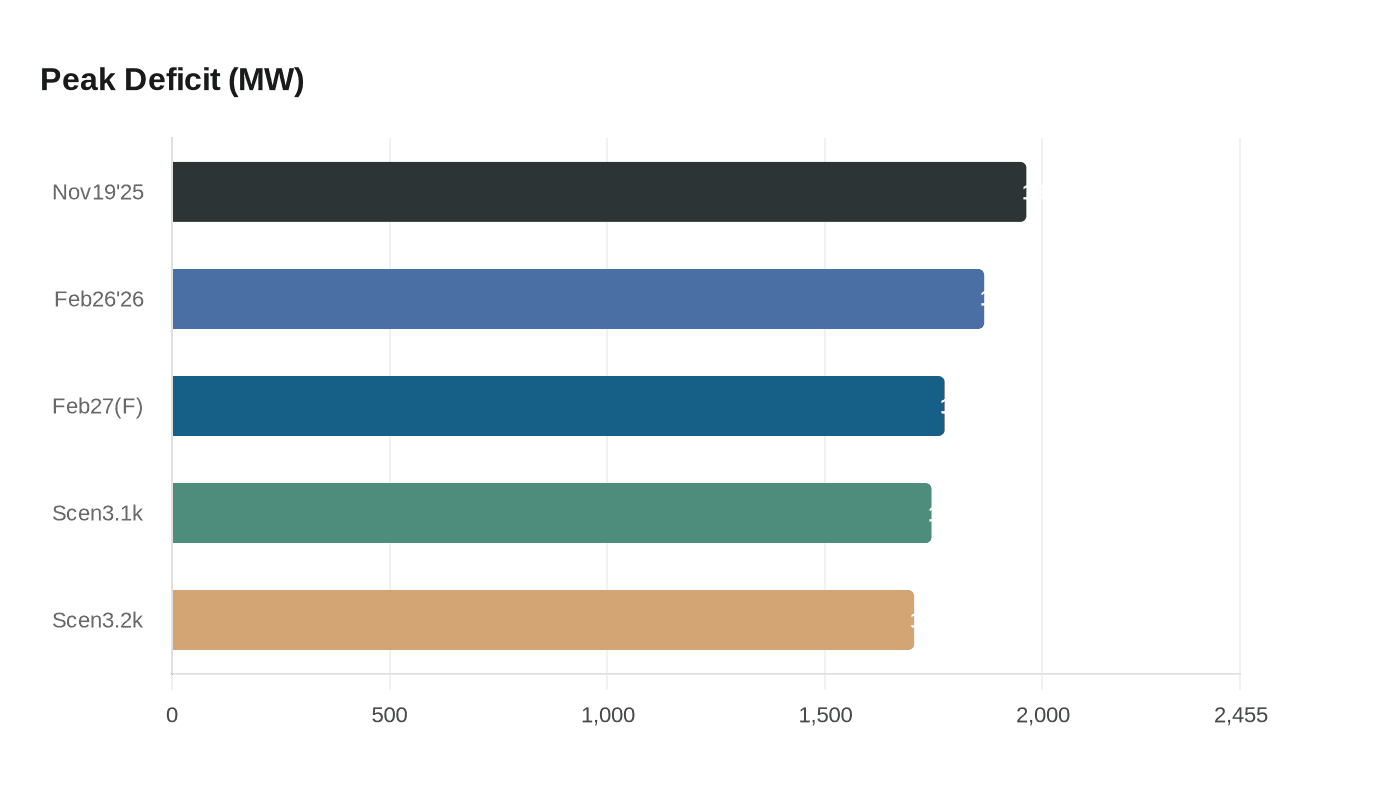
Daily realities are stark. CiberCuba warned that "daily blackouts, which in many areas exceed 20 consecutive hours, paralyze economic activities and severely degrade the quality of life for millions of Cubans," and UNE’s Feb. 27 figures show deficits in the 1,700–1,800 MW range whether described as observed shortfalls or forecasted impacts. Unless the thermal limitations—reported between 443 MW and 458 MW—and the planned Fuel Mariel, Regla and Melones incorporations are realized, UNE’s own scenarios indicate the island will continue to confront systemic blackouts through peak demand periods.
Know something we missed? Have a correction or additional information?
Submit a Tip