University of Basel Study Finds Carbon Markets Favor Traders Over Farmers
University of Basel researchers find climate governance is creating “green capital accumulation” for midstream traders and downstream companies while smallholder farmers shoulder adaptation costs.

A University of Basel open access study published 27 February 2026 argues that climate governance is reshaping global coffee value chains by turning carbon mitigation and net zero commitments into commercial advantage for traders and roasters, while shifting costs onto growers. "The article highlights who benefits from emerging carbon markets—and who carries the risks," the authors write, and the paper says climate-related initiatives are generating new sources of "green capital accumulation" for midstream traders and downstream companies.
The article, titled "Climate Change as a Business Strategy in the Coffee Sector," appears in New Political Economy and is authored by Janina Grabs, Stefano Ponte and Marc Castellón Durán. The University of Basel summary notes the research draws on "extensive interviews and document analysis," but does not supply interview counts or a geographic breakdown in the press item. The study explicitly names the policy and commercial instruments driving change: carbon markets, insetting schemes, sustainability-linked finance, and corporate net-zero commitments.
Grabs, identified on the university pages as an associate professor and head of the Sustainability Research Group in the Department of Social Sciences, has long focused on coffee, cocoa and palm oil governance. In a UNI NOVA profile from November 2025 she reflected on her path into the field: "Even as a student, I was fascinated by the fact that people grow products that allow us to enjoy a good diet here in Central Europe but often don’t afford them a living wage." The University of Basel news item includes a photo captioned "Young professor surrounded by tropical plants in the greenhouse of the Botanical Garden Basel" with photo credit Christian Flierl.
Concrete production-level pressures are visible in Ethiopia, where a December 2025 Sustainable Futures paper (article 101459) documents changing conditions for Arabica coffee. "Ethiopia’s coffee sector, pivotal to the nation’s economy and cultural identity, is currently navigating a labyrinth of natural factors with climate change casting a long and formidable shadow over the future," the authors write. Their mixed-methods study collected data from 1,020 coffee producers through a survey, 30 focus group discussions, and 67 semi-structured interviews, and lists clear impacts: "Rising temperatures and changing rainfall patterns are affecting coffee value chain (farm-to-cup)." It also records that "Khat, Eucalyptus, Juniperus procera, and Grevillea cultivations are expanding in coffee growing areas" and warns that "The increasing incidence of coffee berry disease (CBD) and coffee wilt disease (CWD) pose a threat to the coffee sector."
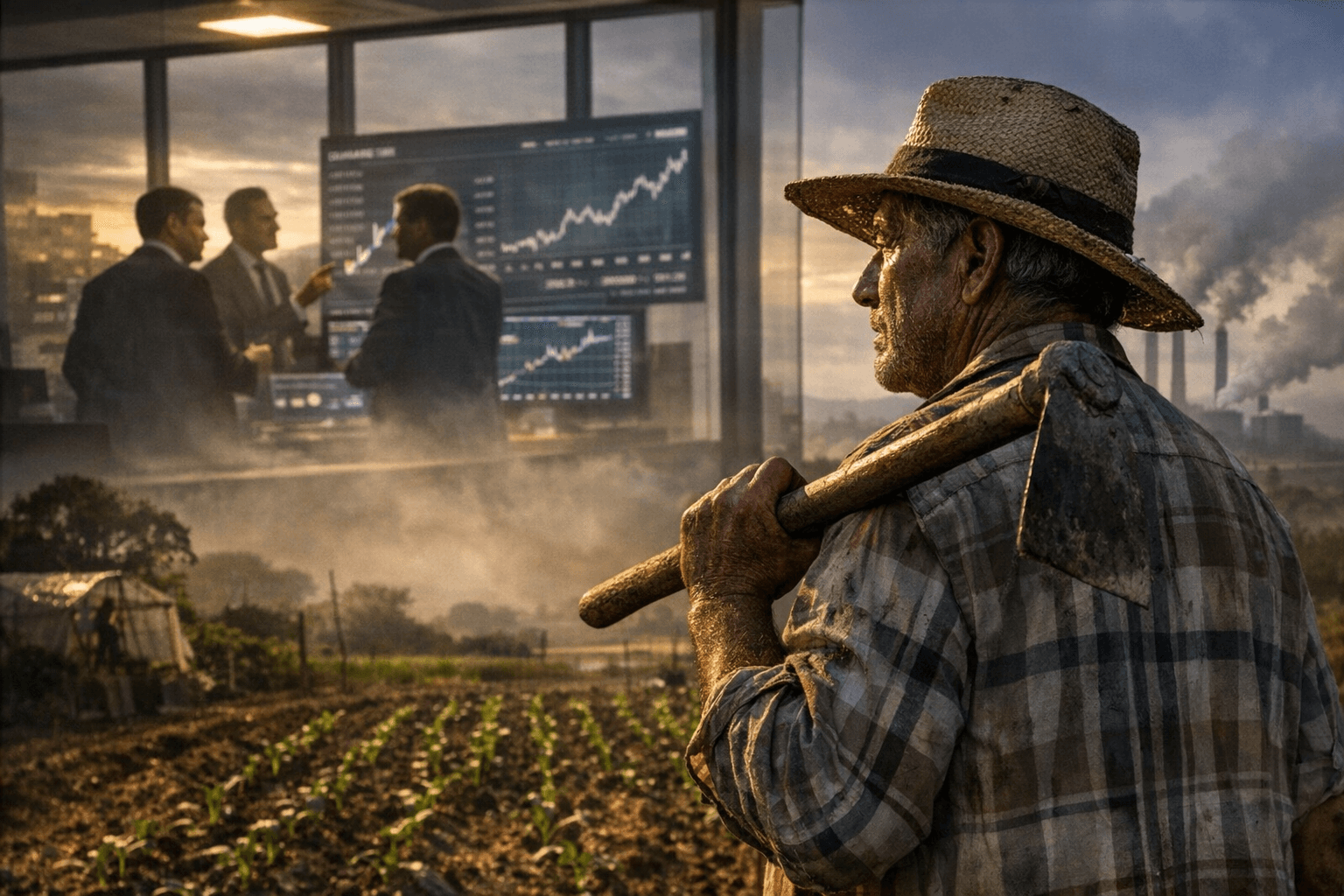
Putting the two studies side by side, the University of Basel analysis maps who is capturing climate-linked revenue streams while the Ethiopia paper maps what growers are losing to heat, pests and crop substitution. The Unibas summary notes plainly that "the costs and risks associated with climate adaptation and mitigation are often borne by smallholder farmers," a distributional outcome the New Political Economy article frames as a transformation of the political economy of the coffee sector.
Policymakers and firms face a choice documented across both papers: scale carbon and finance mechanisms that funnel "green capital accumulation" to midstream and downstream actors, or design interventions that channel support, adaptation finance and technical measures back to smallholders. The Ethiopia paper concludes that "the current impact of climate change on the coffee value chain underscores the immediate need for policymakers and agricultural practitioners to effectively implement sustainable coffee production, processing, storage, and transport methods to enhance the sector’s resilience.
Know something we missed? Have a correction or additional information?
Submit a Tip