U.S. 100% tariff threat jolts South Korea’s chip sector and policy makers
U.S. warnings that semiconductor imports could face tariffs up to 100% unless firms build U.S. plants have alarmed Seoul and prompted urgent talks among government and industry.
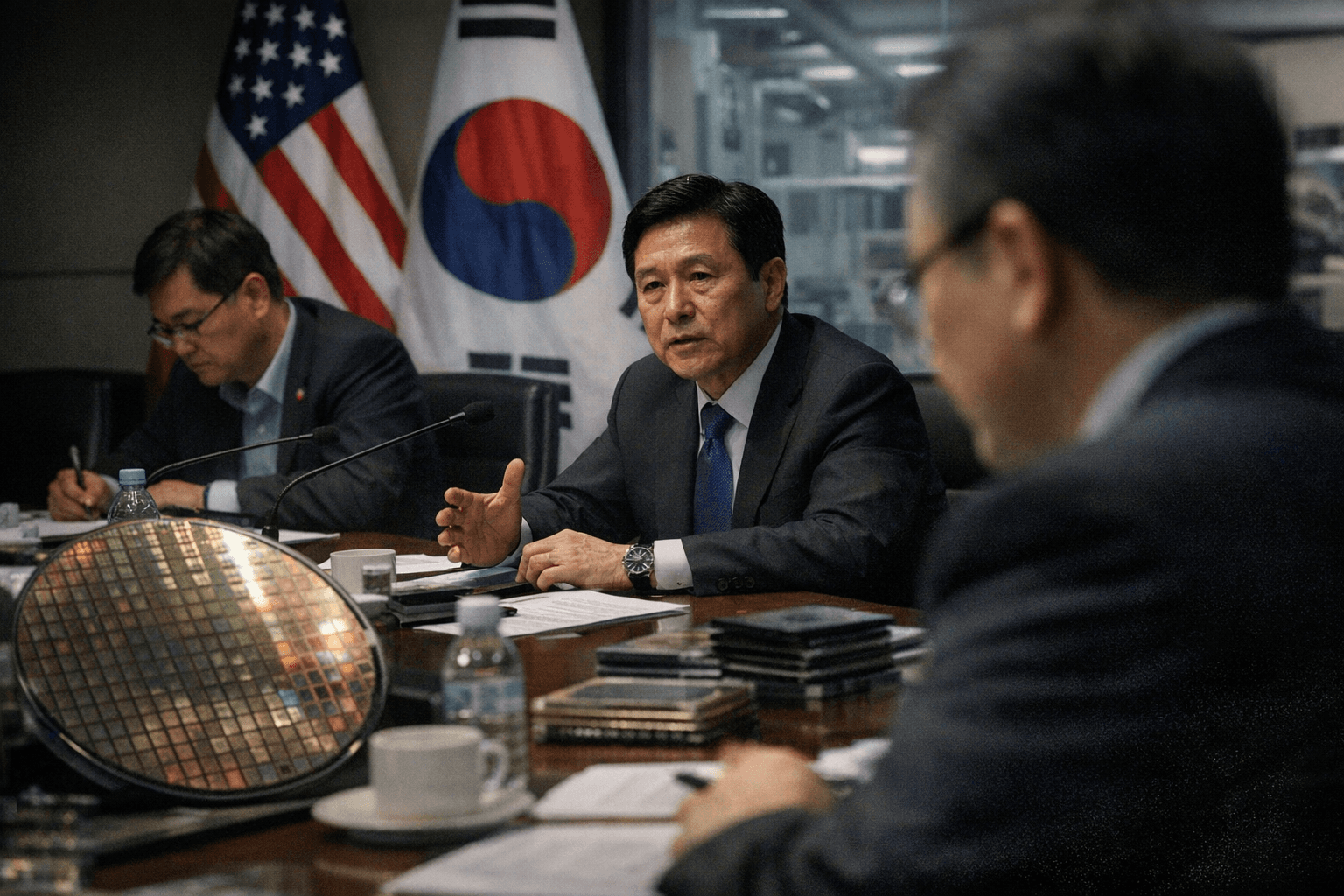
The Biden administration’s public warning that semiconductor imports could face tariffs as high as 100% unless producers commit to building factories in the United States has sent a ripple of alarm through South Korea’s government and chip industry. The threat, voiced by Commerce Secretary Howard Lutnick around a Micron groundbreaking event, has forced Seoul and major firms to weigh rapid strategic and diplomatic responses.
South Korea’s economy remains heavily exposed to semiconductors. Chips account for roughly one fifth of the country’s goods exports and are the single largest contributor to export-led growth through headline names such as Samsung Electronics and SK Hynix. Officials in Seoul have convened emergency consultations with industry leaders and trade officials to assess the scope of the U.S. warning and to map possible rebuttals or accommodations.
A 100% tariff would be effectively prohibitive. For South Korean firms that export memory and logic chips to global customers, such a tariff would devastate competitive positions and could force rapid restructuring of supply chains. For downstream electronics makers worldwide, abrupt cost increases on imported chips would feed through to higher component costs and potentially to consumer prices. The practical effect would be to accelerate the onshoring momentum already incentivized by the U.S. CHIPS and Science Act, which has offered tens of billions of dollars in subsidies to attract semiconductor capital spending to the United States.
Companies face blunt tradeoffs. Building advanced fabs typically requires investments in the $10 billion to $20 billion range and years to reach production. Many South Korean firms have already announced U.S. investments to access subsidies and mitigate geopolitical risk, but the magnitude and pace of additional plant-building required to avoid punitive tariffs would stretch corporate balance sheets and delay return on capital. Short of committing to new U.S. capacity, exporters would confront either withering tariff exposure or painful market share losses.
Seoul’s policy options include immediate diplomatic protest, reciprocal trade measures, and legal recourse through the World Trade Organization. Economists in Seoul warn that escalation would undermine South Korea’s export-driven growth model and increase uncertainty for foreign direct investment. The government’s calculus is also complicated by security ties with Washington and a shared interest in limiting China’s access to advanced chips, creating a triangular policy tension between economic pain and geopolitical alignment.
Market implications extend beyond bilateral relations. The threat crystallizes a longer term trend toward supply chain fragmentation and industrial policy-driven reshoring of strategic technologies. Firms and governments must now balance the short-term efficiency of concentrated production in East Asia with the long-term strategic cost of dependence and the higher monetary and fiscal costs of duplication across regions.
In the coming days, investors and policy makers will watch whether Seoul secures exemptions, negotiates phased compliance windows, or responds with measures of its own. The final outcome will determine not only where factories are built, but also the shape of global semiconductor markets and the political economy of advanced manufacturing for years to come.
This article was produced by Prism’s automated news system from verified source data, official records, and press releases, then run through automated quality and moderation checks before publishing. The system is built and supervised by the people who set the standards it runs under. Read our full AI policy.
Did this article answer your question?

