U.S. Backed Airstrike Touted as Drug Bust Hit Civilian Dairy Farm
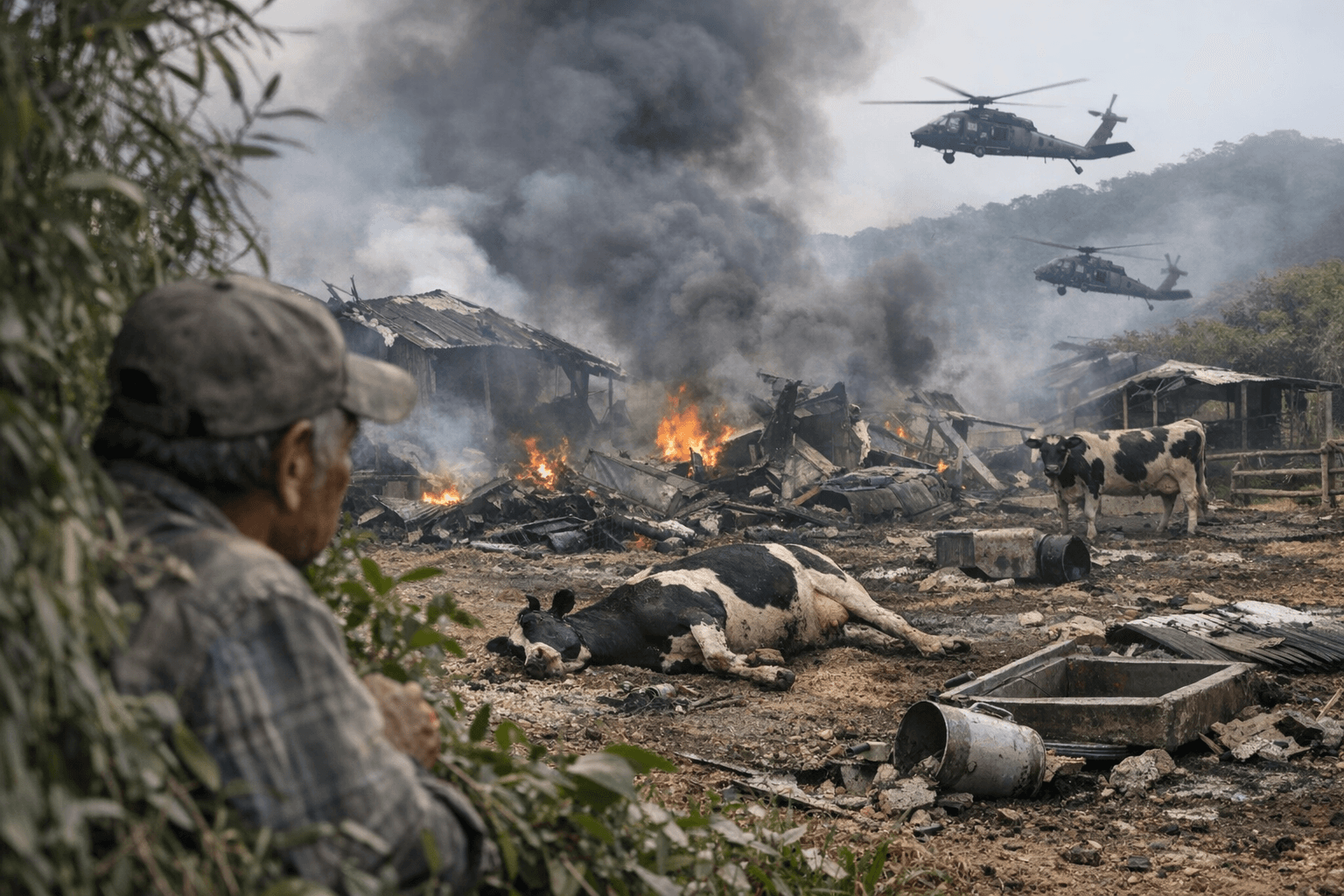
José Peña, 66, hid in bushes as helicopters bombed what he says was his dairy farm; the U.S. and Ecuador called it a narco-terrorist training camp.
José Peña, 66, crouched in the bushes as two Ecuadorean military helicopters thudded overhead. Then came the explosion he says "shook everything" and pulverized the farm where he worked. The U.S. and Ecuadorean governments had a different description for what was destroyed that day: a terrorist training camp.
As President Trump prepared to welcome conservative Latin American leaders to a summit in Florida in early March, U.S. officials released a video of a massive explosion, capturing the destruction of what they said was a drug trafficker's training camp in rural Ecuador. The video was meant to show that the U.S. military, which for months has bombed boats it says are carrying drugs from South America, was "now bombing Narco Terrorists on land," Defense Secretary Pete Hegseth wrote on social media.
The military strike appears to have destroyed a cattle and dairy farm, not a drug trafficking compound, according to interviews with the farm's owner, four of its workers, human rights lawyers, and residents and leaders in San Martín, the remote farming village in northern Ecuador where the strike took place.
The farm's owner, identified only as Miguel, told the Times he paid $9,000 for the 350-acre property six years ago, growing it into an operation with more than 50 cows for dairy and beef. He provided the land's property title listing him as the owner and photos of the farm before its destruction. "It's an outrage," Miguel said. "It's a lie that 50 people trained here. Where are they going to train? Out here in the open? There's no logic."
The account of what happened in the days before the explosion cuts against the official narrative at every turn. Workers on the farm told the Times that Ecuadorian soldiers arrived by helicopter on March 3, doused several shelters and sheds with gasoline and ignited them after interrogating workers and beating four of them with the butts of their guns. Three of the workers, who requested anonymity for fear of retaliation by the government, said the soldiers later choked and subjected them to electrical shocks before letting them go. Village residents said Ecuadorian helicopters returned to the farm three days later, on March 6, and appeared to drop explosives on the farm's smoldering remains. It was at that point, they said, that Ecuadorian soldiers recorded the footage that U.S. and Ecuadorian officials said captured the bombing of a traffickers' compound.
Pentagon spokesman Sean Parnell declared that "the Department of War executed targeted action to advance our shared objective of dismantling narco-terrorist networks." The Ecuadorian government said in a news release that it had relied on U.S. "intelligence and support" to target the farm, which it said was a camp used to train "about 50 drug traffickers." Ecuadorian officials also said it was a "resting place" used by the leader of Comandos de la Frontera, a Colombian armed group that moves cocaine along the Ecuador-Colombia border.
Ecuadorean President Daniel Noboa publicly claimed victory, writing in an Instagram post accompanied by video of a house exploding in a forested area: "We destroyed the hideout of Mono Tole, the leader of the CDF (Border Commandos), and a training area for drug traffickers."
Yet the Pentagon's own framing contained a significant tension. Though the Pentagon said at the time that it had "executed targeted action" against the site at Ecuador's request, U.S. troops had no direct involvement in the strike shown in the video, according to four people with knowledge of the operation, three of whom spoke on the condition of anonymity to discuss a sensitive matter.
Days after the strike, the White House sent Congress a war powers report announcing the introduction of U.S. armed forces into "hostilities" in Ecuador, describing "military action taken on March 6, 2026, against the facilities of narco-terrorists affiliated with a designated terrorist organization."
In an attempt to seek justice, the Alliance for Human Rights, a coalition of organizations in Ecuador, filed a complaint with the United Nations and the country's government. "There isn't a single public official who has come to verify what happened," said María Espinosa, a human rights lawyer.
Vicente Garrido, the vice president of the San Martín village board, summed up the community's view: "All we want is for the truth to come out. They say it was some training camp, but it's becoming clear that they were just homes."
Ecuadorian officials said soldiers found weapons and "evidence of illicit activity" at the site but have not released that evidence to the public. Noboa did not respond to a detailed list of questions submitted by the Times.
This article was produced by Prism’s automated news system from verified source data, official records, and press releases, then run through automated quality and moderation checks before publishing. The system is built and supervised by the people who set the standards it runs under. Read our full AI policy.
Did this article answer your question?


