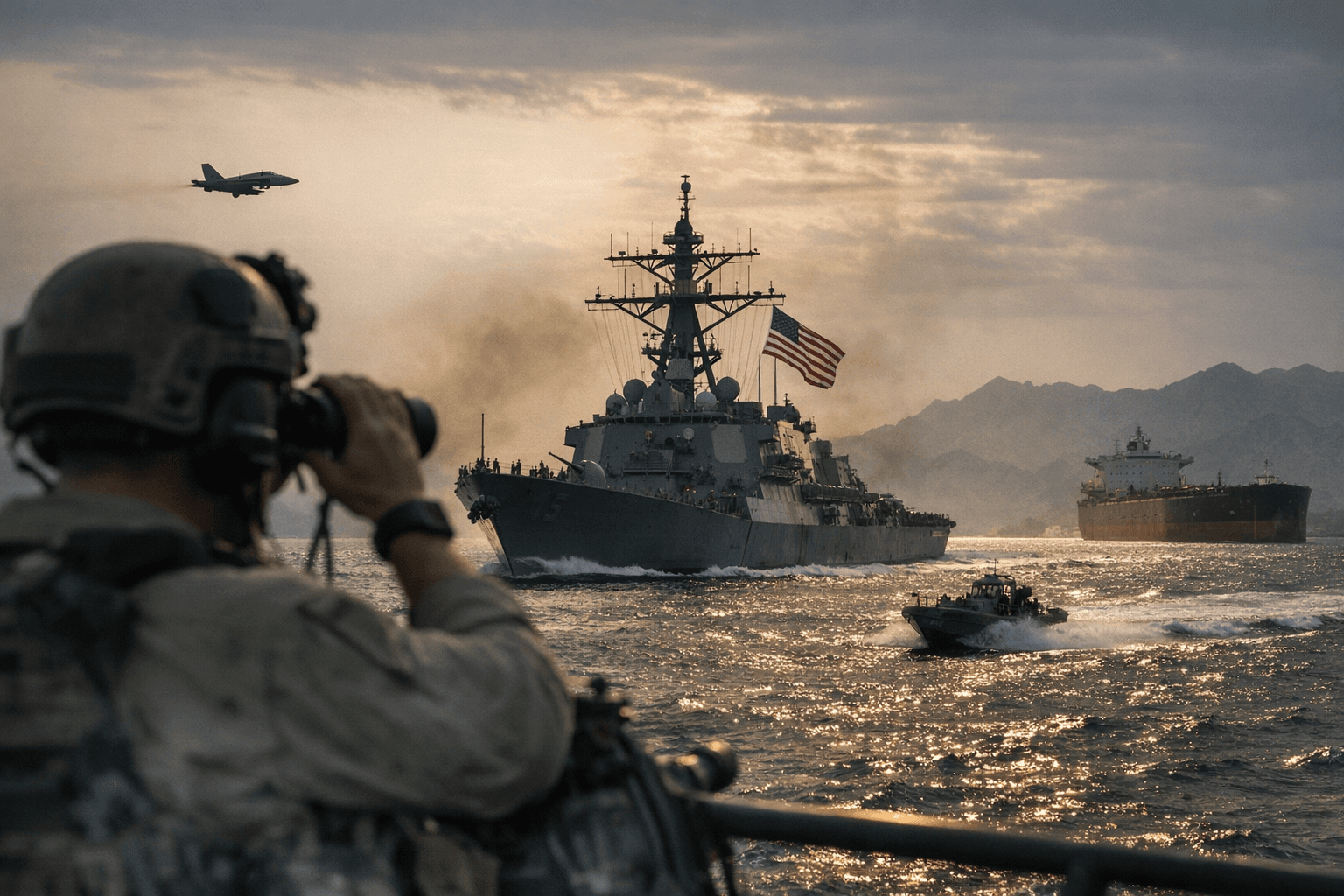
U.S. blockade in Strait of Hormuz could disrupt global oil, gas supplies
Tanker traffic in Hormuz stopped again as oil surged above $104, and the next 48 hours will show whether Iran is posturing or widening the war.

Tanker traffic through the Strait of Hormuz stopped again after the U.S. blockade announcement, and crude prices leapt above $104 a barrel for West Texas Intermediate while Brent rose above $101. The first 48 hours will now show whether Iran is using the chokepoint as leverage or moving toward a longer and more dangerous confrontation.
That matters because Hormuz is not just another shipping lane. At its narrowest point, the strait is only 29 nautical miles wide, with two 2-mile-wide navigation channels and a 2-mile buffer zone. In 2025, about 20 million barrels a day of crude oil and oil products moved through it, roughly a quarter of global seaborne oil trade. Nearly 15 million barrels a day of crude alone passed through, and China and India together received 44% of those exports.
The gas exposure is just as serious. About 20% of global LNG trade transited the strait in 2024, including about 93% of Qatar’s LNG exports and 96% of the United Arab Emirates’. That is why even a short disruption can ripple far beyond the Gulf, tightening oil and gas markets and lifting costs for shipping, fertilizer, helium and other industrial inputs that feed into consumer prices worldwide.
Jon B. Alterman of the Center for Strategic and International Studies brings unusual weight to the discussion. CSIS says he has held the Zbigniew Brzezinski chair in global security and geostrategy since 2012, after more than 20 years leading its Middle East Program and service in the State Department’s Policy Planning Staff. His background in diplomacy and naval affairs fits the narrow question now facing markets: whether this is a controlled squeeze or the start of a spiral.

The most important signals over the next two days will come from Iranian military movements near the waterway, shipping insurance pricing, oil futures and the response from Washington and regional allies. Earlier intelligence assessments suggested Tehran was unlikely to reopen Hormuz quickly because it sees control of the strait as its strongest leverage over the United States. AP also reported that Iran has demanded the right to collect tolls as a condition for reopening, a sign that the blockade may be used as bargaining power rather than a short-lived protest.
The International Energy Agency says 3.5 million to 5.5 million barrels a day of pipeline capacity could reroute some crude around the strait, but that would not fully offset a prolonged shutdown. Maritime analysts have warned that traffic could take weeks or months to normalize even after any ceasefire. For now, Hormuz is testing whether energy markets are staring at temporary coercion or a broader war that would reach China, India and the rest of the global economy.
Know something we missed? Have a correction or additional information?
Submit a Tip