U.S. Consumer Sentiment Falls to Three-Month Low Amid Rising Energy Costs
U.S. consumer sentiment fell to a three-month low in March as gasoline neared $3.98/gallon and the S&P 500 shed 6.7%, hitting middle- and higher-income households hardest.
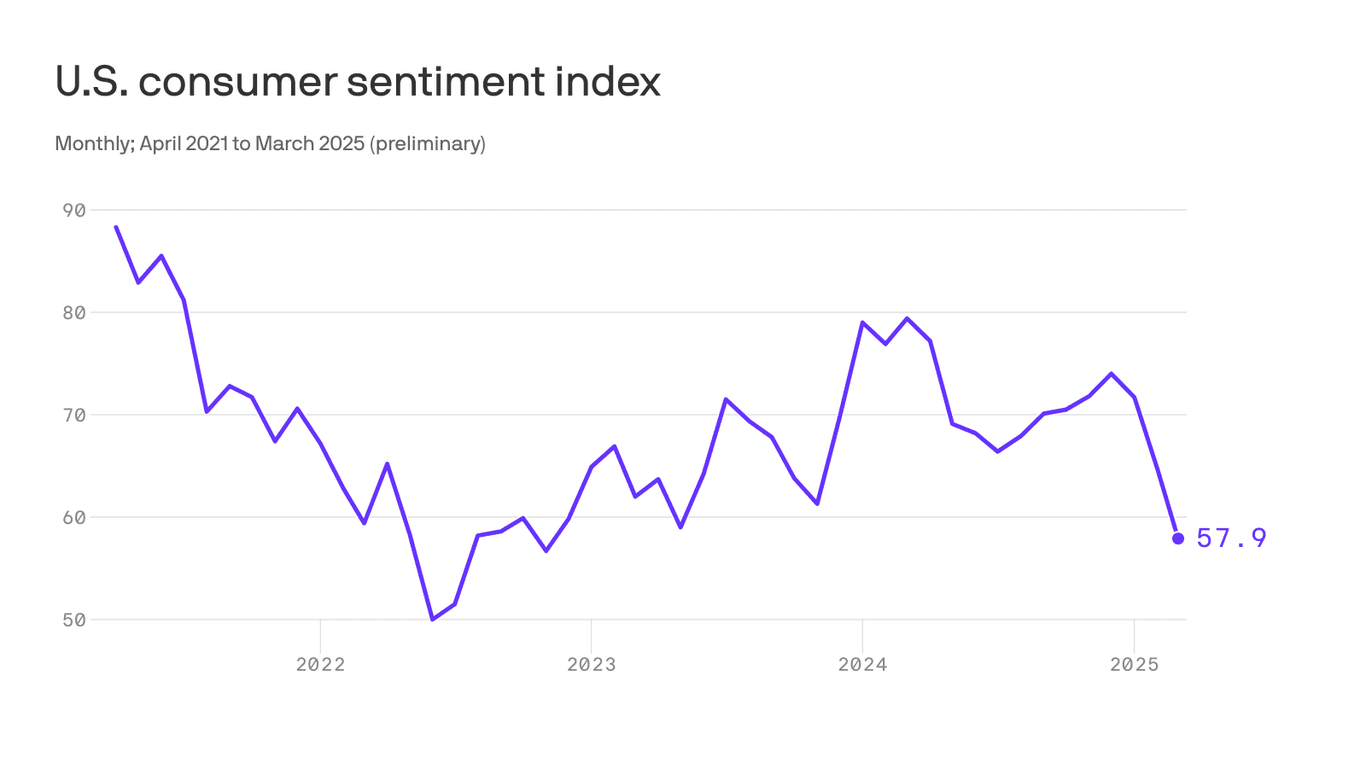
American consumer confidence slid sharply in March, dropping more than economists expected to its weakest reading in three months as a convergence of surging gasoline prices and a retreating stock market eroded household optimism across nearly every demographic measured.
The University of Michigan's monthly consumer survey, one of the most closely tracked barometers of household economic attitudes, recorded a decline that was broad-based across political affiliations and age groups. The sharpest deterioration, however, came from the cohorts that economists watch most closely for spending signals: middle- and higher-income households, homeowners, and stockholders all posted outsized drops.
Two forces drove the pullback. Retail gasoline prices climbed toward a national average of $3.98 per gallon, according to AAA data, as geopolitical turbulence pushed global oil prices higher. Simultaneously, the S&P 500 shed roughly 6.7% over the period covered, compressing the paper wealth of the roughly half of American households that hold equities. The combination hit affluent consumers particularly hard, pointing to a wealth-effect channel that economists have long theorized but rarely see activate so clearly within a single survey cycle.
The demographic pattern carries real weight for growth forecasts. Higher-income households have shouldered a disproportionate share of discretionary spending in recent years, and a sentiment-driven pullback among that group carries more economic consequence than an equivalent decline among lower-income respondents. If caution translates into reduced spending, the sectors most exposed include retailers, travel companies and leisure firms, all of which depend heavily on non-essential outlays.

The findings also complicate the Federal Reserve's already delicate policy calculus. Energy-driven inflation pressures argue for keeping rates elevated, but weakening consumer confidence and softer equity markets point toward growth risks that tighter monetary policy would only amplify. Loosening policy prematurely, meanwhile, could risk embedding higher inflation expectations at a moment when gasoline prices are already testing psychological thresholds near $4 per gallon.
Economists are careful to note that sentiment surveys and actual spending data do not move in lockstep. Consumers frequently express pessimism in surveys while continuing to spend; the two series have diverged notably at several points over the past decade. But the breadth of March's decline, spanning income levels, age groups and partisan affiliations, makes it harder to dismiss as noise. When wealthy stockholders and middle-income families register simultaneous confidence drops against the backdrop of rising fuel costs and a weakening equity market, the downside risks to near-term consumption become harder for forecasters to set aside.
This article was produced by Prism’s automated news system from verified source data, official records, and press releases, then run through automated quality and moderation checks before publishing. The system is built and supervised by the people who set the standards it runs under. Read our full AI policy.
Did this article answer your question?

