U.S. Economy Grows 2% in First Quarter, but Housing and Consumers Lag
Growth rebounded to 2%, but government spending, AI investment and imports did most of the heavy lifting while housing and consumers stayed soft.

The U.S. economy grew at a 2% annual rate in the first quarter, a rebound that looks sturdier on the surface than it may prove in practice. Government spending and investment helped lift output after the drag from last fall’s 43-day federal shutdown faded, but consumers remained cautious, housing weakened again and the war in Iran raised fresh doubts about whether the spring pickup can last.
The Commerce Department’s advance estimate, released at 8:30 a.m. EDT on Thursday, April 30, showed real gross domestic product rising after a 0.5% increase in the fourth quarter of 2025. Real final sales to private domestic purchasers, a closely watched measure of underlying demand, advanced 2.5%, up from 1.8% in the previous quarter. That suggests the economy was still expanding on a private-sector basis, even if the headline number was boosted by volatile components.

Government spending and investment rose at a 9.3% annual pace and added more than half a percentage point to GDP after subtracting from growth in the prior quarter. Business investment increased at an 8.7% pace, helped in part by an artificial-intelligence spending boom and data-center construction. But the stronger investment picture was offset by a consumer sector that is still under strain: household spending, which accounts for about 70% of U.S. economic activity, slowed to 1.6% from 1.9% at the end of 2025 as higher gasoline prices and other bills continued to weigh on budgets.
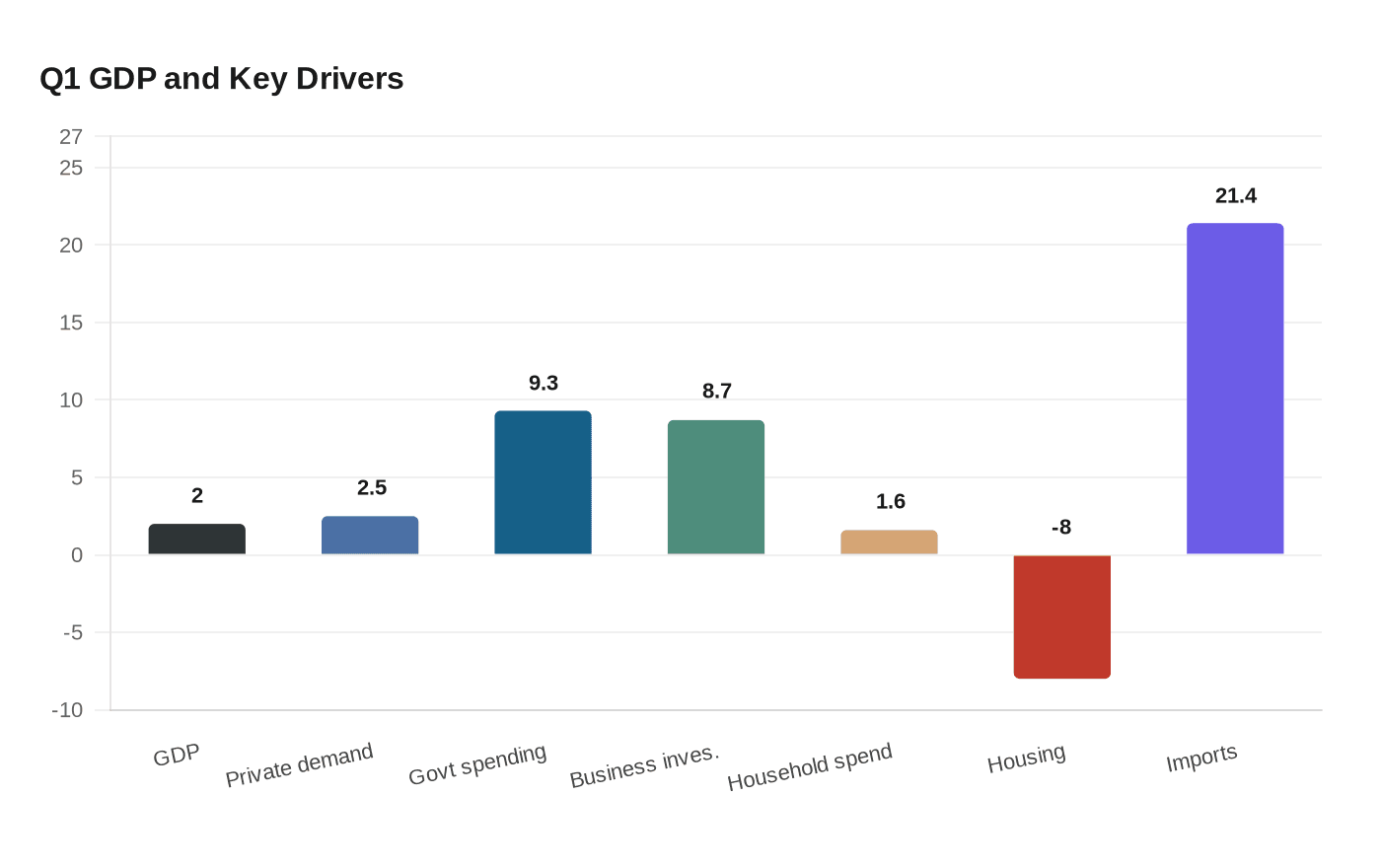
Housing was another clear weak spot. Residential investment fell at an 8% annual rate, the fifth straight quarterly decline and the steepest drop since the end of 2022. Imports surged at a 21.4% annual rate as companies rushed to bring in foreign goods, slicing more than 2.6 percentage points from growth and complicating the interpretation of the quarter’s rebound.
The inflation backdrop was still uncomfortable. The PCE price index rose 4.5% in the quarter, core PCE increased 4.3% and the gross domestic purchases price index climbed 3.6%. March PCE inflation was running at 3.5% year over year, leaving the Federal Reserve with little room for complacency.
One economist described the moment as a “split-screen economy,” with AI-linked companies and investors doing well while middle- and lower-income households struggle. That split, along with the shutdown’s distortions and the uncertainty tied to Iran and energy markets, makes the first-quarter growth rate look increasingly like a rearview-mirror number. The next GDP release is scheduled for May 28, and it will test whether the rebound was durable or just a temporary break from a volatile year.
This article was produced by Prism’s automated news system from verified source data, official records, and press releases, then run through automated quality and moderation checks before publishing. The system is built and supervised by the people who set the standards it runs under. Read our full AI policy.
Did this article answer your question?