U.S., Ecuador launch joint operations against narco-terror groups linked to Los Lobos
SOUTHCOM said U.S. and Ecuadorian forces launched operations March 3; the U.S. Embassy credited a dismantled DTO tied to Los Lobos while Ecuador kept operational details classified.
U.S. Southern Command announced that Ecuadorian and U.S. military forces carried out operations on March 3 targeting “Designated Terrorist Organizations” in Ecuador, releasing a short video showing helicopters and personnel deployed. SOUTHCOM said the action was “a powerful example of the commitment of partners in Latin America and the Caribbean to combat the scourge of narco‑terrorism” and posted that “Together, we are taking decisive action to confront narco‑terrorists who have long inflicted terror, violence, and corruption on citizens throughout the hemisphere.”
The video, disseminated by SOUTHCOM and reproduced as a still image by Reuters, appears to show helicopters lifting off from an unknown location. Ecuador’s Defense Ministry confirmed it was conducting an “offensive” operation with U.S. forces but said operational specifics were “classified,” leaving key questions about scope, locations and outcomes unanswered.
In a separate claim reported by Fox News, the U.S. Embassy in Quito said the United States “successfully concluded a joint operation” with Europol and Ecuadorian authorities that dismantled the Hernán Ruilova Barzola transnational drug trafficking organization, which the Embassy said is linked to the Los Lobos cartel. SOUTHCOM and Ecuadorian officials have not publicly provided arrests, seizure inventories or casualty figures to corroborate that description.
The exact role of U.S. personnel in the Ecuador operation remains contested. ABC News, citing an unnamed source familiar with the operation, reported that the U.S. role “was limited to advising Ecuadorian troops, and they did not participate in the actual ground operation.” That characterization contrasts with SOUTHCOM’s wording that both Ecuadorian and U.S. military forces “launched operations,” and neither SOUTHCOM nor Ecuador’s Defense Ministry has clarified whether U.S. forces were embedded in ground units or confined to advisory, intelligence or logistical support.
Gen. Francis L. Donovan, commander of SOUTHCOM, praised the Ecuadorian military’s participation, saying: “We commend the men and women of the Ecuadorian armed forces for their unwavering commitment to this fight, demonstrating courage and resolve through continued actions against narco‑terrorists in their country.” His comments, reported by U.S. outlets, came amid intensified cooperation between Washington and Quito at senior levels.

The operation follows a string of U.S. counter‑drug actions in maritime zones off Latin America, including prior U.S. strikes against suspected drug‑running boats that U.S. officials and some outlets have said killed 11 people across three strikes. Analysts and regional officials have framed Ecuador as a growing transit hub: The Guardian noted roughly 70 percent of drugs produced in Colombia and Peru now transit through neighboring Ecuador, a statistic that underlines why Quito has sought outside support.
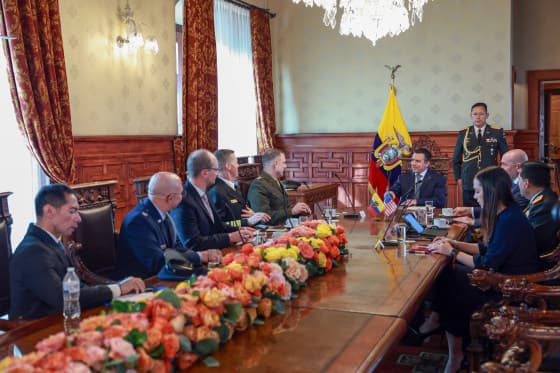
President Daniel Noboa has publicly cast the moves as part of a broader regional effort; The Guardian reported he met with SOUTHCOM chief Donovan and Mark Schafer, head of U.S. Special Operations for the region, to discuss information sharing and coordination at airports and seaports. Legal and diplomatic questions remain prominent: officials have not disclosed the legal basis for U.S. military involvement on Ecuadorian soil or whether formal requests, memoranda or agreements authorized specific roles.
For now, official releases provide a vivid image of cooperative action without the operational detail that would allow independent verification of outcomes. Journalists and regional authorities will be watching for follow‑up statements from SOUTHCOM, the Ecuadorian government, Europol and the U.S. Embassy to clarify arrests, evidence and the exact extent of U.S. participation.
Know something we missed? Have a correction or additional information?
Submit a Tip