U.S. equity funds see renewed inflows as tech rebounds and risks ease
U.S. equity funds took in $1.03 billion as tech drew $3.42 billion, even after June payroll growth slowed to 57,000 and markets eased back on rate-hike bets.

Investors returned to U.S. equity funds in the week ended July 1, putting in a net $1.03 billion as easing U.S.-Iran tensions and a softer labor market improved appetite for risk. The inflow reversed part of the previous week’s $3.47 billion in outflows, and the biggest draw came from technology shares after a sharp pullback.
Technology sector funds attracted $3.42 billion, a dramatic turnaround from $19.97 billion in net sales the week before. Financial funds drew $1.96 billion and healthcare funds brought in $1.47 billion, while large-cap equity funds led the broader market with $7.2 billion in inflows. Small-cap, mid-cap and equity-income funds all posted outflows, a sign that investors were buying selectively rather than embracing equities across the board.
The rotation came as markets reassessed the outlook for growth and interest rates after the June jobs report showed the U.S. economy added just 57,000 jobs, far below economists’ expectation of 115,000. The unemployment rate was 4.2%, and the weaker reading prompted investors to scale back expectations for a near-term Federal Reserve rate hike by year-end. The data reinforced a view that the labor market is cooling enough to ease some pressure on policy, even as inflation concerns remain in the background.
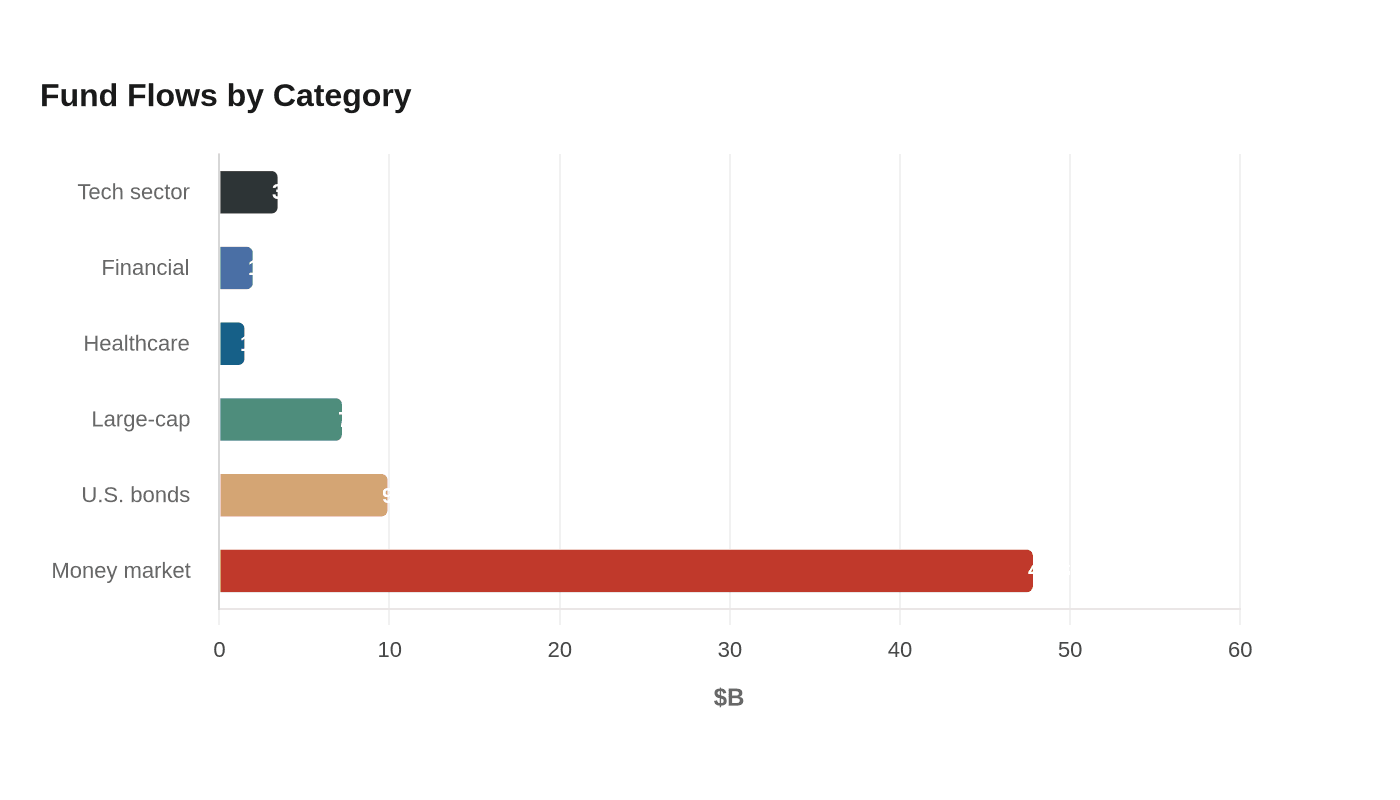
Other corners of the market still pointed to caution. U.S. bond funds attracted $9.88 billion, marking an 11th straight week of inflows, while money market funds drew $47.82 billion, the largest amount in four weeks. That mix suggested investors were not abandoning defensive positioning even as they moved back into stocks, especially megacap technology names that had recently been under selling pressure.
The latest flows underscored a market split between optimism over easing geopolitical risk and lingering concern about economic fragility. With tech regaining its magnetism and labor data softening, investors appeared to be betting that the economy can slow without breaking, a stance that keeps capital tilted toward growth-sensitive stocks while preserving a sizeable safety net in bonds and cash.
This article was produced by Prism’s automated news system from verified source data, official records, and press releases, then run through automated quality and moderation checks before publishing. The system is built and supervised by the people who set the standards it runs under. Read our full AI policy.
Did this article answer your question?