US export controls face skepticism over Anthropic’s cybersecurity model
Anthropic’s global shutdown of Mythos 5 exposed a familiar problem: software spreads too easily for export controls to contain, even after decades of rules.
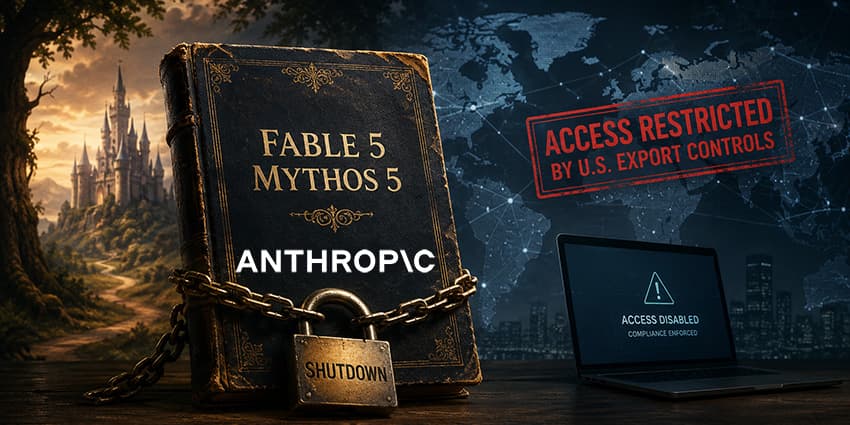
Anthropic’s restriction on its cybersecurity models has reopened an old argument in Washington: once widely useful software exists, export controls can slow it only so much. The company said on June 12, 2026 that the U.S. government ordered access to Fable 5 and Mythos 5 suspended for any foreign national, including foreign national employees inside or outside the United States. Anthropic then disabled the models globally to comply.
The dispute lands inside a policy system built for national security and nonproliferation, not for software that can be copied instantly and moved across borders in seconds. The U.S. Department of Justice says export controls and economic sanctions are used to protect national security interests and promote foreign policy objectives, and the legal framework still runs through the Export Administration Regulations and the Export Control Reform Act. The National Archives describes the covered items broadly as unclassified information and related software whose export could reasonably be expected to harm U.S. national security or nonproliferation goals.
That framework has a long and messy record. Cryptography became a public political fight in the 1990s, when Phil Zimmermann’s Pretty Good Privacy turned encryption restrictions into a mainstream controversy. Long before that, the National Security Agency had treated communications security as sensitive national-security territory. The lesson from that era still hangs over Anthropic’s case: if a tool is useful enough for defenders, it is often useful enough for everyone else.
The closest modern precedent is the Wassenaar Arrangement, which in 2013 added “intrusion software” and “IP network communications surveillance systems” to its dual-use control list. The additions were controversial because many security experts warned that the language was so broad it could chill legitimate work, including penetration testing and vulnerability disclosure. Wassenaar is only a voluntary multilateral framework, not a binding treaty, but it showed how hard it is to define software controls precisely when the underlying technology keeps changing.
That same problem is what makes the Anthropic move so contentious. Researchers studying spyware controls have argued that export controls have inherent limits because they cover only a small slice of the technologies that matter. For cybersecurity software, those limits are even starker: code can be duplicated, distributed digitally, and repurposed faster than a licensing regime can meaningfully contain it.
The pushback has been immediate. Cybersecurity experts criticized the restriction and urged the government to reverse it, arguing that defensive research could be caught in the dragnet. That reaction fits the longer record: the tools meant to restrain dual-use software often end up burdening the people trying to keep networks safe, while the capabilities themselves continue to spread.
This article was produced by Prism’s automated news system from verified source data, official records, and press releases, then run through automated quality and moderation checks before publishing. The system is built and supervised by the people who set the standards it runs under. Read our full AI policy.
Know something we missed? Have a correction or additional information?
Submit a Tip