U.S. futures fall as AI valuation fears hit tech; Nasdaq set for steep monthly drop
U.S. stock futures declined on Feb. 27 as investor anxiety over AI valuations pressured technology shares, leaving the Nasdaq on track for its steepest monthly fall since March 2025.
U.S. stock index futures declined on Feb. 27 as growing investor unease about artificial intelligence valuations and uncertain returns from massive AI spending weighed on technology shares, leaving the Nasdaq on track for its steepest monthly drop since March 2025, according to market briefings.
The weakness showed up in cash markets earlier in the session. The Associated Press reported the S&P 500 slipped 0.3% for its first loss in four days, the Dow Jones Industrial Average dropped 267 points or 0.5%, and the Nasdaq composite slipped 0.3%. Barchart’s intraday snapshot showed the S&P at 6,834.88, down 74.63 points or 1.08%, and the Nasdaq 100 E-Mini (NQH26) at 24,739.75, down 327.75 points or 1.31% for that feed.
Technology and software names led the declines. Reuters and Yahoo Finance cited a string of post-earnings and guidance shocks: Germany’s SAP plunged more than 16% after analysts flagged its cloud backlog and 2026 revenue forecast fell short of projections, ServiceNow dropped 11% despite forecasting annual subscription revenue above Wall Street estimates, and Microsoft slid 12.1% after reporting record AI spending and slower cloud growth. Reuters noted the selloff dragged Salesforce down 7.1%, Adobe lost 3.9%, Datadog fell 8.3%, Atlassian slid 12.6%, Zscaler lost 6.3%, Intuit shed 7.8% and HubSpot fell 11.5%.

Market-data provider Barchart captured related intraday pressure across the group, with CrowdStrike Holdings listed down 8.57% to 355.29 and Workday and DocuSign each down more than 8% in its snapshot. Barchart also said AppLovin was down more than 9% after the SEC said its probe was “still active and ongoing.”
Analysts and strategists framed the moves as a repricing of software risk as AI capabilities advance. “The malaise in software sentiment persists, coupled with a seemingly paradoxical and vicious cycle of depressed valuations, with maintained, if not rising, investor expectations,” J.P. Morgan analysts wrote in a note cited by Yahoo Finance. Adam Turnquist, chief technical strategist for LPL Financial, told Reuters, “All these software names are performing terribly because the market's kind of in our view pricing a worst-case scenario that software is dead because AI is disrupting the space.” The Associated Press added that investors “have been punishing stocks of companies seen as under threat by AI so suddenly and aggressively that analysts have likened it to a ‘shoot first-ask questions later’ mentality.”
Not all tech news was negative. WRAL reported Advanced Micro Devices jumped 6.8% after announcing a multi-year deal to supply chips to help power Meta Platforms’ AI ambitions. WRAL said Meta also obtained the right to buy up to 160 million shares of AMD stock for 1 cent each, depending in part on how many chips Meta ultimately buys. WRAL described the deal as “a reminder of the excitement that built in recent years about the billions of dollars pouring into AI, which could remake the world and create a more productive economy.”
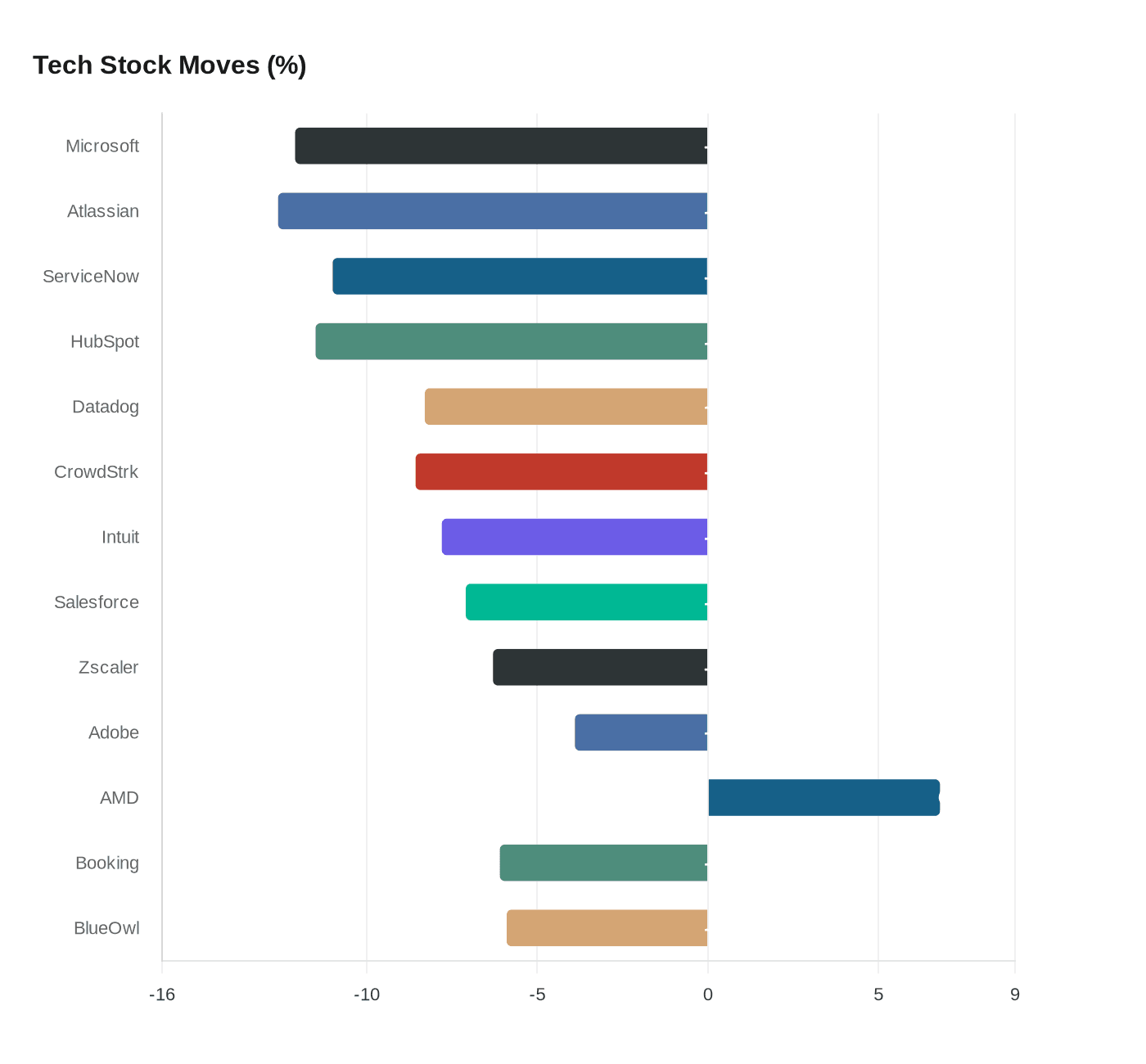
Pressure extended beyond pure software. The AP highlighted travel and asset-management names under strain: Booking Holdings dropped 6.1% despite a modestly beating profit, and private credit and asset managers such as Blue Owl Capital, Apollo Global Management and Ares Management fell sharply. AP reported Blue Owl Capital fell 5.9% to bring its loss for the year so far to 22.5%. WRAL published a different figure for Blue Owl in its snapshot; that discrepancy remains in the sources.
Sector and index volatility underscores an unsettled market reckoning with AI: analysts note that heavy up-front spending and uncertain revenue offsets are prompting revaluations across incumbents and vendors. Jeffries has moved to downgrade names it sees as exposed, citing “more persistent risk and negative sentiment” in research cited by Barchart.
This article was produced by Prism’s automated news system from verified source data, official records, and press releases, then run through automated quality and moderation checks before publishing. The system is built and supervised by the people who set the standards it runs under. Read our full AI policy.
Did this article answer your question?
%3Amax_bytes(150000)%3Astrip_icc()%2FCertificate-of-deposit-2301f2164ceb4e91b100cb92aa6f868a.jpg&w=1920&q=75)