U.S. Jobless Claims Rise Modestly as Inflation Stays Firm Amid Middle East Disruptions
Jobless claims climbed to 219,000 as March inflation hit a two-year high of 3.3%, driven by Iran war energy shocks that now threaten to derail the Fed's rate-cut timeline.
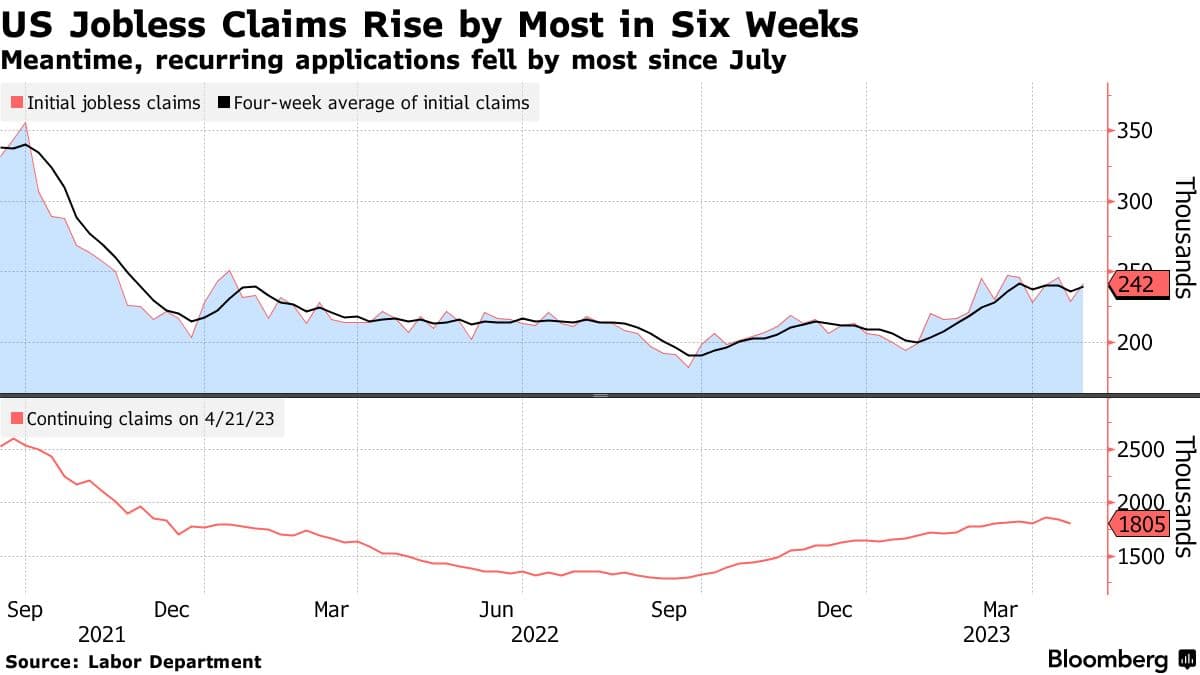
A two-year high in consumer prices landed on the same morning that the Labor Department reported new unemployment filings rose more than expected, putting the Federal Reserve in the crosshairs of one of the most uncomfortable policy dilemmas of the current rate cycle.
Initial jobless claims climbed to 219,000 in the week ended April 4, an increase of 16,000 from the prior week's revised level of 203,000 and above the median market estimate. The reading marked the highest filing total in roughly two months, though it remained well within historical ranges that economists associate with a healthy labor market. Continuing claims, a proxy for ongoing unemployment, actually fell by 32,000 to 1,819,000, tying the lowest level since May 2024 and reinforcing that layoffs are not accelerating broadly.
The labor-market data arrived alongside a March Consumer Price Index report that showed headline inflation surging 0.9 percent on a monthly basis and 3.3 percent year over year, the steepest annual pace since May 2024. Energy prices, elevated sharply after the U.S.-Israel joint military action against Iran, were the primary driver. Core CPI, which strips out food and energy, rose a more contained 0.2 percent for the month and 2.7 percent annually, but that offered limited comfort given the persistence of supply-chain pressures tied to the broader Middle East conflict and mounting concern over the Strait of Hormuz, through which roughly a fifth of the world's oil supply passes.
The combination placed Fed policymakers in a familiar but newly sharpened bind. With the federal funds rate sitting at 3.50 to 3.75 percent following 175 basis points of cuts since September 2024, markets had been pricing in roughly one additional cut for 2026. That calculus now depends heavily on whether the energy shock proves transitory. Chris Zaccarelli, chief investment officer at Northlight Asset Management, put the stakes plainly: "The duration of the war matters as does the extremely important Strait of Hormuz, because if the supply shock is temporary then the economy can weather this storm and the Fed will have an opportunity to lower interest rates by the end of the year, but if the inflation shock is more long-lasting they will have no choice but to sit on their hands for the entire year."

Bond strategists nudged yield forecasts modestly higher in response to the data, and Treasury markets showed sensitivity to both sides of the ledger: stronger inflation supporting higher yields, softer growth signals pulling them back. Average hourly earnings, running at 3.5 percent year over year as of March, remain above the pre-war inflation baseline of 2.4 percent, but the gap is eroding as energy costs push headline prices faster than wage gains.
For households carrying variable-rate debt, the policy stalemate has tangible consequences. Credit card rates, which track closely with the federal funds rate, remain elevated; mortgage borrowing costs have yet to fall to levels that would meaningfully revive a housing market still constrained by affordability; and auto loan rates continue to reflect the broader tightness in financial conditions. Any further delay in Fed easing, whether driven by a persistent Iran-related energy shock or by a labor market that simply refuses to cool, extends that pressure across the consumer balance sheet.
The next major test will be the April jobs report and the subsequent inflation print. If oil prices stabilize and core inflation resumes its slow descent, the case for a late-2026 rate cut remains intact. If the Strait of Hormuz situation escalates and energy costs feed through more broadly into goods and services prices, the Fed may find itself holding rates steady well into next year, whatever the weekly claims data says.
This article was produced by Prism’s automated news system from verified source data, official records, and press releases, then run through automated quality and moderation checks before publishing. The system is built and supervised by the people who set the standards it runs under. Read our full AI policy.
Did this article answer your question?

