U.S. launches Pax Silica to cut China reliance in AI supply chains
Washington widened Pax Silica from seven founders to a larger coalition, aiming to secure minerals, chips and AI infrastructure outside China.
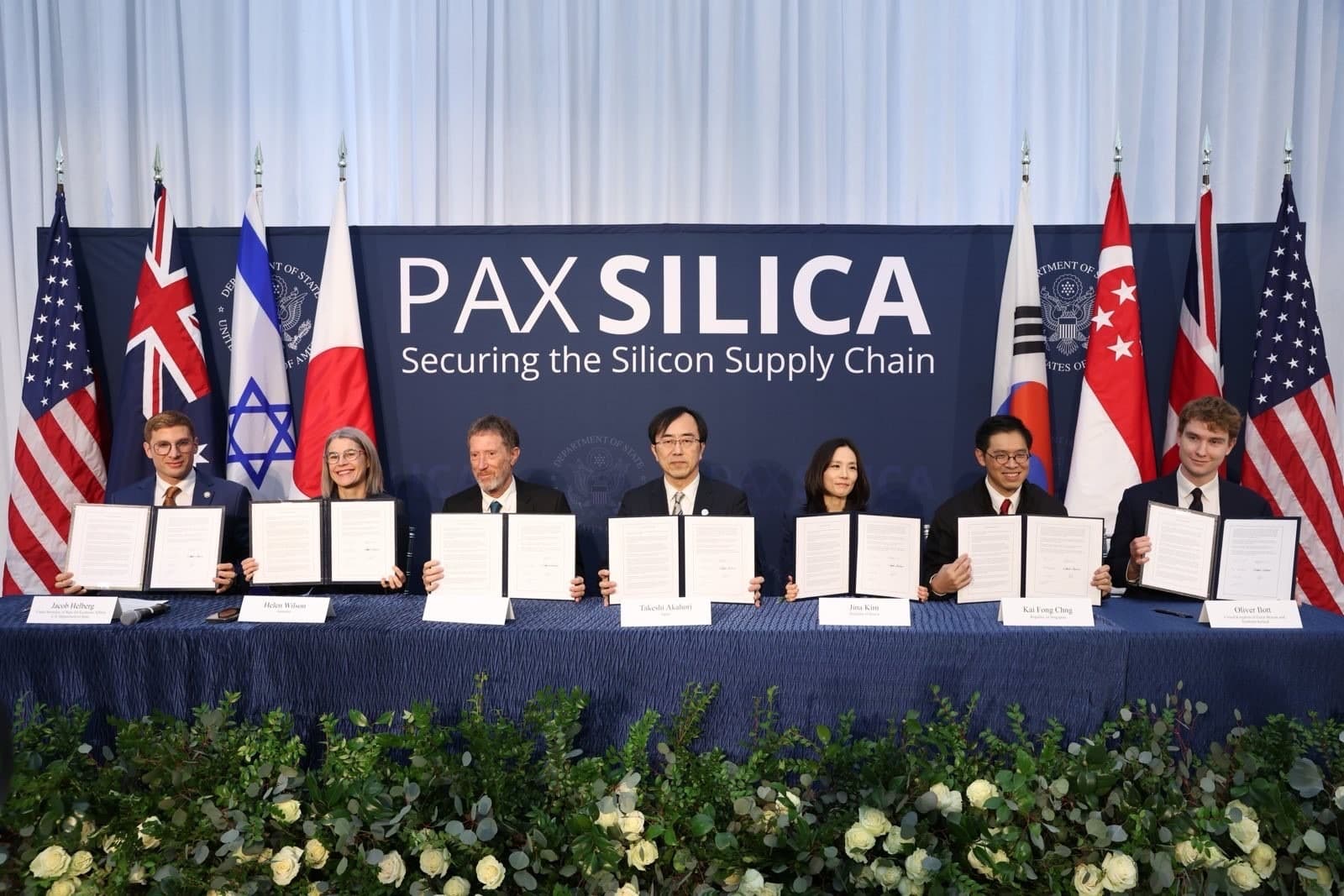
The State Department set a two-day Pax Silica summit for June 25-26 in Washington, pushing its flagship AI and supply-chain security effort as allies move to reduce exposure to China-linked chokepoints. The initiative aims to secure the minerals, energy, processing and manufacturing that make those systems possible.
Pax Silica covers the full AI stack, from energy and critical minerals to minerals refining and processing, advanced manufacturing, transportation logistics, compute, semiconductors, AI infrastructure, software platforms and frontier foundation models. That means the United States and its partners are trying to protect the upstream inputs behind advanced computer chips and the downstream systems that turn those chips into deployable AI models.
The initiative launched in December 2025, when Australia, Japan, South Korea, the United Kingdom, Singapore, Israel and the United States signed the Pax Silica Declaration at a founding summit in Washington, D.C. The State Department cast the project as a “positive-sum partnership” built to reduce coercive dependencies and protect the materials and capabilities foundational to artificial intelligence rather than isolate other countries.
By late June, the coalition had expanded further. The European Union, Germany, the Netherlands and Greece were joining Pax Silica, and the group could grow to 24 member countries once the new memberships were finalized. Jacob Helberg, the Under Secretary of State for Economic Affairs and one of the initiative’s principal architects, cast Pax Silica as an American alternative to the UN’s Global Digital Compact and to the idea of “digital sovereignty,” arguing that duplicated national systems can waste money and slow investment.
This article was produced by Prism’s automated news system from verified source data, official records, and press releases, then run through automated quality and moderation checks before publishing. The system is built and supervised by the people who set the standards it runs under. Read our full AI policy.
Did this article answer your question?


