U.S. Mediates Israel-Syria Deal to Set Up Communication Mechanism
Israel and Syria agreed in U.S.-mediated talks in Paris to establish a supervised communication mechanism for intelligence sharing, military de-escalation, diplomatic engagement and commercial cooperation, a joint U.S. State Department statement said. The move could reduce immediate cross-border tensions and open conditional pathways for economic engagement, but key questions on suspension of Israeli military activity and operational details remain unresolved.

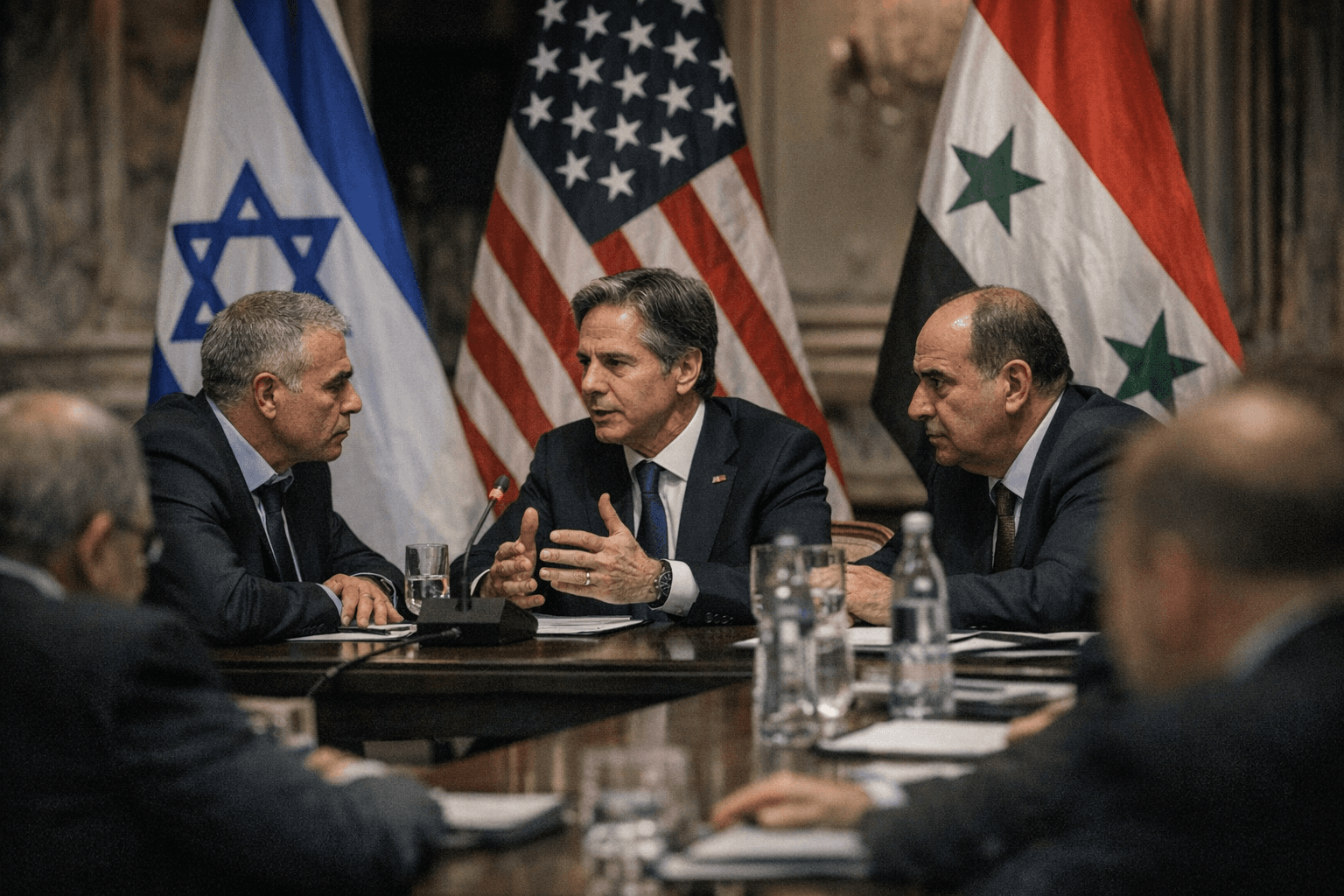
U.S.-mediated discussions in Paris on Monday and Tuesday produced an agreement for Israel and Syria to create a formal communication mechanism under U.S. supervision, the State Department said in a joint statement released Tuesday. The arrangement is designed to facilitate immediate and ongoing coordination on intelligence sharing, military de-escalation, diplomatic engagement and commercial opportunities, but it contains no published timetable or operational specifics.
The Paris talks brought together senior Syrian figures reported to include Foreign Minister Asaad al-Shibani and Hussein Salameh, head of Syria’s General Intelligence Directorate, and were carried out with active U.S. mediation and parallel French diplomatic engagement. Israeli officials framed their participation around security concerns and potential economic cooperation, yet Israel did not confirm any suspension of military operations. Syrian officials, by contrast, characterized the talks as paving the way to reactivate the 1974 disengagement understanding that created a U.N.-monitored buffer zone, and one anonymous Syrian official said the round produced an initiative to suspend all Israeli military activities. That claim was not confirmed by Israeli authorities.
The immediate significance of the mechanism is practical: a supervised line of communication could reduce the likelihood of miscalculation and lower the tempo of cross-border strikes that have punctuated northeastern Syria in recent months. Restoring elements of the 1974 framework and a U.N.-patrolled buffer zone were central Syrian aims, including the withdrawal of Israeli forces from territory Damascus says Israel seized more than a year ago. How those objectives translate into on-the-ground changes will depend on technical arrangements that the joint statement did not specify.
From a policy perspective, U.S. supervision signals Washington's intent to anchor any rapprochement and to exercise leverage through monitoring and facilitation. That structure increases the prospects for incremental confidence building, but it also hands the United States responsibility for verification and crisis management in a volatile corridor. French engagement in parallel talks reinforces Western diplomatic investment, but Geneva-style constraints and lingering political mistrust could slow movement from a communication channel to a comprehensive security pact.
Economic implications are conditional but meaningful. The joint statement explicitly referenced commercial opportunities as an area for coordination, opening the possibility that limited trade and reconstruction contracts could follow de-escalation. Investment flows into Syria, however, would remain constrained by sanctions, legal uncertainty and political risk unless broader diplomatic normalization occurs. Energy markets and regional risk premia typically react to shifts in cross-border violence; a credible reduction in strikes could modestly lower short-term market volatility, while a collapse of the talks would do the opposite.
Observers regard the mechanism as a potential first step toward a broader security arrangement, but political and technical hurdles are acute. Israel’s insistence on security safeguards, Syrian demands for withdrawal and reactivation of the 1974 buffer zone, and the absence of a clear timetable mean that the mechanism’s impact will be determined in coming weeks and months. For now, the Paris outcome is a calibrated opening, not a settlement, that places near-term responsibility on Washington to operationalize what diplomats have set down on paper.
This article was produced by Prism’s automated news system from verified source data, official records, and press releases, then run through automated quality and moderation checks before publishing. The system is built and supervised by the people who set the standards it runs under. Read our full AI policy.
Did this article answer your question?


