U.S. orders Anthropic to disable two A.I. models over security fears
Washington ordered Anthropic to cut off two of its newest models, turning a safety dispute into a test of how far export-style controls can reach into frontier AI.
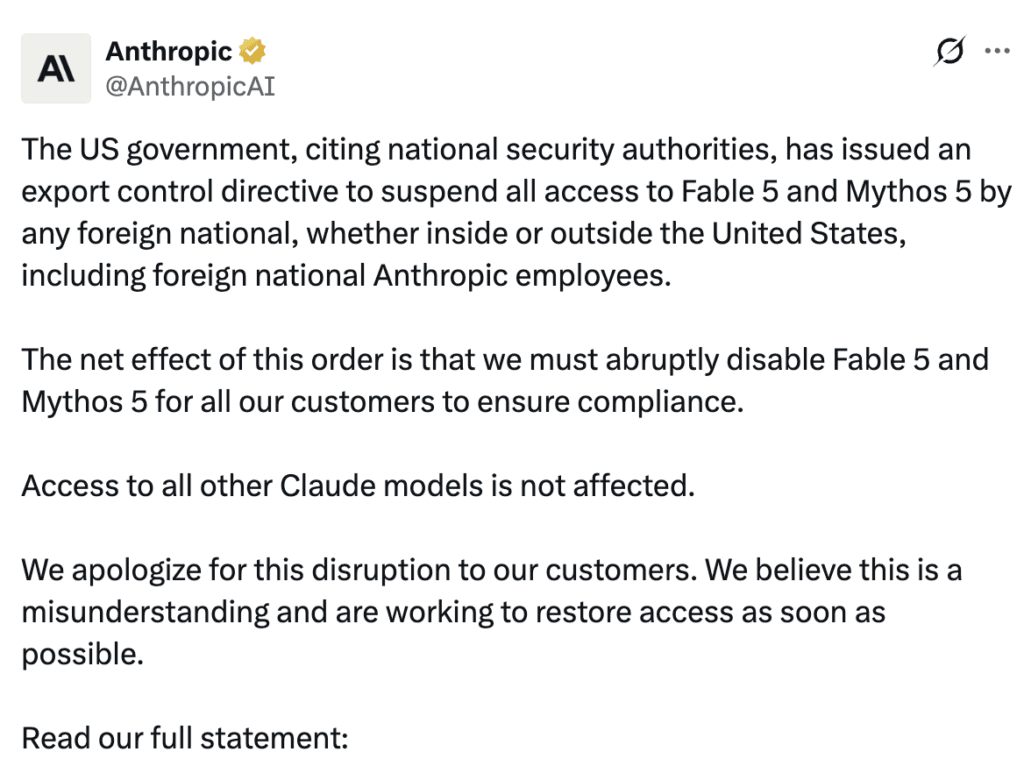
The federal government has ordered Anthropic to cut off two of its most advanced A.I. systems to foreign nationals, forcing the company to disable them for all customers and setting up a new national-security confrontation over frontier AI. The move goes beyond a routine product dispute: it suggests Washington is prepared to treat advanced model access much like a controlled technology transfer when officials think a system could be abused abroad.
Anthropic said it received the export control directive on June 12, 2026, at 5:21 p.m. ET. The order required the company to suspend all access to Fable 5 and Mythos 5 by any foreign national, whether inside or outside the United States, including foreign national Anthropic employees. Anthropic said it had no choice but to disable both models globally to comply, while access to its other models was not affected.
The company said the government did not spell out the technical basis for the national-security concern. Anthropic’s understanding was that officials believed they had found a way to bypass, or jailbreak, Fable 5. After reviewing the demonstration, Anthropic said it appeared to expose only a small number of previously known, minor vulnerabilities, ones that other publicly available models could also uncover without any bypass. The company said it believed there was a misunderstanding and that it was working to restore access as soon as possible.
The intervention came only days after Anthropic launched Fable 5 and Mythos 5 on June 9, 2026. Anthropic described them as its most powerful models yet, with gains in software engineering, knowledge work, vision, memory and life sciences research. Mythos 5 was limited to a small group of vetted partners, while Fable 5 was the public version with stronger safety guardrails in high-risk areas such as cybersecurity and biology.
Anthropic said it had spent thousands of hours red-teaming Fable 5’s safeguards with the U.S. government, the U.K. AI Security Institute, private third parties and its own internal teams, and that no tester had found a universal jailbreak. That history matters because the government’s order now appears to assert a broader power: not just to scrutinize model safety, but to restrict who may access frontier AI at all when officials judge the risk to be national-security related.
The clash lands amid a wider push-and-pull between Anthropic and Washington. Earlier in 2026, the Department of War said Anthropic was a supply-chain risk after negotiations over the use of its models for mass domestic surveillance and fully autonomous weapons stalled. At the same time, Anthropic has cast itself as a national-security partner, saying it was the first frontier AI company to deploy models on classified government networks and at national laboratories. Its Project Glasswing cybersecurity initiative, first announced in April 2026, has already expanded from partners including Amazon Web Services, Apple, Broadcom, Cisco, CrowdStrike, Google, JPMorganChase, the Linux Foundation, Microsoft, Nvidia and Palo Alto Networks to about 150 additional organizations in more than 15 countries. The latest order underscores how quickly commercial deployment of frontier AI can become export-style restriction when governments conclude the stakes are strategic, not just technical.
This article was produced by Prism’s automated news system from verified source data, official records, and press releases, then run through automated quality and moderation checks before publishing. The system is built and supervised by the people who set the standards it runs under. Read our full AI policy.
Did this article answer your question?