U.S. pauses Taiwan arms sales to preserve munitions for Iran
The Pentagon put a $14 billion Taiwan weapons sale on hold so missiles and interceptors could be reserved for Iran operations, deepening doubts in Taipei and on Capitol Hill.

The Trump administration’s decision to put Taiwan arms sales on pause exposed a hard tradeoff at the center of U.S. power projection: munitions sent to one conflict can leave another theater less protected. Acting Navy Secretary Hung Cao told a Senate Appropriations Defense Subcommittee hearing on Capitol Hill that the hold was meant to make sure the U.S. had enough munitions for its Iran operations, even as he said the military still had “plenty” of missiles and interceptors.
The pause has been described as affecting a proposed $14 billion arms sale to Taiwan, a package that would have been one of the most consequential signals of U.S. backing for the island in years. Cao told Sen. Mitch McConnell that the administration was doing the pause “in order to make sure we have the munitions we need for Epic Fury,” while saying the foreign military sales process would resume when the administration deemed it necessary. The State Department and the Pentagon did not immediately respond to requests for comment.
For Taiwan, the timing cut sharply against an already tense backdrop. Taiwan is a self-ruled democracy that Beijing claims as its own territory, and U.S. arms sales are a central part of Washington’s legal and strategic support under the Taiwan Relations Act. Just days earlier, President Donald Trump said he had discussed U.S. arms sales to Taiwan with Chinese President Xi Jinping and would decide soon whether to move ahead, then later suggested he had not yet approved the package.
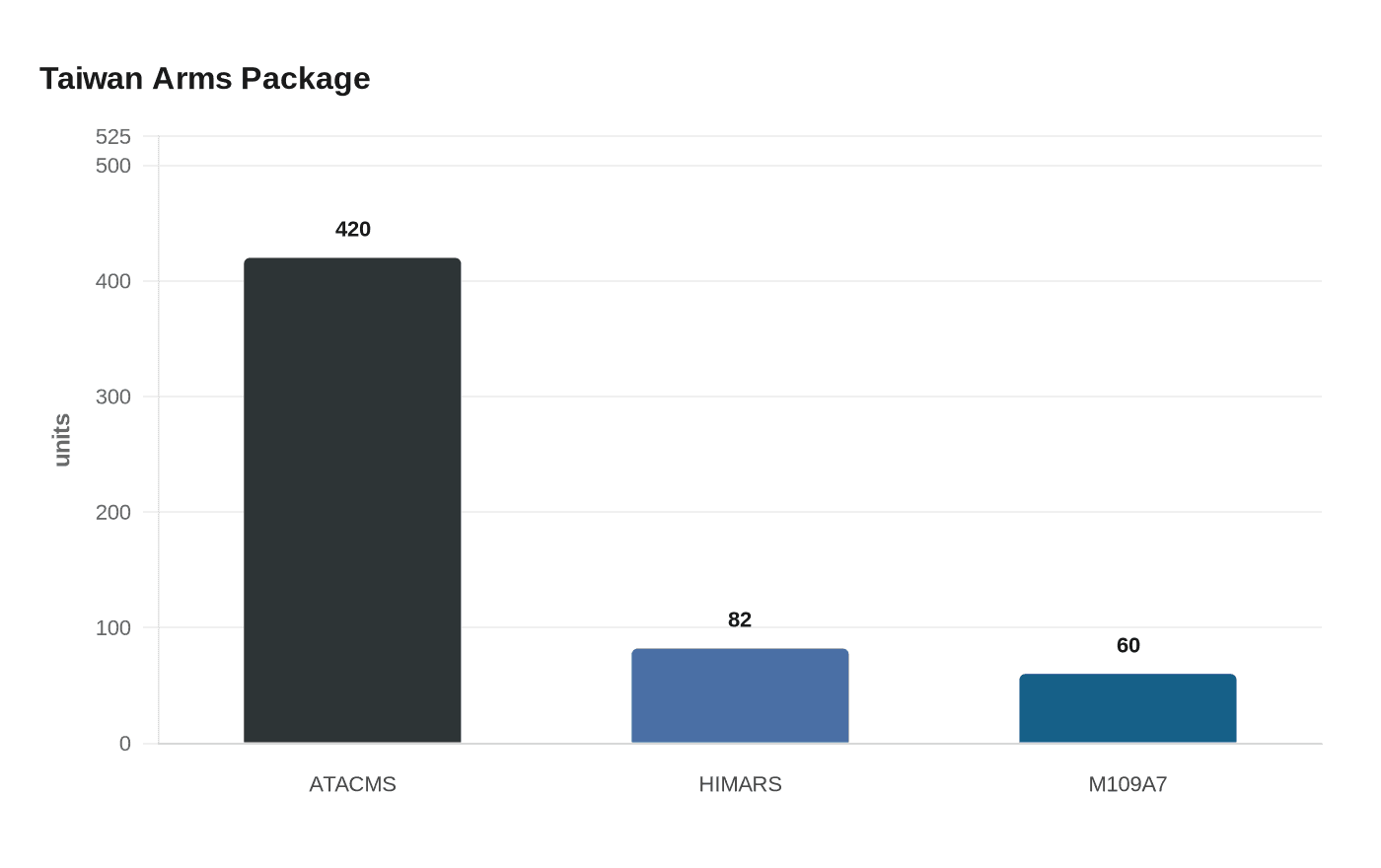
The latest pause lands after Washington announced a record $11.1 billion arms package for Taiwan on Dec. 17, 2025, the largest-ever U.S. weapons package for the island. That sale included 82 HIMARS rocket systems, 420 ATACMS missile systems, 60 M109A7 self-propelled howitzers, loitering munitions, Javelin missiles and TOW missiles, underscoring how much Taiwan’s defense planning depends on a steady flow of advanced weapons. Chinese officials condemned that package, saying it violated the one-China principle.
In Taipei, the concern is not just whether weapons arrive, but whether they become leverage in a broader U.S.-China bargain. Taiwan’s government had said it was “cautiously optimistic” about U.S. arms sales and insisted it would not be sacrificed or traded. That message now carries added weight as lawmakers in Washington, D.C., confront a familiar strategic problem: if the U.S. cannot produce and replenish munitions fast enough, support for Ukraine, deterrence in Asia and readiness for Iran-related operations all start competing for the same stockpiles.
Know something we missed? Have a correction or additional information?
Submit a Tip