U.S. payrolls fall 92,000 in February as unemployment rises to 4.4%
BLS reports a 92,000 payroll loss and unemployment at 4.4%, a cooling labor market that could keep the Fed cautious on rate cuts.

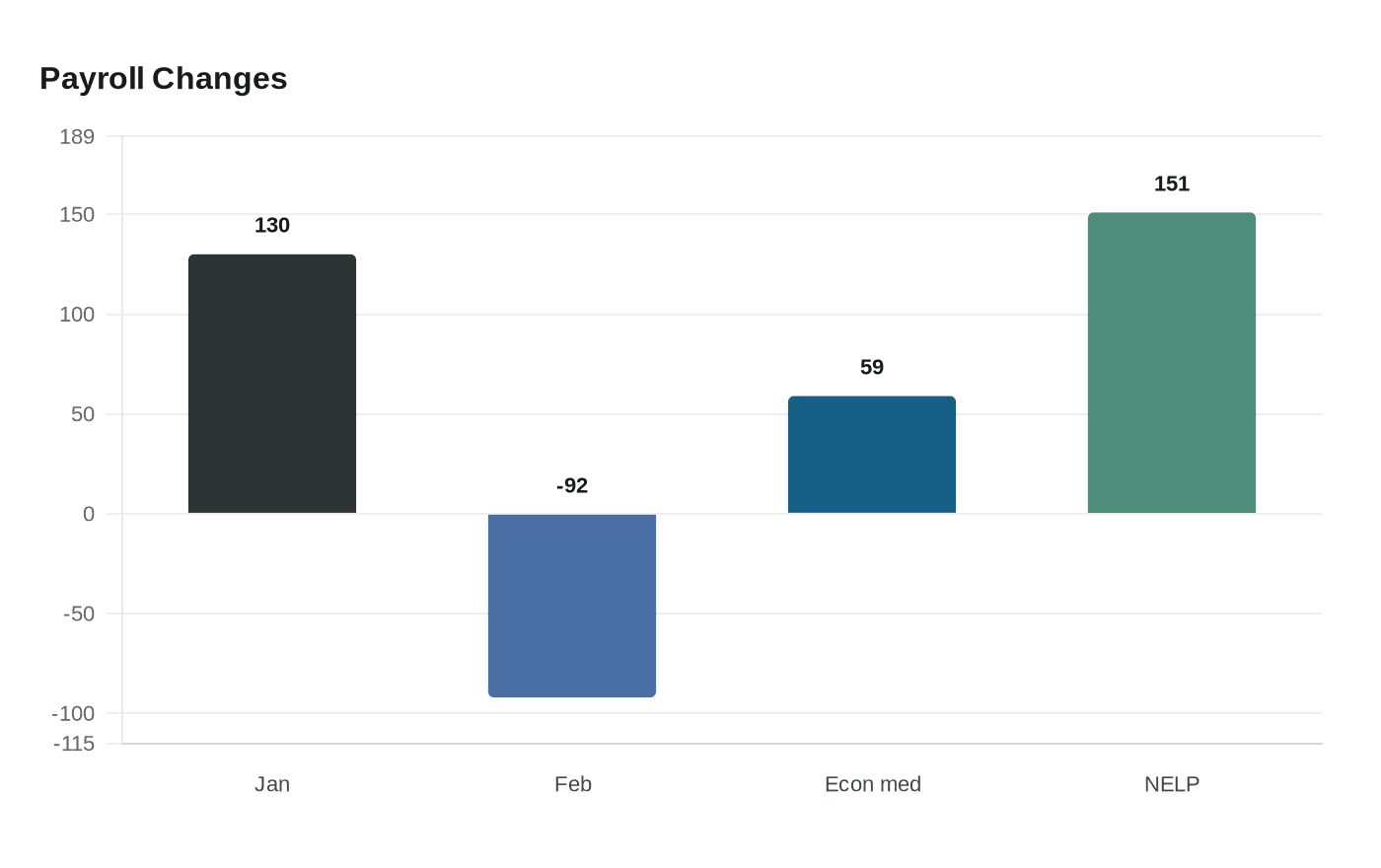
The U.S. economy shed 92,000 nonfarm payroll jobs in February and the unemployment rate rose to 4.4 percent, the Bureau of Labor Statistics said in its March 6 Employment Situation release, with losses concentrated in health care. The official print marks a clear slowdown from January’s 130,000 gain and weakens the labor market backdrop heading into central bank deliberations.
The BLS tally conflicts sharply with a National Employment Law Project news release that said, “Nationwide, In February, the economy added 151,000 jobs while the unemployment rate inched up to 4.1%,” and that 7 million workers were unemployed. NELP also highlighted recent federal personnel actions, saying the month’s numbers “do indicate a loss of 10,000 federal jobs” but do not reflect “all of the thousands of probationary federal employees fired in mid-February by the Trump administration because of a lag in federal payrolls.” NELP further said a federal judge “recently ruled that the Office of Personnel Management lacks the legal authority to order these mass firings,” and urged affected workers to apply for unemployment insurance immediately.
Economists had broadly expected hiring to slow but not reverse: a survey of economists produced a median forecast of about a 59,000 payroll gain for February, with estimates ranging from a 9,000-job loss to a 125,000 increase. Analysts point to several measurement and transitory factors that help explain the swings. Health-care payrolls surged by 82,000 in January, more than double the 2025 monthly average of 33,000, and economists say an update to the BLS birth-and-death model may have added roughly 70,000 jobs to January’s figures, inflating the baseline that February would normalize against. A strike affecting about 31,000 health-care workers in California and Hawaii and harsh winter weather were also cited as possible near-term drags on payrolls.
The softer-than-expected report has policy and market implications. Economists warned the print would “reinforce views that the Federal Reserve was in no rush to resume cutting interest rates” given lingering inflation risks and geopolitical uncertainty. Gus Faucher, chief economist at PNC Financial, said, “We have a job market that is in solid shape, but it's not as good as it was in 2023 and 2024. The war just creates additional uncertainty, businesses are already cautious, and maybe they become even more cautious. The economy is vulnerable.”
Beyond the headline conflict, the data sharpen political and policy debates. NELP used the release to press for federal unemployment insurance reform, calling for reintroduction of the Unemployment Insurance Modernization and Recession Readiness Act previously advanced by Senators Ron Wyden and Michael Bennet and Representative Don Beyer; NELP outlined provisions including a 26-week minimum benefit, higher replacement rates, expanded coverage for part-time and temporary workers, and a federally funded Jobseekers Allowance.
For workers and markets the takeaway is one of increased uncertainty: payrolls look weaker than expected, sector patterns, particularly in health care, are volatile, and measurement quirks complicate trend-reading. Policymakers will watch whether the slowdown extends beyond February or simply reflects short-term adjustments and data revisions.
This article was produced by Prism’s automated news system from verified source data, official records, and press releases, then run through automated quality and moderation checks before publishing. The system is built and supervised by the people who set the standards it runs under. Read our full AI policy.
Did this article answer your question?

