U.S., Qatar dominate LNG market as global trade tops 411 million tonnes
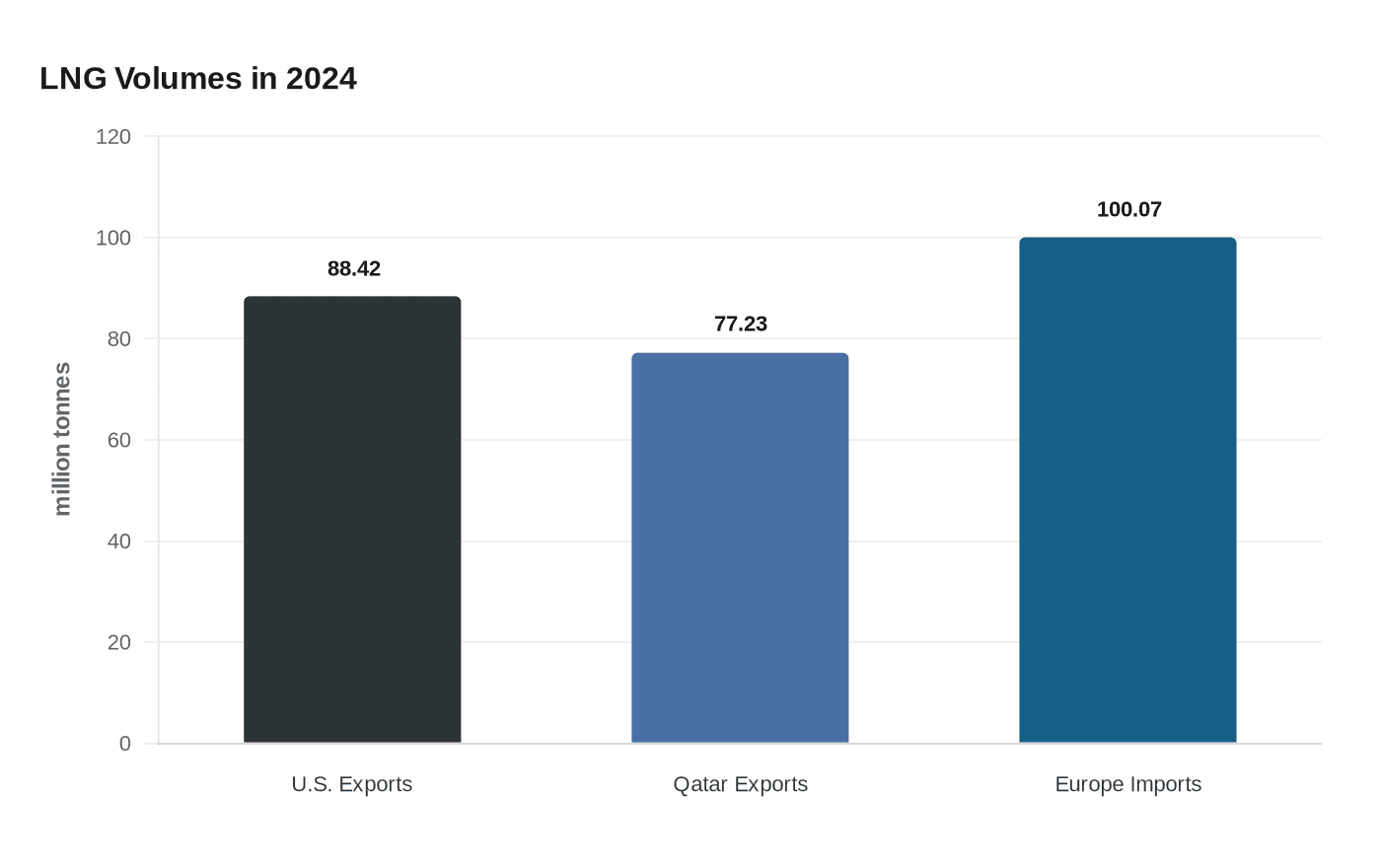
The LNG market now hinges on a few giant exporters: the U.S. shipped 88.42 million tonnes in 2024, while Qatar’s supply chain proved how a single disruption can rattle prices.
The world’s LNG trade crossed 411.24 million tonnes in 2024, but the market’s center of gravity sat with just a handful of super-exporters. The United States, Australia and Qatar together accounted for about 60% of global LNG exports, leaving importers exposed to any disruption in one of the system’s few dominant supply hubs.
The United States stayed the largest LNG exporter in 2024 at 11.9 Bcf/d, or 88.42 million tonnes, equal to 21.5% of global LNG output. Qatar exported 77.23 million tonnes, an 18.8% share, while Australia remained close behind and broadly stable through 2020 to 2024 at roughly 10.2 to 10.7 Bcf/d. That concentration mattered in 2023 as well, when the United States became the world’s largest LNG exporter and the top three suppliers again controlled 60% of the market.
That dominance has created a new kind of fragility. The International Energy Agency said the gas shock triggered by Russia’s invasion of Ukraine in February 2022 sent prices soaring and tightened the market across Europe and beyond. LNG cargoes helped replace some of the lost Russian pipeline gas, but the agency said LNG flexibility did not fully offset the disruption, leaving the global gas system more structurally and geopolitically fragile.

Europe remains the clearest example of that dependence. In 2024, it was still the primary destination for U.S. LNG exports, taking 53% of the total, even as those shipments fell 19% year on year, or 1.5 Bcf/d, as mild weather kept storage high and demand soft. The International Gas Union said European LNG imports fell 21.22 million tonnes to 100.07 million tonnes in 2024, reflecting high inventories, sluggish consumption and steady pipeline flows.
Qatar’s role is even more concentrated. All of its LNG exports transit the Strait of Hormuz, a chokepoint that turns any regional shock into a global supply risk. That vulnerability was underlined in March 2026, when Qatar declared force majeure after attacks hit its gas liquefaction system and European gas prices jumped on fears of a prolonged outage at the world’s largest LNG export plant.
QatarEnergy is still betting on expansion. Its North Field Expansion Project is scheduled to start production in 2026 and add more than 48 MTPA by 2027, lifting Qatar’s LNG production capacity to 126 MTPA. For buyers, that means more supply later, but it also confirms the deeper problem: the world has come to rely on a narrow club of exporters to carry a fuel market that now underpins energy security, industrial planning and price stability from Doha to Europe.
This article was produced by Prism’s automated news system from verified source data, official records, and press releases, then run through automated quality and moderation checks before publishing. The system is built and supervised by the people who set the standards it runs under. Read our full AI policy.
Did this article answer your question?
%3Amax_bytes(150000)%3Astrip_icc()%2FCertificate-of-deposit-2301f2164ceb4e91b100cb92aa6f868a.jpg&w=1920&q=75)