U.S. student achievement has been sliding since 2013, report says
Math scores are down in 70% of districts and reading in 83%, with the slide beginning around 2013, years before COVID-19 closed schools.

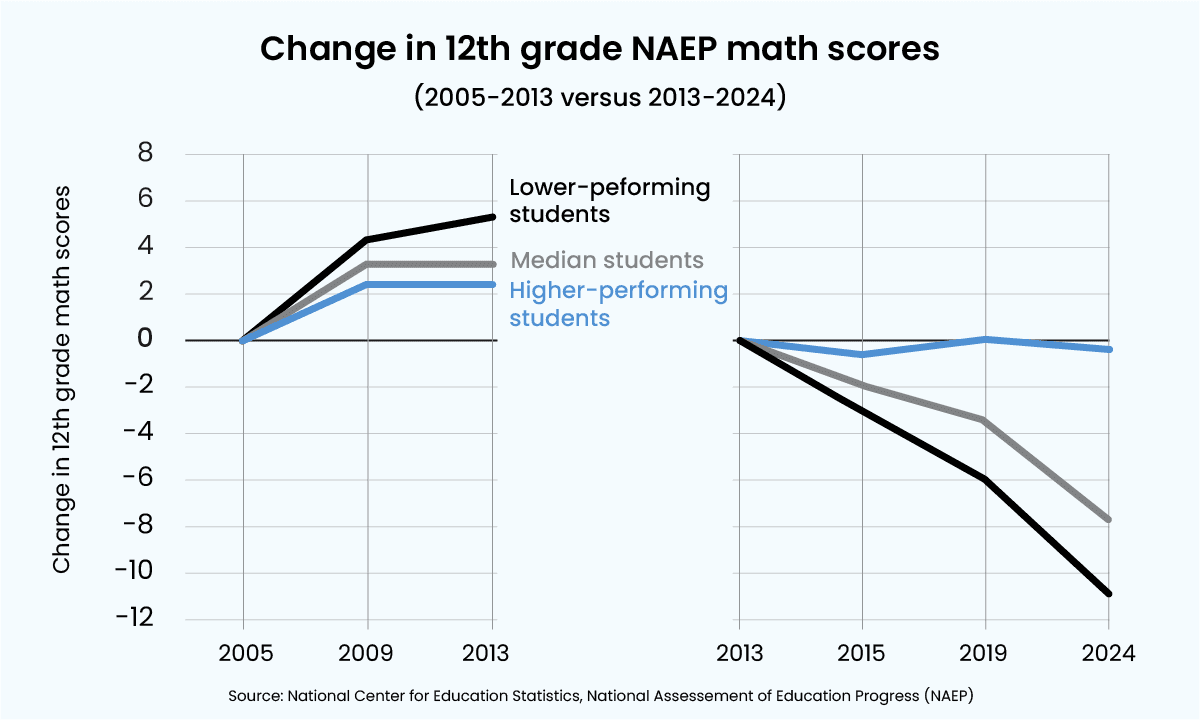
U.S. student achievement was already in retreat before the pandemic, and the latest district-level data suggest the damage has been broad, persistent and uneven. Across roughly 35 million grade 3-8 students, math scores are down in 70% of school districts and reading scores are down in 83%, with eighth-grade reading now at its lowest level since 1990.
The Education Scorecard said students entered a “learning recession” in 2013, after two decades of gains. Harvard education professor Thomas J. Kane said the pandemic was less the origin of the problem than a “mudslide” that followed years of erosion in student performance, while warning that lawmakers effectively “turned off the smoke alarms” when they dismantled test-based accountability at the end of No Child Left Behind. The report links that shift to a period when children’s out-of-school time was increasingly absorbed by smartphones and social media.
Sean F. Reardon of Stanford said the longer view is striking: math and reading improved dramatically from the early 1990s through 2013, including gains of more than two grade levels in math. After that, the trend reversed. The report found the average annual decline in reading from 2017 to 2019 was as large as during the pandemic years of 2019 to 2022, underscoring that the loss of ground had already accelerated before classrooms closed.
The latest analysis, which covers the 2024-25 school year, showed only modest improvement since 2022, not enough to claw back the losses of the past decade. Harvard and Stanford researchers said the recovery has been “U-shaped,” with the largest gains in the highest- and lowest-income districts and weaker progress in middle-income districts. The Education Scorecard also identified 108 “Districts on the Rise,” a sign that some systems are making durable gains in reading and math relative to similar districts.

Attendance remains one of the clearest barriers to recovery. Harvard’s summary said 23% of students were chronically absent in 2024-25, up from 15% before the pandemic, and RAND found that in roughly half of urban school districts, more than 30% of students were chronically absent last year. The report’s authors say the most credible fixes are not slogans about rigor, but evidence-based changes: stronger literacy instruction, reductions in absenteeism and renewed accountability. Early evidence on phone bans appears to show only modest benefits, suggesting that devices matter, but only as part of a larger education system problem that began well before COVID-19.
This article was produced by Prism’s automated news system from verified source data, official records, and press releases, then run through automated quality and moderation checks before publishing. The system is built and supervised by the people who set the standards it runs under. Read our full AI policy.
Did this article answer your question?