U.S. Troops Deploy to Middle East as DHS Funding Talks Continue
Up to 3,000 paratroopers from Fort Bragg's 82nd Airborne have been ordered to the Middle East as the Iran war enters its fourth week, while Senate Republicans push a new DHS funding deal amid growing airport chaos.
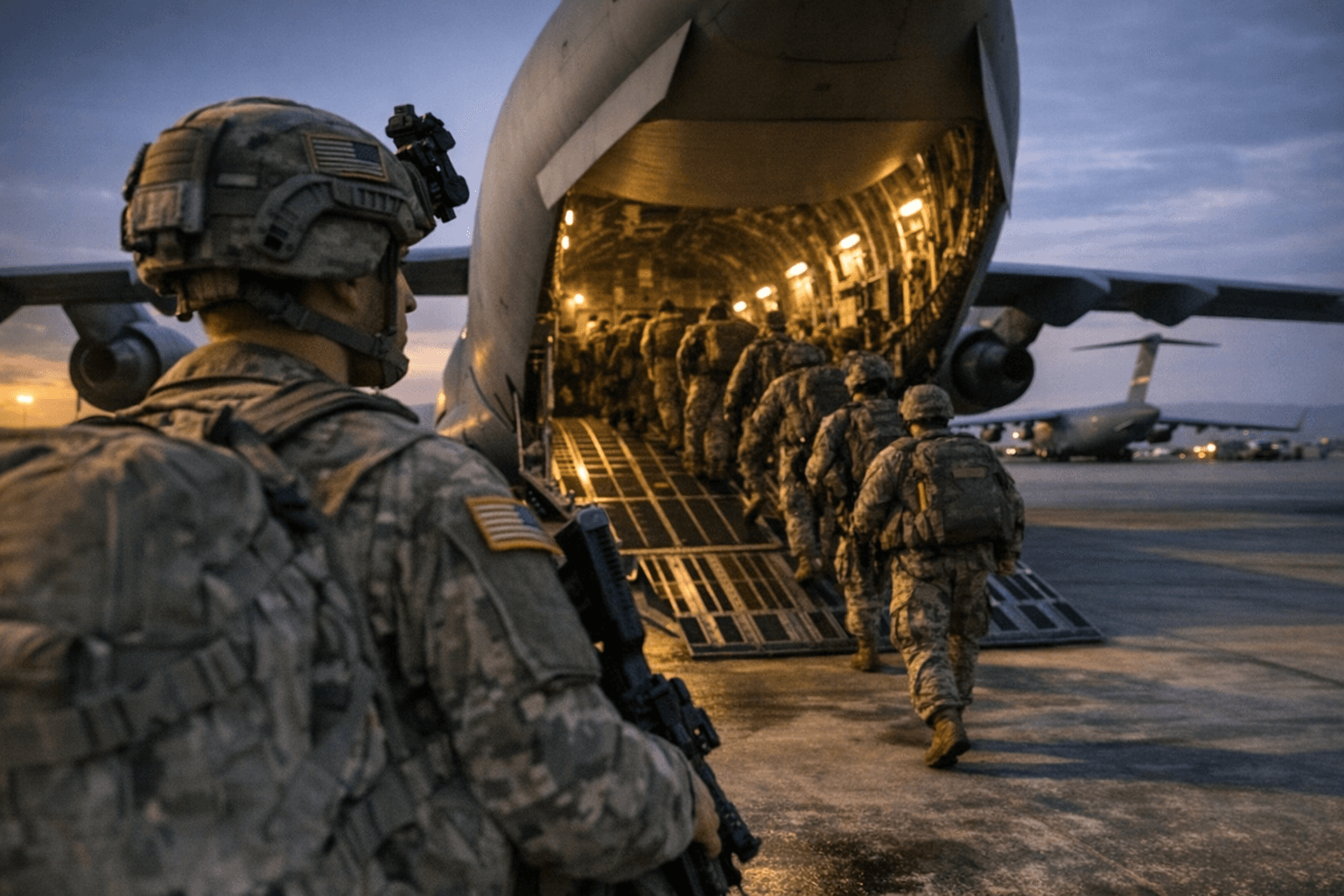
Paratroopers from the 82nd Airborne Division at Fort Bragg received orders Tuesday to deploy to the Middle East, a significant escalation in U.S. force posture as the war with Iran stretches into its fourth week and diplomatic signals remain deeply mixed.
Between 2,000 and 3,000 Army paratroopers from the 82nd Airborne Division received written orders to deploy to the Middle East, according to a U.S. government official who was not authorized to speak publicly. Reuters, citing anonymous officials, reported the figure as between 3,000 and 4,000. CBS News put the number lower, reporting that the deployment was expected to be fewer than 1,500 troops, citing a U.S. official. The Pentagon has not issued an on-record figure, and the discrepancy across outlets reflects the ongoing uncertainty around the scope of the movement.
The soldiers are being drawn from the 82nd Airborne's quick-reaction brigade known as the Immediate Response Force, designed to mobilize anywhere in the world in 18 hours. The contingent headed to the Middle East includes two battalions of roughly 800 soldiers each along with the division's commander, Maj. Gen. Brandon Tegtmeier, and supporting staff.
The Pentagon is expected to send parts of the 82nd Airborne division to the Middle East as the Iran war extends into its fourth week. Sources told Reuters that officials speaking on condition of anonymity did not specify where the Army troops would go or when they would arrive, and that no decision has been made to send troops on the ground into Iran. CBS News reported separately that senior military commanders had submitted specific requests aimed at preparing for the use of ground troops in the Iran conflict. Both statements can hold simultaneously: planning can proceed while no final authorization has been issued.
The troop movement follows a significant Marine buildup already underway. Thousands more U.S. forces are coming to the region in addition to the 82nd Airborne. Two Marine Expeditionary Units and Amphibious Ready Groups have recently deployed to the region. The 11th MEU and Boxer Amphibious Ready Group were having their scheduled deployments accelerated and rerouted from the Indo-Pacific to the Middle East. The U.S. is preparing to deploy up to 3,000 paratroopers to supplement some 50,000 troops already present in the Middle East.
The air campaign has been staggering in scale. According to U.S. Central Command figures reported by CBS News, the U.S. has carried out over 9,000 combat flights in Iran, striking more than 9,000 military targets including IRGC headquarters buildings, ballistic missile sites, missile defense systems, military manufacturing facilities, and Iranian navy vessels. So far, 13 U.S. troops have been killed in action and at least 290 have been wounded.
On the diplomatic front, the picture is fractured. President Trump said Tuesday that direct negotiations with Iran are underway, naming Secretary of State Marco Rubio, Vice President Vance, special envoy Steve Witkoff, and Jared Kushner among those involved. Trump said of Iran, "The other side, I can tell you, they'd like to make a deal." Iranian Foreign Ministry spokesperson Esmaeil Baghaei told a television channel Wednesday that "there is no talks or negotiations between Iran and the United States," and that there have "not been such negotiations for the past 25 days of the illegal war against Iran."
When asked about the troop deployment, the Pentagon deferred questions to the White House. A White House spokesperson told CBS News that announcements about troop deployments would come from the Pentagon, completing a full circle with no official statement from either office.
On Capitol Hill, Senate Republicans sent Democrats a new proposal Tuesday to end the partial shutdown of the Department of Homeland Security, which has led to long lines at airport security in recent days and has forced many of the agency's employees to go without pay for more than a month. The deal would fund most of the DHS, except for a portion of the Immigration and Customs Enforcement budget. Senate Democrats confirmed they received the offer and said they would counter.
Momentum toward reopening DHS evaporated Tuesday as Democrats drew a hard line on reforms to ICE, swiftly rejecting a proposal that GOP senators had only just persuaded President Trump to entertain. The Department of Homeland Security has been shut down for more than five weeks. Senate Majority Leader John Thune said at a press conference Tuesday that "Democrats have in front of them" the legislative text of the proposal. "The time to end this is now," Thune said. Senate Minority Leader Chuck Schumer indicated Democrats would not accept the offer without ICE reforms, setting up continued negotiations with a two-week congressional recess looming at week's end.
Know something we missed? Have a correction or additional information?
Submit a Tip