USDA confirms rare Texas screwworm cases, launches national response
Texas ranchers face drought and a rare screwworm return: USDA confirmed two calf cases in Zavala County and is dispersing 100 million sterile insects a week.
Ranchers in South Texas are dealing with more than dry pastures and early cattle sales. A rare New World screwworm has reappeared in Texas, and USDA is trying to stop the parasite before it spreads beyond a handful of cases and into the nation’s beef supply.
USDA confirmed a screwworm in a 3-week-old calf in Zavala County on June 3, with larvae found in the animal’s umbilical area. Two days later, the agency confirmed a second Texas case near the first detection, escalating concern that the parasite has crossed into U.S. livestock after decades of absence. USDA says the fly can infect livestock, pets, wildlife and, less commonly, people and birds, and that its larvae burrow into living flesh, causing serious damage and economic losses.
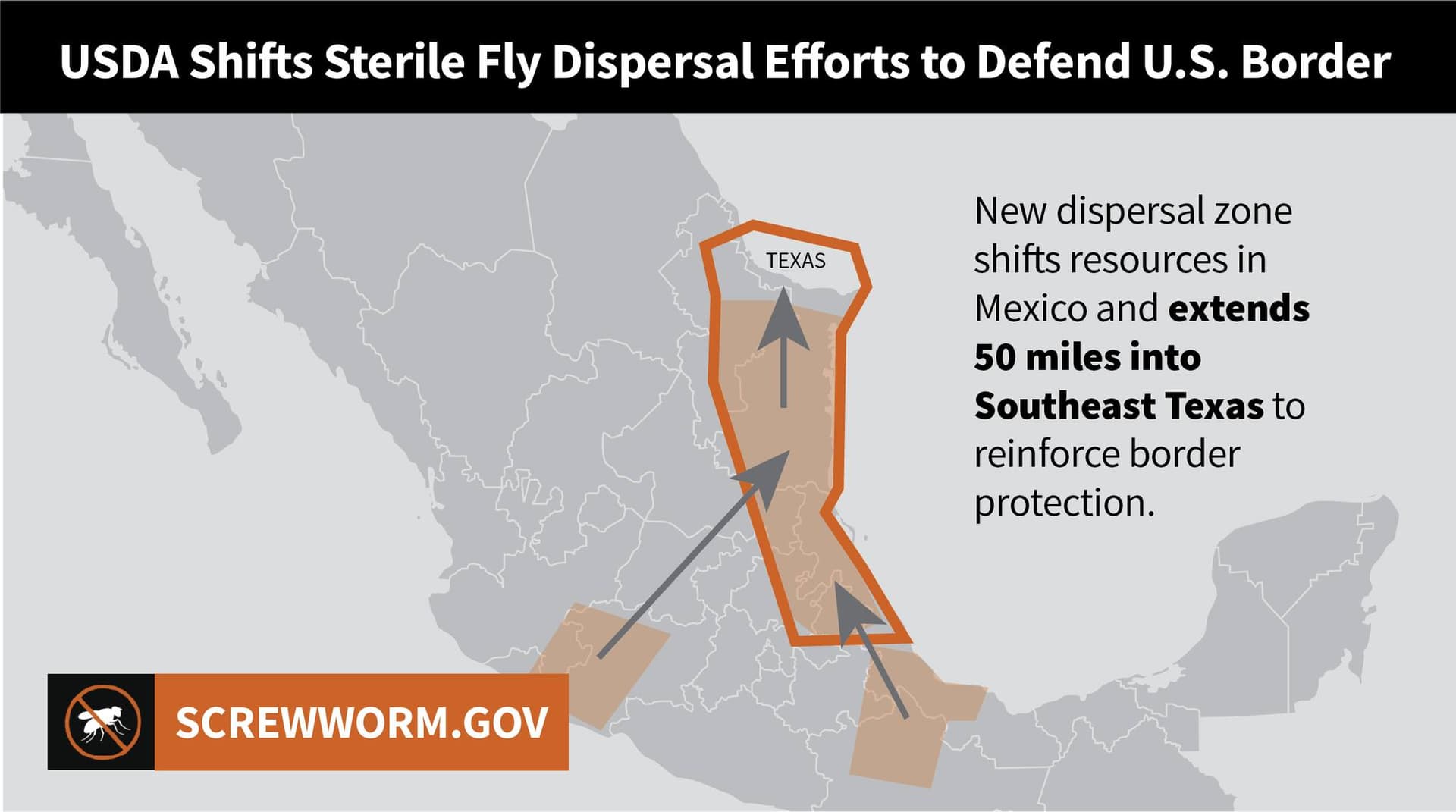
The response is already national in scope. USDA says it is dispersing 100 million sterile insects per week in Mexico and along the U.S.-Mexico border, part of the same sterile insect technique that helped drive New World screwworm out of the United States in 1966. The original U.S. eradication campaign began in 1957, and the return of the pest to Texas has revived memories in ranching families who remember how much damage the fly once caused to domestic and wild animals.
The threat had been building for months. Mexico confirmed a case in Sabinas Hidalgo, Nuevo León, on Sept. 21, 2025, less than 70 miles from the U.S. border, showing how close the pest had already moved. USDA shifted sterile fly dispersal efforts on Jan. 30, 2026, to reinforce coverage along the border, and on June 5 updated its status page with detection information for the United States, Mexico and Central America.

The outbreak has landed at the same time cattle producers are already under pressure from drought and feed shortages that are forcing animals to market earlier than planned. Texas A&M AgriLife said after the first Texas detection that the state was not in crisis mode, but entering a period of heightened awareness and coordinated response. USDA opened the Knipling-Bushland U.S. Livestock Insects Research Laboratory in Kerrville on May 27 to develop tools against insect pests, underscoring how quickly the animal-health issue has moved up the agenda.
The economic stakes stretch well beyond one county. APHIS and state officials are trying to keep the parasite from regaining a foothold in the United States, where a broader outbreak could raise costs for ranchers, tighten cattle supplies and ripple through meat markets. Bloomberg reported that feeder cattle futures jumped after the Texas case, a sign that traders see the threat as more than a veterinary problem. Texas Gov. Greg Abbott has pressed for a faster fly-breeding factory, arguing the current pace is too slow for a pest that can turn animal-health risk into a national food and trade issue.
This article was produced by Prism’s automated news system from verified source data, official records, and press releases, then run through automated quality and moderation checks before publishing. The system is built and supervised by the people who set the standards it runs under. Read our full AI policy.
Did this article answer your question?