USS Tripoli Delivers 3,500 Troops to Middle East Amid Iran Campaign
Secretary Rubio says no ground troops needed, but USS Tripoli just delivered 3,500 sailors and Marines carrying F-35Bs and amphibious assault craft to CENTCOM waters.
Marco Rubio told the world the United States would not put boots on Iranian soil. Then the Navy dispatched a three-ship strike force from Japan that can do nearly everything else.
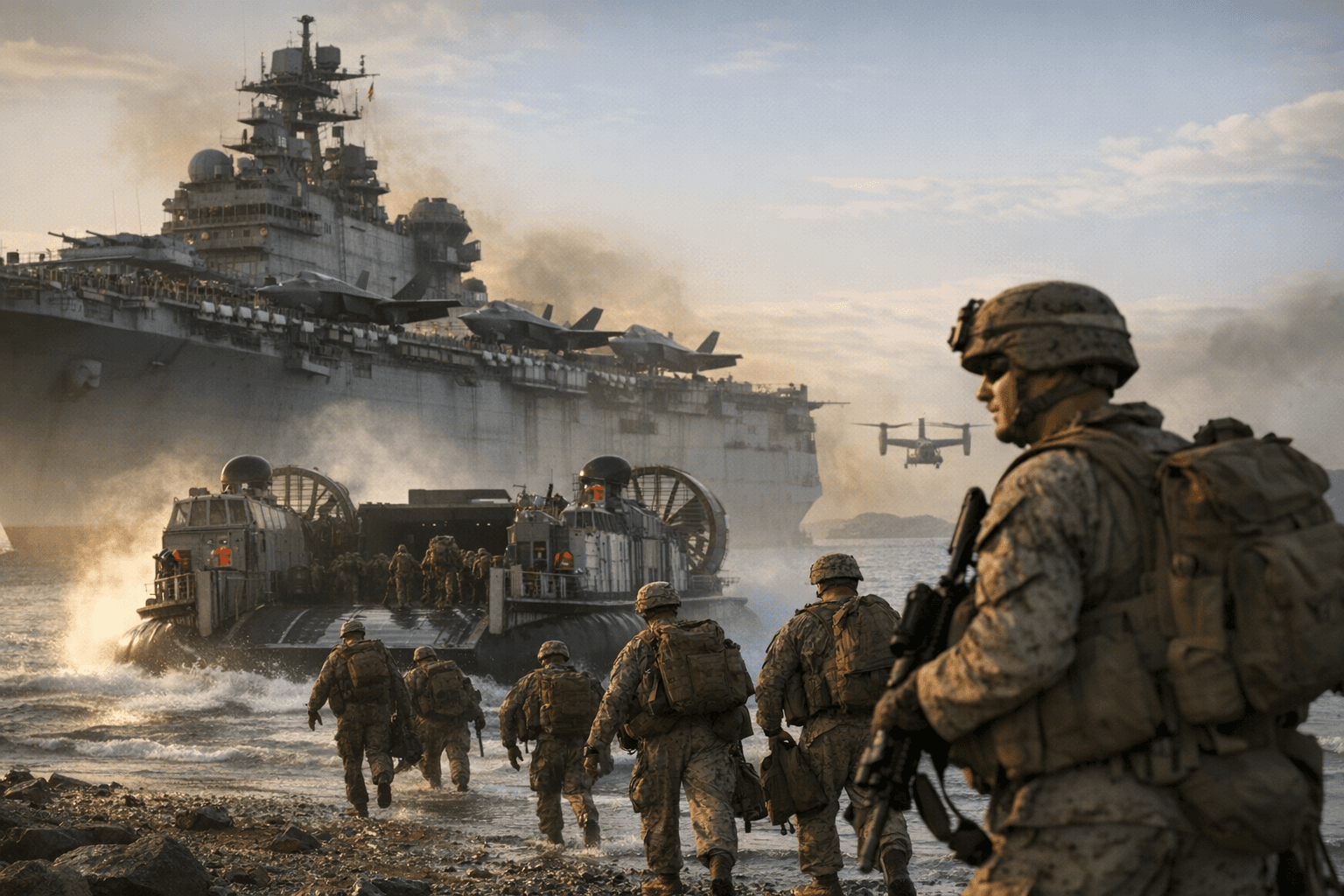
The USS Tripoli (LHA-7) and its Amphibious Ready Group arrived in the U.S. Central Command area of responsibility on March 27, completing a roughly two-week transit from Sasebo, Japan, that carried approximately 3,500 U.S. Sailors and Marines through the Strait of Malacca, a refueling stop at Diego Garcia, and a final passage through the Suez Canal. With them came F-35B fighter jets, MV-22 Osprey tiltrotors, attack helicopters and the amphibious assault craft capable of putting Marines on a beach within hours of an order.
The 31st Marine Expeditionary Unit, until recently based at Camp Hansen in Okinawa, accounts for roughly 2,200 of those personnel. The remainder are sailors assigned to the three-ship ARG, which also includes the amphibious transport dock ships USS New Orleans and USS San Diego. Together they form what the military considers its most versatile rapid-response package: a self-contained force built for noncombatant evacuations, humanitarian corridors, maritime raids, sustained air campaigns and, if ordered, forcible entry onto a contested shoreline.
That final option is precisely the point. CENTCOM publicly confirmed the arrival, describing the America-class assault ship as a platform carrying transport and strike aircraft, amphibious assets and tactical capabilities for U.S. forces in the theater. Pentagon officials characterized the deployment as providing "optionalities" for the commander-in-chief and senior leadership, institutional language that translates in practice to: every contingency for an adversary just became more reachable. Rubio said the U.S. can achieve its objectives "without any ground troops" but acknowledged the military must remain prepared to respond to contingencies, threading a rhetorical needle that concedes the force's potential without committing to its use.
The operational tempo involved is striking. The Tripoli departed Sasebo around March 13, fewer than three weeks into the U.S.-Israeli campaign against Iran that began in late February. The transit spanned thousands of miles across three oceanic chokepoints in just 14 days. Families of the 31st MEU's roughly 2,200 Marines, most living in base communities on Okinawa, have received no official public timeline for the deployment's duration.
The decision to pull the 31st MEU from Japan carries a second-order consequence that has alarmed regional security analysts: its absence from Okinawa leaves a gap in U.S. Indo-Pacific readiness at a moment when tensions elsewhere in the region remain elevated. Japan hosts both the Sasebo naval base and the Okinawa Marine installations. With the ARG now operating under CENTCOM control, Tokyo no longer has the amphibious force typically within reach for crisis response in nearby waters.
Inside CENTCOM, the Tripoli group is now positioned in the Red Sea and northern Arabian Sea, within operational range of the Iranian coast. Historically, ARG/MEU teams assigned to CENTCOM have focused on noncombatant evacuation operations, a mission made more urgent by Iran's escalating pressure on Strait of Hormuz shipping lanes. But an F-35B-equipped amphibious assault ship requires no host-nation airfield, no negotiated basing agreement and no advance notice to shift its strike radius.
The 3,500 sailors and Marines aboard that force understand the calculus better than most. For them, the gap between a readiness posture and a combat mission has rarely felt narrower.
This article was produced by Prism’s automated news system from verified source data, official records, and press releases, then run through automated quality and moderation checks before publishing. The system is built and supervised by the people who set the standards it runs under. Read our full AI policy.
Did this article answer your question?