Vanguard to pay $29.5 million and curb climate stewardship in coal antitrust settlement
Vanguard agreed to pay $29.5 million and accept new proxy-voting and engagement limits to resolve Republican state claims it helped constrict the coal market.
Vanguard agreed to pay $29.5 million and adopt sweeping limits on its shareholder engagement to settle claims by Texas and other Republican-led state attorneys general that the asset manager conspired with peers to "artificially constrict" the coal market. The settlement, announced Feb. 26 by Vanguard and in subsequent state statements, requires the firm to expand investor proxy choices, withdraw certain climate-driven stewardship activities and restrict specific engagement tactics while not admitting wrongdoing.
Under the deal Vanguard must "offer proxy voting to investors in funds accounting for at least 50 percent of assets invested in U.S. equity funds it advises," a threshold described in state materials. The agreement also bars Vanguard's U.S.-based businesses from joining groups with "climate-focused investment or stewardship objectives" and includes an explicit pledge not to advocate that portfolio companies "take any particular course of conduct to reduce carbon emissions." Vanguard is further restrained from nominating directors or filing shareholder proposals, from threatening to sell securities to coerce company action, and from implying that its support for directors is conditioned on corporate responses to engagement.
Vanguard said the settlement was reached with investors' interests in mind, writing that it "decided to settle with its investors' best interests in mind" and that the agreement would let the firm "put this distraction behind us and focus on what matters." Company communications also described the payment as being made "solely for the purpose of avoiding the burden and expense of litigation." The firm did not admit to any illegal conduct as part of the resolution.
The underlying lawsuit was filed as a multi-state antitrust action in late 2024 by Texas Attorney General Ken Paxton and joined by Republican attorneys general in several other states. Public summaries of the settlement differ on the exact roster of plaintiff states: some state filings and news summaries describe an 11-state resolution led by Texas and 10 other Republican-led states, listing Alabama, Arkansas, Indiana, Iowa, Kansas, Missouri, Montana, Nebraska, West Virginia and Wyoming; other state materials and a Missouri attorney general statement describe broader coalitions that suggest 12 to 13 states participated in a partial resolution. Court filings or the Texas AG's press release will be needed to confirm the definitive list and whether the pact resolves Vanguard's entire exposure in the suit.
The case sits at the intersection of antitrust law, investor stewardship and political backlash against ESG investing. Federal agencies weighed in last year: the Department of Justice and the Federal Trade Commission issued a statement supporting the case in May 2025, and the administration framed enforcement as a fight against politicalized ESG activity, saying it "has vowed to fight left-wing ideologues who seek to make us weaker and poorer under the guise of ESG." Critics of the suit warned it could have dramatic market consequences; an opinion piece cited in filings estimated as much as $18 billion in coal-related holdings could be affected if full divestment remedies prevailed.
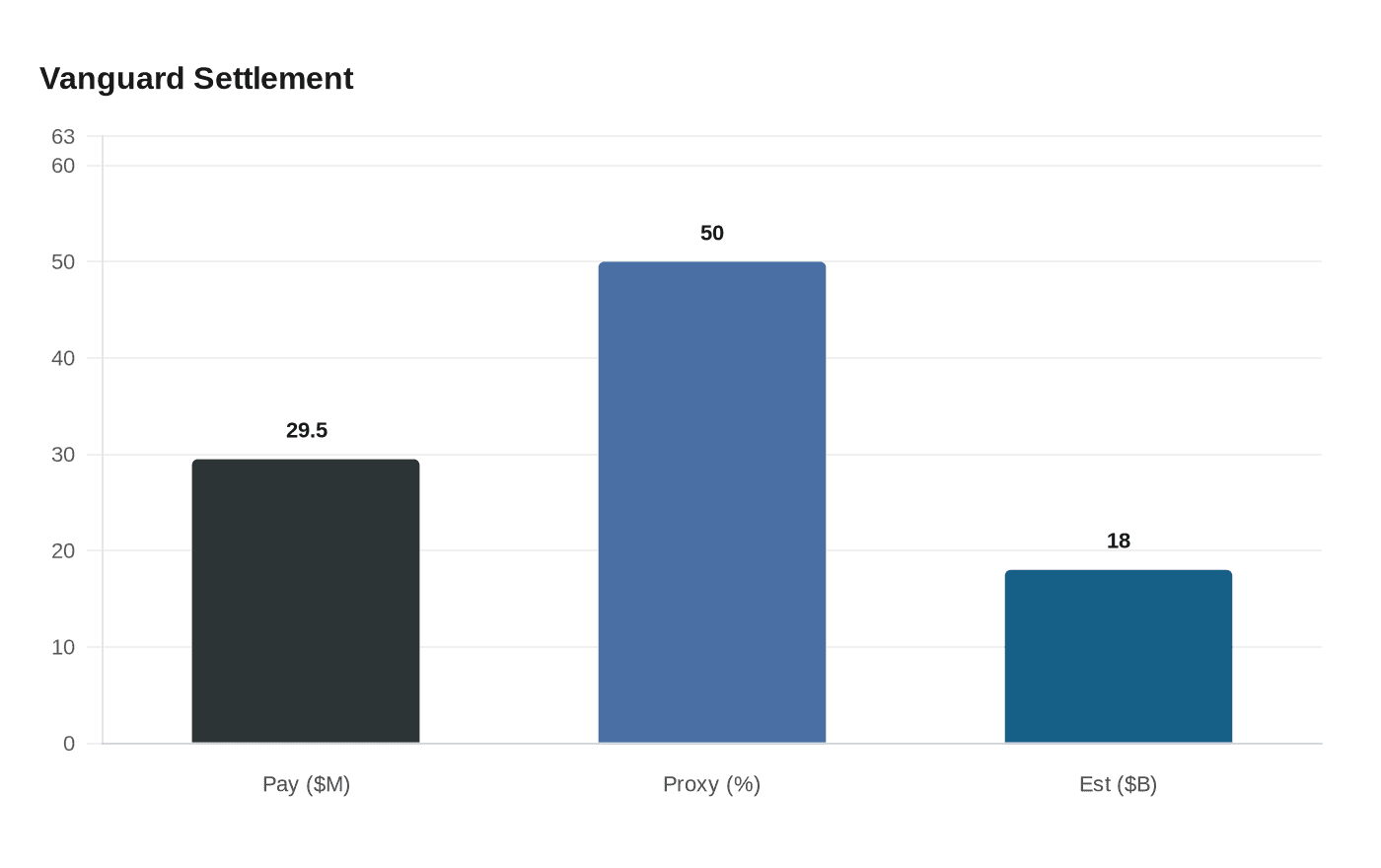
For institutional investors the settlement's nonfinancial terms may matter more than the $29.5 million payment. By expanding investor proxy choice and constraining activist engagement, the agreement could recalibrate how large passive managers influence corporate strategy and reshape expectations about stewardship across trillions of dollars in assets managed by Vanguard, BlackRock and State Street. BlackRock and State Street remain defendants in the broader litigation; their status was not altered by Vanguard's separate deal.
This article was produced by Prism’s automated news system from verified source data, official records, and press releases, then run through automated quality and moderation checks before publishing. The system is built and supervised by the people who set the standards it runs under. Read our full AI policy.
Did this article answer your question?

