Vermont 14-Year-Old Qualifies for 2026 Governor's Race Ballot
A 14-year-old Stowe freshman is the first minor to reach Vermont's gubernatorial general election ballot, exposing a constitutional gap most states closed decades ago.
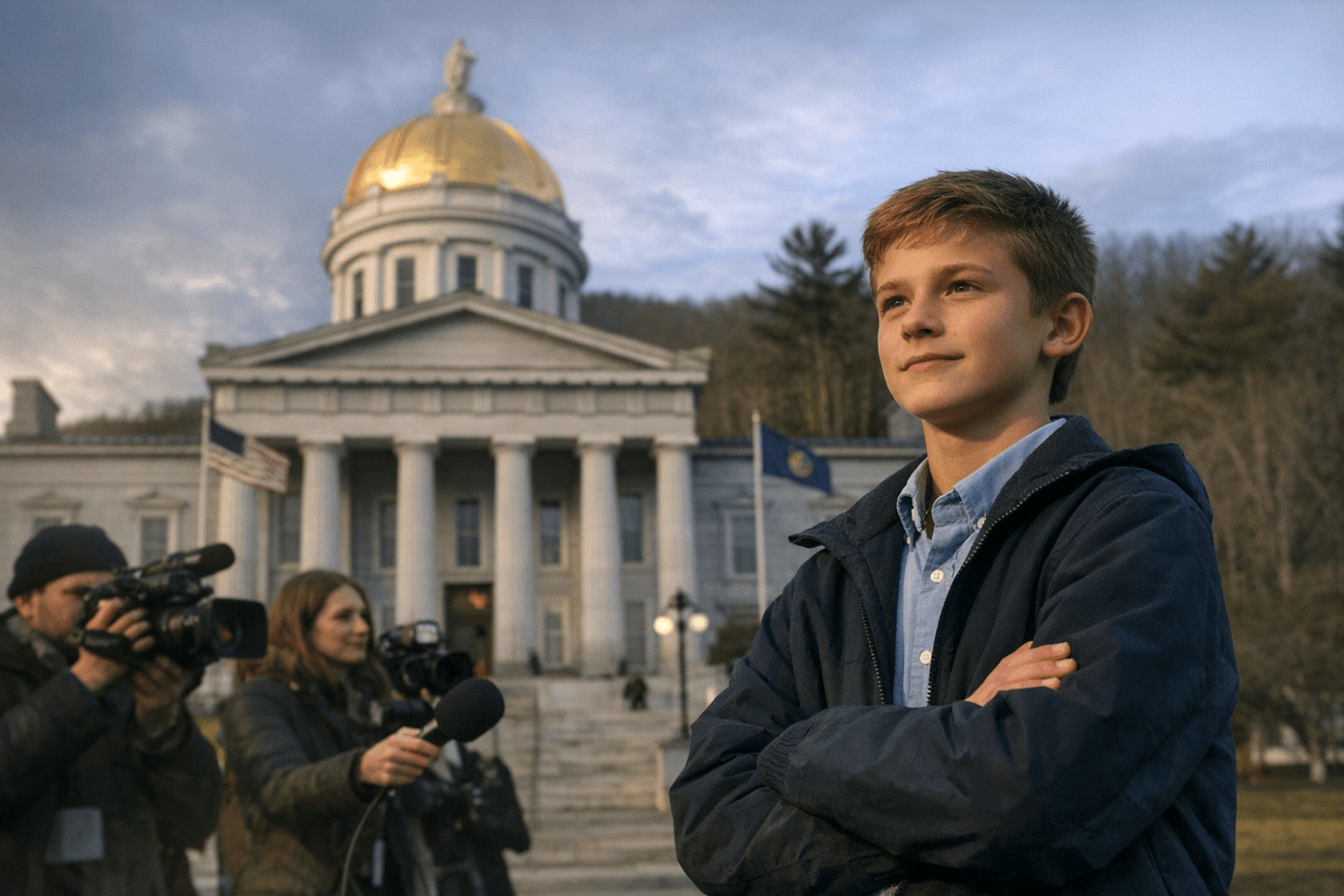
Dean Roy collected 500 signatures at post offices and small businesses across Vermont, founded his own political party, and secured a spot on the November 2026 general election ballot as a candidate for governor, all before finishing his freshman year at Stowe High School. The mechanics of how a 14-year-old pulled that off reveal as much about American ballot-access law as they do about Roy himself.
Vermont's constitution is the starting point. Unlike nearly every other U.S. state, which typically sets minimum gubernatorial ages of 30, Vermont imposes no age floor whatsoever. The only explicit eligibility requirement for governor in the state constitution is four years of residency before election day, a threshold Roy clears easily as a native Vermonter. That gap gave Roy his opening, and he moved quickly to exploit it: he founded the Freedom and Unity Party in 2025 specifically to run as a third-party candidate, then gathered the 500 signatures required to bypass the traditional primary process entirely and go straight to the general election ballot. That last step is what separates him from the only meaningful precedent, Ethan Sonneborn of Bristol, who ran for the Democratic gubernatorial nomination in 2018 at age 13 and finished last in a four-way primary, never reaching the general election.
Whether Roy could actually take office if he won is a more contested question than Vermont's ballot-access rules suggest. Peter Teachout, a professor at Vermont Law and Graduate School, points to a section of the state constitution defining who is "entitled to the privileges of a voter," which requires a person to be 18 years of age. Under Teachout's reading, that provision could be interpreted as an implicit eligibility floor that Roy does not yet meet, regardless of what the ballot says. Roy and his supporters dispute that interpretation, and the question has not been tested in court. "In theory, a 4-year-old could run for governor," Teachout said. "Should we be worried about it? No. Vermonters can be a little cantankerous and provocative just for the fun of it, but it is not something they are likely to support in this context."
Other states have decided not to leave that ambiguity on the books. After six teenagers ran for governor in Kansas, lawmakers there added a statutory requirement in 2018 that gubernatorial candidates be at least 25 years old. Vermont has made no similar move, even after Sonneborn's 2018 primary run generated national attention.
Roy's political ambitions took root the year before during his time as a legislative page at the Vermont Statehouse in Montpelier, an eighth-grade experience he has credited with launching his candidacy. His platform centers on housing as the state's top priority, and also includes consolidating school districts, taxing large corporations and short-term rentals, and deepening Vermont's economic relationships with Canada and the European Union.
James Carpenter, Roy's former history teacher, described the candidacy as genuine rather than performative. "There's no gimmick behind this," Carpenter said. "I think he blends that youthful optimism with some pragmatism that few kids have."
Governor Phil Scott's office offered qualified praise. Press secretary Amanda Wheeler said Scott "believes it's important for our youth to get involved," but added that "a teenager may not be best suited to serve in that role given the lack of experience and lived perspectives youth have at that point in their lives."
Roy is clear-eyed about the long odds. "I don't expect necessarily to win," he said. What he expects instead is to use the campaign as pressure: "If I can get people to think that I am a threat to them, then I know I've succeeded." Whether Vermont's legislature concludes the same about its own open-ended eligibility rules may be the more durable question this candidacy leaves behind.
This article was produced by Prism’s automated news system from verified source data, official records, and press releases, then run through automated quality and moderation checks before publishing. The system is built and supervised by the people who set the standards it runs under. Read our full AI policy.
Did this article answer your question?

