Vietnam says it does not pick sides in U.S.-China rivalry
To Lam told Asia’s top defense summit that Vietnam “does not pick sides,” even as Hanoi deepened ties with China and kept the United States in play.

Vietnam was not choosing sides in the sharpening U.S.-China rivalry, To Lam said in Singapore, casting Hanoi’s foreign policy as a search for room to maneuver rather than a bid to join either camp. Lam said U.S.-China competition was an “objective reality,” but stressed that Vietnam wanted good relations with major countries and that stronger ties with China would support regional peace and security, while ties with the United States remained important.
Lam delivered that message at the IISS Shangri-La Dialogue, held in Singapore from May 29 to 31 and widely regarded as Asia’s premier defense summit. His keynote was the first time a Vietnamese party chief had been invited to open the forum, giving Hanoi a larger stage than it has traditionally had at the region’s most closely watched security gathering. The audience included U.S. Defense Secretary Pete Hegseth and counterparts from Australia, Britain, France and Japan, while China’s defense minister, Dong Jun, skipped the event for a second consecutive year.
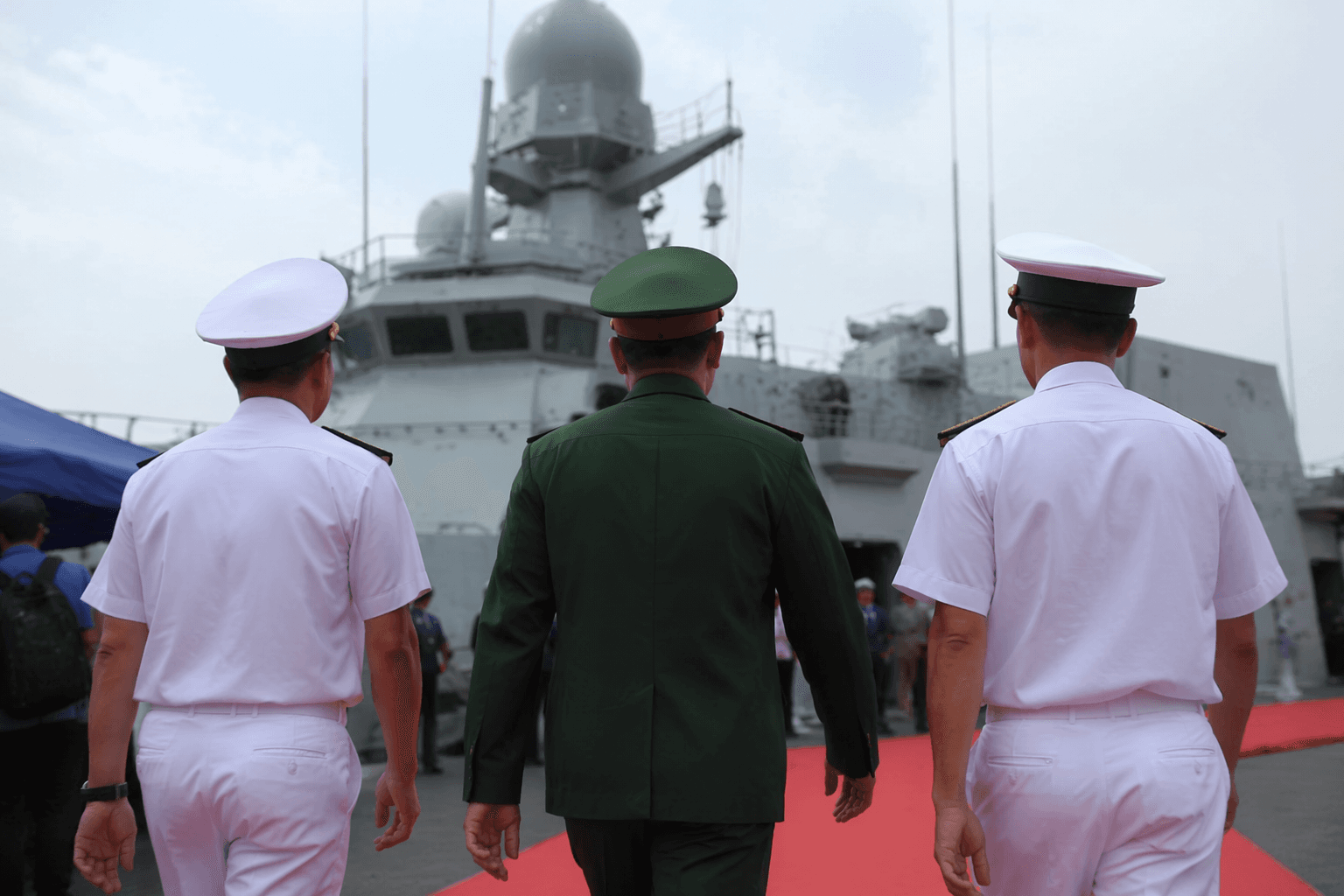
The setting sharpened the politics of Lam’s remarks. He warned of distrust and a lack of respect for established rules, saying they had created a world of “the big fish swallowing the small fish,” a phrase that echoed Vietnam’s long concern about power politics. He also pointed to the Strait of Hormuz as a reminder that strategic waterways matter far beyond the Middle East, underscoring how maritime chokepoints and regional conflict can ripple through global security and trade.
Lam’s approach fits Vietnam’s so-called bamboo diplomacy, the flexible but sovereignty-driven foreign policy associated with late Communist Party chief Nguyen Phu Trong. Lam now holds both the party chief and state president roles, giving his foreign-policy signals unusual weight at a time when Vietnam is trying to preserve strategic autonomy while expanding influence.
That balancing act was already visible on March 16, when China and Vietnam held the first ministerial meeting of their new “3+3” strategic dialogue in Hanoi. The talks brought together Wang Yi, Wang Xiaohong and Dong Jun on the Chinese side with Le Hoai Trung, Phan Van Giang and Luong Tam Quang for Vietnam. Both sides said the mechanism was meant to deepen political trust and strategic coordination, and Vietnam’s foreign ministry said it could contribute to peace, stability and development in the region and the world.
Taken together, Lam’s comments in Singapore showed a familiar but increasingly important Vietnamese message: deepen institutional ties with China, keep engagement with the United States, and avoid becoming a pawn in a rivalry that is tightening across Asia.
This article was produced by Prism’s automated news system from verified source data, official records, and press releases, then run through automated quality and moderation checks before publishing. The system is built and supervised by the people who set the standards it runs under. Read our full AI policy.
Know something we missed? Have a correction or additional information?
Submit a Tip