Violinist and Ethnomusicologist Elisabeth Waldo Dies at 107
A violinist who grew up beside a Native American reservation, Waldo spent 107 years bridging Indigenous sound and Western concert form in work that still sparks debate.
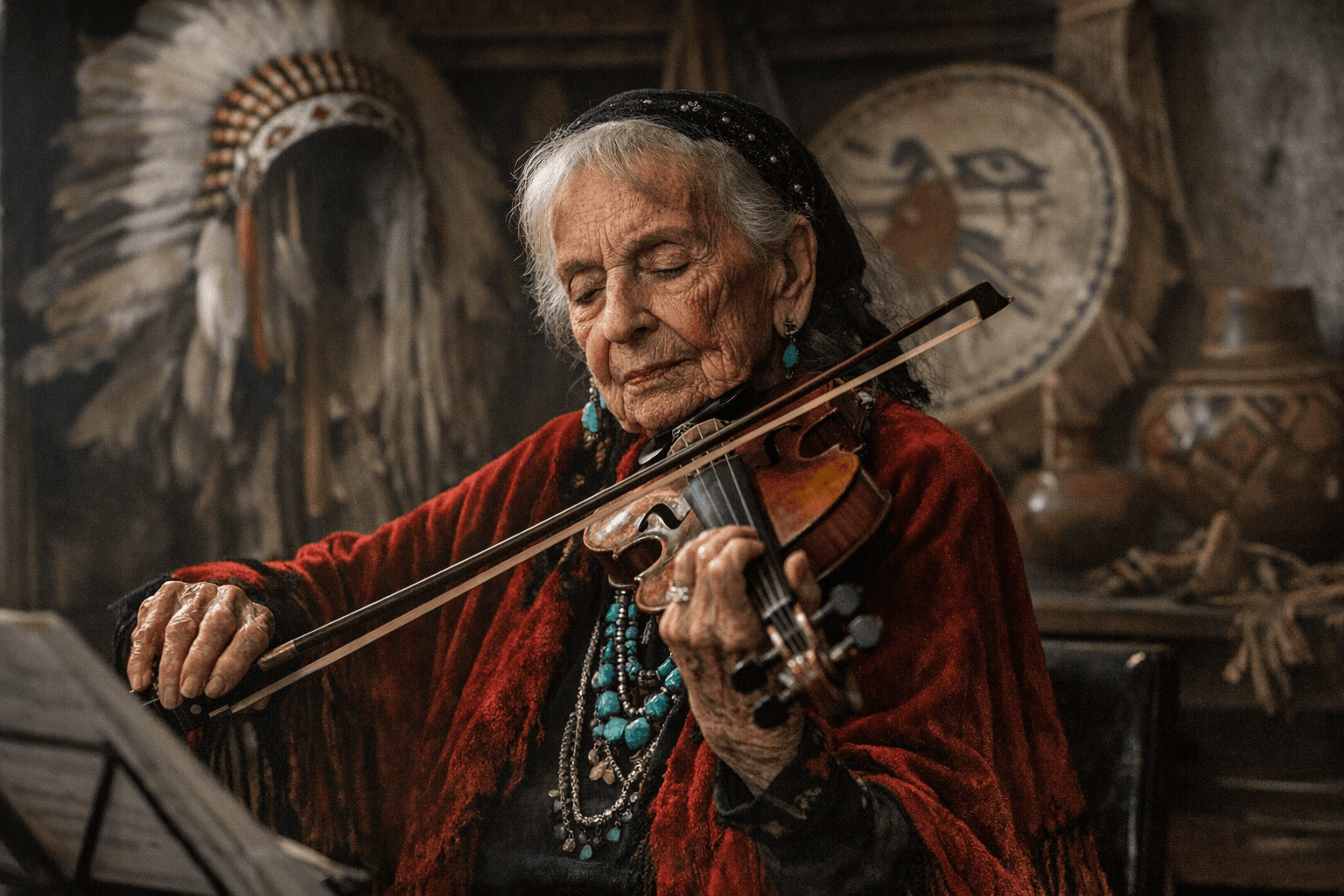
Elisabeth Waldo, the violinist and ethnomusicologist who became one of the first classically trained musicians to bring pre-Columbian instruments into a recording studio, died at 107. Born June 18, 1918, in Tacoma, Washington, Waldo grew up on a family ranch at the edge of the Yakima (Yakama) Native American Reservation, an upbringing that fixed the terms of a career that would never separate art from ancestry.
Her path into music began almost before she could speak. Waldo was singing by age three and playing violin by five. Jascha Heifetz, the Russian-born virtuoso, heard her play and helped secure a scholarship to the Curtis Institute of Music in Philadelphia, where she trained under Efrem Zimbalist. In 1940, conductor Leopold Stokowski recruited her for his All-American Youth Orchestra, which toured South America that year and North America in 1941 before disbanding when the United States entered World War II.
Those tours proved decisive. Waldo began collecting pre-Columbian instruments during the South American leg of the journey, a practice that would define the rest of her working life. After a single season as a first violinist with the Los Angeles Philharmonic, she returned to Latin America as a touring soloist and eventually settled in Mexico City. There she immersed herself in the study of indigenous music and forged a close friendship with muralist Diego Rivera. At Rivera's suggestion, she developed a system of hieroglyphic musical notation designed specifically for pre-Columbian instruments, enabling others to learn and play them, a practical act of cultural transmission that also raised questions about who held the authority to transcribe and teach ancestral traditions.
From 1954 to 1955, Waldo played violin for Peruvian-American soprano Yma Sumac, whose performances at Hollywood and Las Vegas venues and concert halls across North America and Europe fused Andean folk songs with big band jazz and operatic technique. She viewed that collaboration as an extension of her ongoing research rather than a detour from it.
Her three landmark albums, Maracatu (1959), Rites of the Pagan (1960), and Realm of the Incas (1961), represented something genuinely new in American music. These were not field recordings but original compositions scored for ensembles that combined pre-Columbian instruments with Western orchestration. She has been cited as the first person to record rare pre-Columbian instruments and to recreate the long-forgotten music of indigenous peoples, and she is recognized as a pioneer of the genre known as exotica. Her recordings anticipated the multicultural turn later taken by avant-garde and New Age movements and are considered a forerunner of what became world music.
That legacy was not without friction. As the discipline of ethnomusicology matured through the latter half of the 20th century, scholars increasingly scrutinized the distinction between documentation and invention, between collaboration and appropriation. Waldo's compositions, which reimagined rather than recorded Indigenous music, occupied an uneasy middle ground that communities and academics continued to contest long after the albums were pressed.
Outside the studio, she played violin on Hollywood soundtracks including Song of Mexico (1945) and The Blue Iguana (1988) and maintained a compound in Northridge, California, called Rancho Cordillera del Norte, which housed her collection of pre-Columbian instruments and a Mission-style theater.
Her father, Benjamin Franklin Waldo, was a descendant of Ralph Waldo Emerson; her mother, Jane Althea Blodgett, trained as a singer at the Boston Conservatory of Music. Her younger sister was actress and voice artist Janet Waldo (1920–2016), known for voicing characters on The Jetsons and Josie and the Pussycats. She married Carl Schaefer Dentzel in 1948; he died in 1980.
This article was produced by Prism’s automated news system from verified source data, official records, and press releases, then run through automated quality and moderation checks before publishing. The system is built and supervised by the people who set the standards it runs under. Read our full AI policy.
Did this article answer your question?