Voice of America Journalists Sue, Alleging Trump Officials Politicized the Broadcaster
An official at Voice of America demanded reporters pledge loyalty to Trump or lose their jobs, a new federal lawsuit alleges, as VOA journalists accuse the administration of turning the broadcaster into a propaganda arm.

Coverage of the Iran war sent into that country on Voice of America's Persian service included no reporting on death tolls from U.S. air strikes or perspectives from world leaders outside the administration, while the bombing of an elementary school was "barely mentioned," according to a new federal lawsuit. That allegation sits at the center of a complaint filed Monday in U.S. District Court in Washington, in which four veteran VOA journalists and a coalition of press freedom organizations accused the Trump administration of converting the federally funded broadcaster into a partisan mouthpiece and suppressing independent journalism across multiple language services.
The named plaintiffs are Barry Newhouse, Ayesha Tanzeem, Dong Hyuk Lee, and Ksenia Turkova. They allege Kari Lake promoted pro-Trump propaganda on air and trampled the network's editorial independence in violation of federal law and First Amendment principles. Turkova, a journalist for VOA's Russian-language service, has been deemed a foreign agent by the Putin regime. The complaint is captioned Newhouse v. USAGM.
The suit's central legal claim rests on the "firewall," a statutory safeguard Congress created to shield VOA's editorial independence from government interference. The complaint says the Trump administration is actively "suppressing coverage of events that it wishes had not occurred" and "directing that its own partisan messages be passed off to viewers and listeners as 'news.'" Attorneys for the journalists wrote that such conduct "violates the federal statutes that govern VOA, and the Constitution itself" and "undermines the credibility of the United States in the eyes of the world."
The complaint names one official by name who crossed a particularly stark line: plaintiffs accused USAGM Acting CEO Michael Rigas and Kari Lake of censoring interviews, video footage, and stories about anti-government protests within Iran and completely banning reporting on certain elements in opposition to the Iranian regime from VOA's Persian Service. A separate official named in the New York Times' account of the complaint, Hui Jing, allegedly demanded "loyalty" to the Trump administration from reporters who wanted to "keep their jobs."
The lawsuit alleges that VOA transmissions to populations in Iran, China, North Korea, and Kurdish populations are not being run as objective news sources, as required by law, and instead parrot White House talking points and suppress news the administration wants downplayed. Kari Lake herself appeared in a January 2026 segment on VOA's Persian language service, praising President Trump effusively. The service also broadcast an hour-long glowing retrospective on Trump's first year back in office, including full-throated praise from the anchor, with Lake appearing in a five-minute segment during that broadcast, repeatedly lauding the president.
Named as defendants are USAGM, recently appointed acting CEO Michael Rigas, and Kari Lake, who purported to occupy the USAGM leadership role until March 7 when Judge Lamberth ruled that her appointment and all of her actions were legally void. That ruling came as part of broader litigation: a federal judge last week ordered hundreds of VOA journalists who had been placed on paid leave for the past year be put back to work, saying Kari Lake exceeded her authority. Following Trump's March 2025 executive order to reduce VOA's footprint, Lake had fired the network's contractors and placed more than 1,000 network employees on paid administrative leave, slashing VOA's 49 language services to six. The administration is appealing the reinstatement order to the D.C. Circuit.
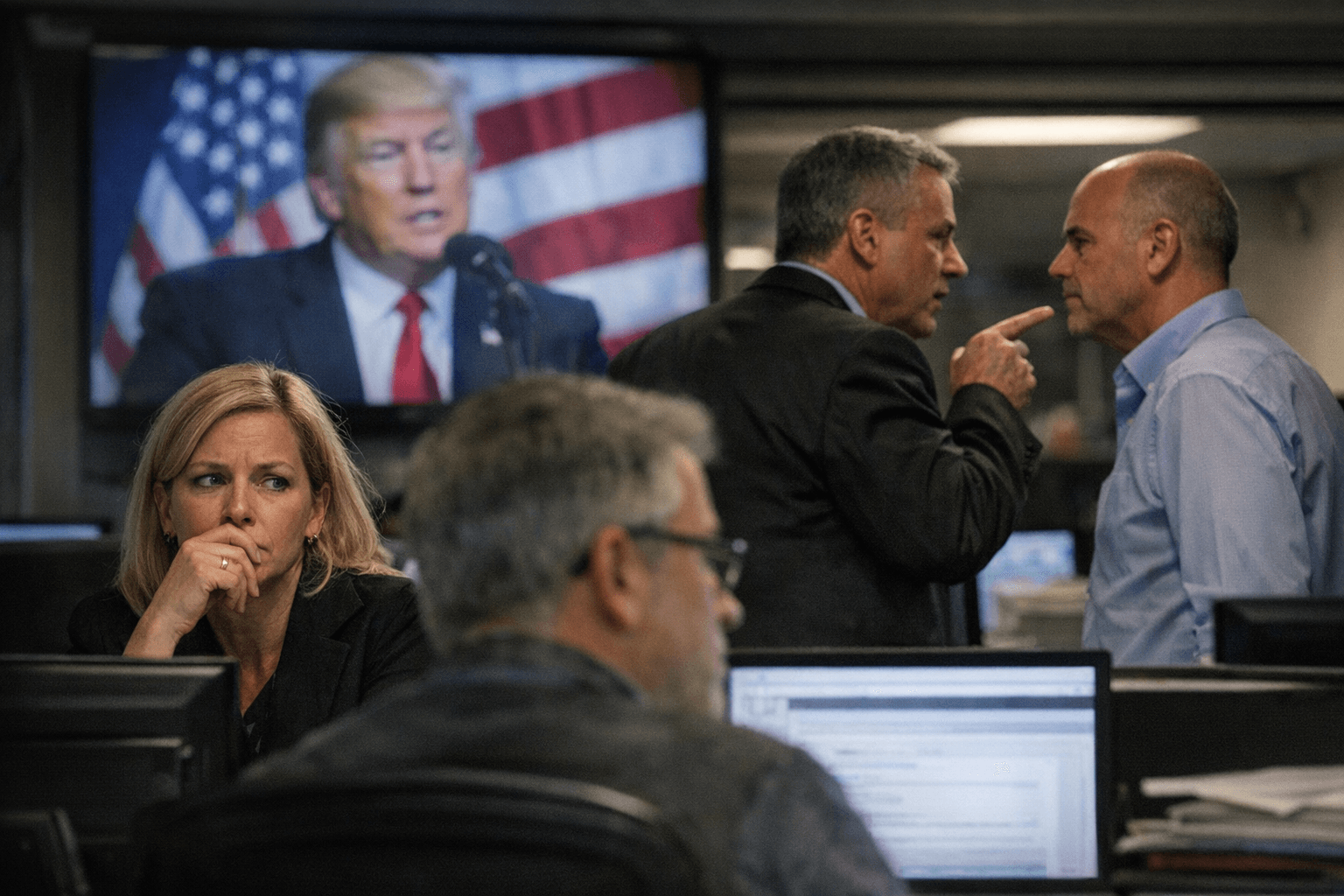
Lead attorney Norm Eisen framed the lawsuit around the ongoing conflict in the Middle East. "The Voice of America has been breaching the Constitutional and statutory rules that require that outlet not to push propaganda or censorship," Eisen said, adding: "In a time of crisis and conflict, like what we have right now in Iran, people count on the U.S. government broadcasts, and in particular, the Voice of America, to tell the truth."
The plaintiffs issued a joint statement tying the lawsuit to national security interests: "The integrity of VOA's content is not just a legal requirement — it is in the national interest. For decades, VOA has represented America's commitment to freedom of the press to audiences who are denied this right in their own countries. Allowing that legacy to be compromised from within serves no one — least of all the United States."
USAGM pushed back on the suit's framing. A USAGM spokesperson said that "American taxpayers fund USAGM and Voice of America, and those funds by law must support broadcasting that reflects U.S. policy and the interests of the American people," and that USAGM "is responsible for oversight of its networks, including Voice of America, and for ensuring compliance with the VOA Charter, which requires authoritative, accurate journalism that is reflective of and clearly presents U.S. policies." In earlier congressional testimony, Lake made her philosophy explicit: "We should be able to have control over what kind of content goes out. It should be in alignment with our foreign policy."
The three press freedom organization plaintiffs are PEN America, Reporters Sans Frontières, and Reporters Without Borders, Inc. Clayton Weimers, executive director of Reporters Without Borders, offered a pointed assessment: "The Trump administration has made clear that if it can't eliminate VOA, it wants to turn it into a political propaganda machine, cheerleading Trump's agenda. That is at odds with VOA's mission to inform millions around the world who lack regular access to authentic, trustworthy journalism." The journalists are represented by the Government Accountability Project, Democracy Defenders Fund, Emery Celli Brinckerhoff Abady Ward & Maazel LLP, and the Media Freedom & Information Access Clinic at Yale Law School.
Plaintiffs are urging the court to grant relief from viewpoint discrimination, award nominal damages, and cover their attorney fees in addition to any other relief deemed just. Until last year, VOA reached more than 360 million people globally each week, according to official estimates. The outcome of the case will determine whether that audience, many living under authoritarian governments with no access to independent journalism, continues to receive what Congress mandated: news the U.S. government cannot touch.
This article was produced by Prism’s automated news system from verified source data, official records, and press releases, then run through automated quality and moderation checks before publishing. The system is built and supervised by the people who set the standards it runs under. Read our full AI policy.
Did this article answer your question?

