Volkswagen restructuring could shift power and test German factory law
Volkswagen’s restructuring is not just about cost cuts. It could redistribute power from labor and Lower Saxony to management, while testing whether Blume can move fast enough to keep VW competitive.
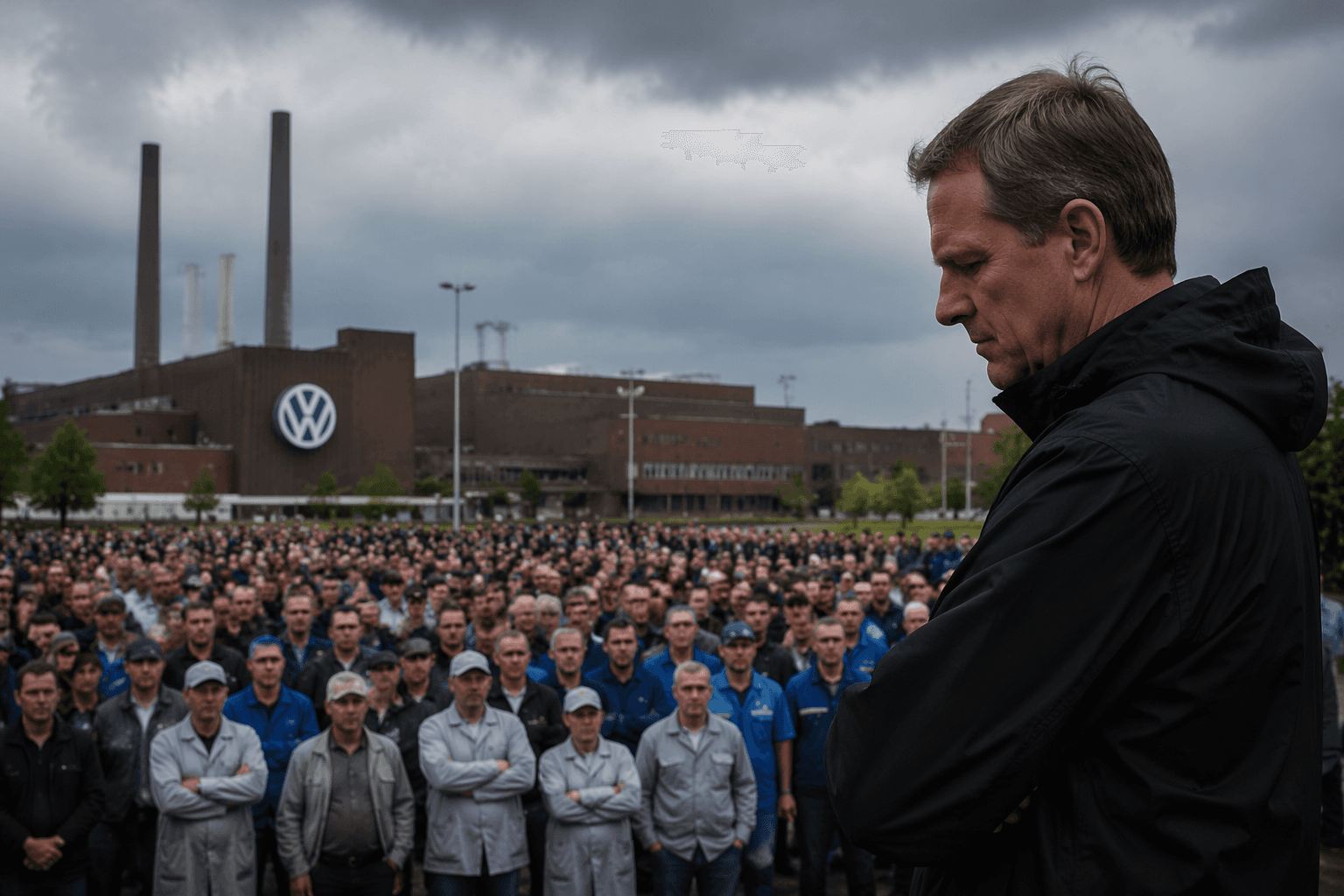
Oliver Blume is weighing cuts of as many as 100,000 jobs, the closure of high-cost German factories and a possible split of business units at Volkswagen, moves that could loosen the influence of labor and the state of Lower Saxony over Europe’s biggest automaker.
A restructuring that reaches beyond payroll
Volkswagen no longer sees incremental trimming as enough. The company is battling tariffs, higher expenses and tougher competition from Asia, and the pressure is landing on a group that already agreed to a sweeping 2024 labor settlement with IG Metall and the works council. That deal, called Zukunft Volkswagen, or Future Volkswagen, was designed to realign production capacity in Germany, but the new restructuring push implies management now believes the earlier plan did not go far enough.
The possible cuts are unusually large even by Volkswagen standards. Two people familiar with the matter said the company is considering its biggest restructuring ever, with the number of planned job cuts potentially doubling and as many as four German factories facing closure.
Why the governance fight matters
Lower Saxony held 20.0% of Volkswagen AG voting rights at the end of 2024, making it the second-largest shareholder, according to Volkswagen’s annual report. Under the company’s Articles of Association, the state can appoint two Supervisory Board members as long as it directly or indirectly holds at least 15% of ordinary shares.
The Volkswagen law has long protected labor and state influence, especially on major factory decisions. Any move to close plants inside VW AG runs into that framework, which helps explain why management is considering separate entities for passenger cars and components. A split structure could give executives more room to act without confronting the same constraints that have slowed change for years.
The European Court of Justice ruled on October 23, 2007, in Case C-112/05, that provisions of the Volkswagen law violated EU free-movement-of-capital rules. Even so, the law’s political force remains, and any attempt to weaken labor and state influence would still be sensitive in Germany’s industrial heartland.
The deal Volkswagen already made with labor
Volkswagen’s 2024 labor agreement already committed the company to large savings. After intense negotiations, the company reached consensus with IG Metall and the works council on Zukunft Volkswagen, which Volkswagen says creates conditions for financial labor-cost savings of €1.5 billion a year and more than €4 billion in annual cost effects in the medium term.
The agreement also calls for a reduction in technical capacity of 734,000 units in German plants and a socially responsible reduction of more than 35,000 employees along the demographic curve by 2030.
In its annual report, Volkswagen described 2024 as dominated by increasingly fierce competition in the automotive sector and the implementation of its performance program.
Labor tensions are already visible
In a works council note seen by Reuters, Volkswagen management told the employee side that the current job cuts are not enough. That is a sharp signal to workers that the company’s appetite for restructuring has moved beyond the existing agreement.
Members of Volkswagen’s supervisory board had already been informed of the plans and were due to discuss them at a July 9 meeting. That makes the next board discussion a key moment for a company whose governance has often forced compromise between management, labor and the state of Lower Saxony.
What this would mean for Volkswagen’s future
If Blume succeeds, Volkswagen could emerge with a more flexible corporate structure, one better able to respond to Chinese rivals, price pressure and the faster pace of electric-vehicle competition. If he does not, the group may remain locked in a governance model designed for a different industrial era, when scale and stability mattered more than speed and portfolio reshaping.
Volkswagen was founded in 1937, and its 89-year history has been defined by a tightly managed balance between industrial power and political oversight.
This article was produced by Prism’s automated news system from verified source data, official records, and press releases, then run through automated quality and moderation checks before publishing. The system is built and supervised by the people who set the standards it runs under. Read our full AI policy.
Did this article answer your question?