Wadagni sworn in as Benin president, vows security and growth focus
Romuald Wadagni took office in Cotonou after winning more than 94% of the vote, setting up a test of continuity, not rupture, in Benin.

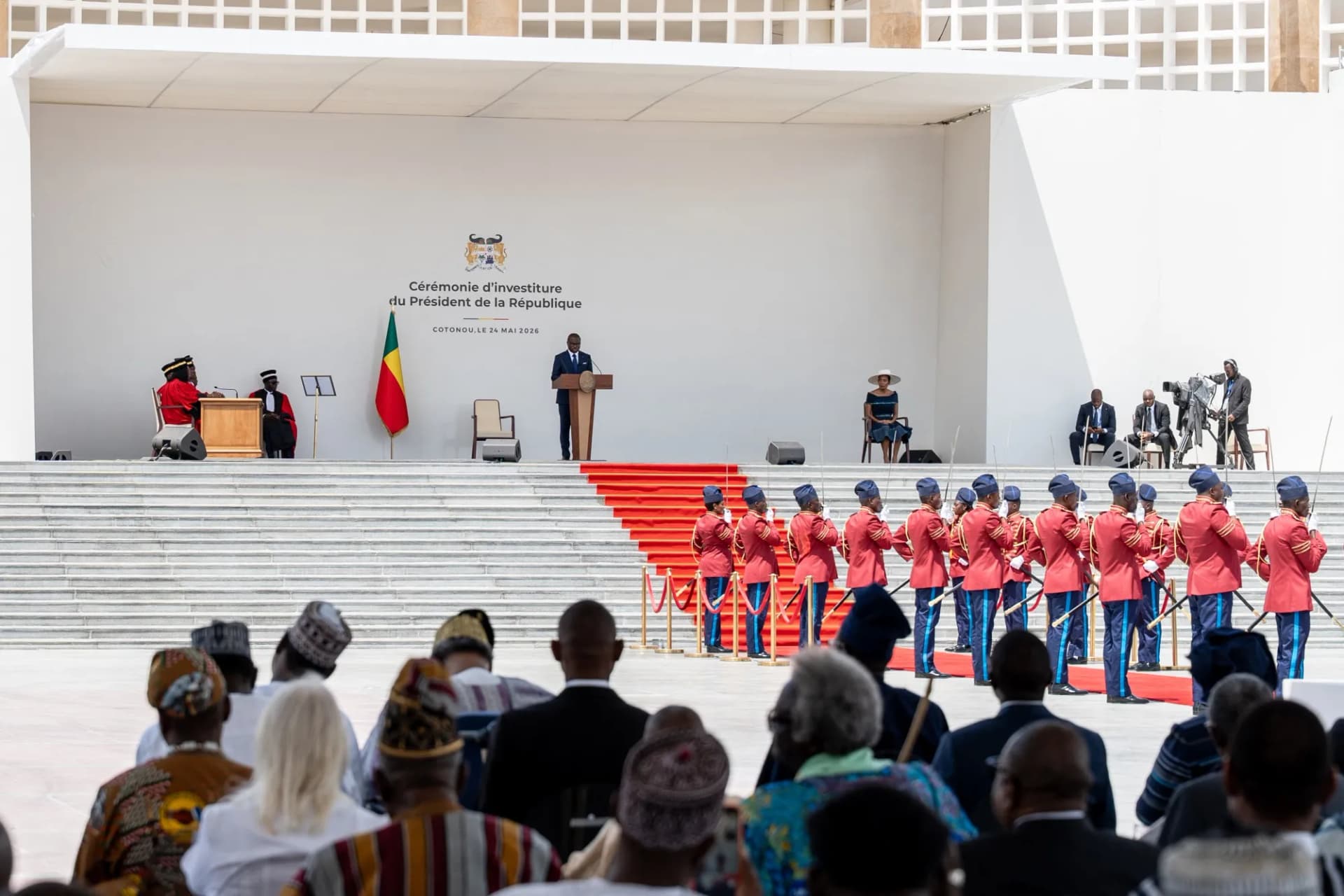
Romuald Wadagni took the oath as Benin’s president in Cotonou on Sunday, turning a sweeping election victory into a formal handover from Patrice Talon after a decade of rule. The ceremony at the Palais des Congres, marked by ceremonial guards, opened a new phase for a country that has paired fast growth with tighter politics and rising insecurity.
Wadagni, the former finance minister, won the April 12 vote with more than 94% of the ballot against Paul Hounkpe, a result that underscored how little room remained for competition. The Constitutional Court had already upheld the exclusion of Les Démocrates, the main opposition party, after rejecting its ticket over insufficient sponsorship endorsements, leaving Benin’s presidential race without the country’s strongest opposition force.

The new president framed his mission as one of protection as much as prosperity. He said Benin would not yield to fear or complacency, and vowed to serve with the awareness that power is never a personal privilege. He also pledged to confront rising security threats, improve living standards, and make sure growth benefits ordinary people, with jobs, basic services and social protection among the priorities he set out at the inauguration.
That agenda suggests more continuity than rupture. Wadagni is widely seen as the technocratic successor to Talon, and his first mandate inherits the economic model that drove Benin’s recent expansion. The World Bank said growth reached 7.5% in 2024, the country’s fastest pace since 1990, while the IMF projected another 7.5% in 2025 and a fiscal deficit of 2.9% of gross domestic product, just below the WAEMU ceiling.
The political context is less reassuring. Benin’s constitutional reform, promulgated on December 17, 2025, extended elected terms from five years to seven and created a Senate, changes that broadened the institutional reach of Talon’s last months in office even as they lengthened the runway for his successor. Talon stepped down after two terms, but the broader system still bears the imprint of his decade in power.
Security may prove the sharper test. Violence has spread in the north since 2021, especially in Alibori and Atacora, and ACAPS said more than 3,000 refugees crossed into Segbana from northwestern Nigeria since mid-February 2026, adding to nearly 29,000 refugees and asylum seekers in Benin by late February, most from Burkina Faso. The outgoing government narrowly survived a coup attempt in December 2025, a reminder of how fragile the regional environment remains.

Neighbors across the Sahel are already watching. Niger, Burkina Faso and Mali were represented at the ceremony, and the presence of Niger’s prime minister, Ali Mahaman Lamine Zeine, hinted at possible thaw in strained relations. For Benin, Wadagni’s inauguration looked less like a clean break than a controlled transfer inside the Talon era, with the real measure of change likely to come in whether economic gains are widened and insecurity is contained.
This article was produced by Prism’s automated news system from verified source data, official records, and press releases, then run through automated quality and moderation checks before publishing. The system is built and supervised by the people who set the standards it runs under. Read our full AI policy.
Did this article answer your question?


