Wagyu beef branding battle exposes confusion over premium meat claims
Wagyu on a label can mean everything from lineage-backed beef to loose marketing, and the premium only sticks when genetics and grading are verifiable.
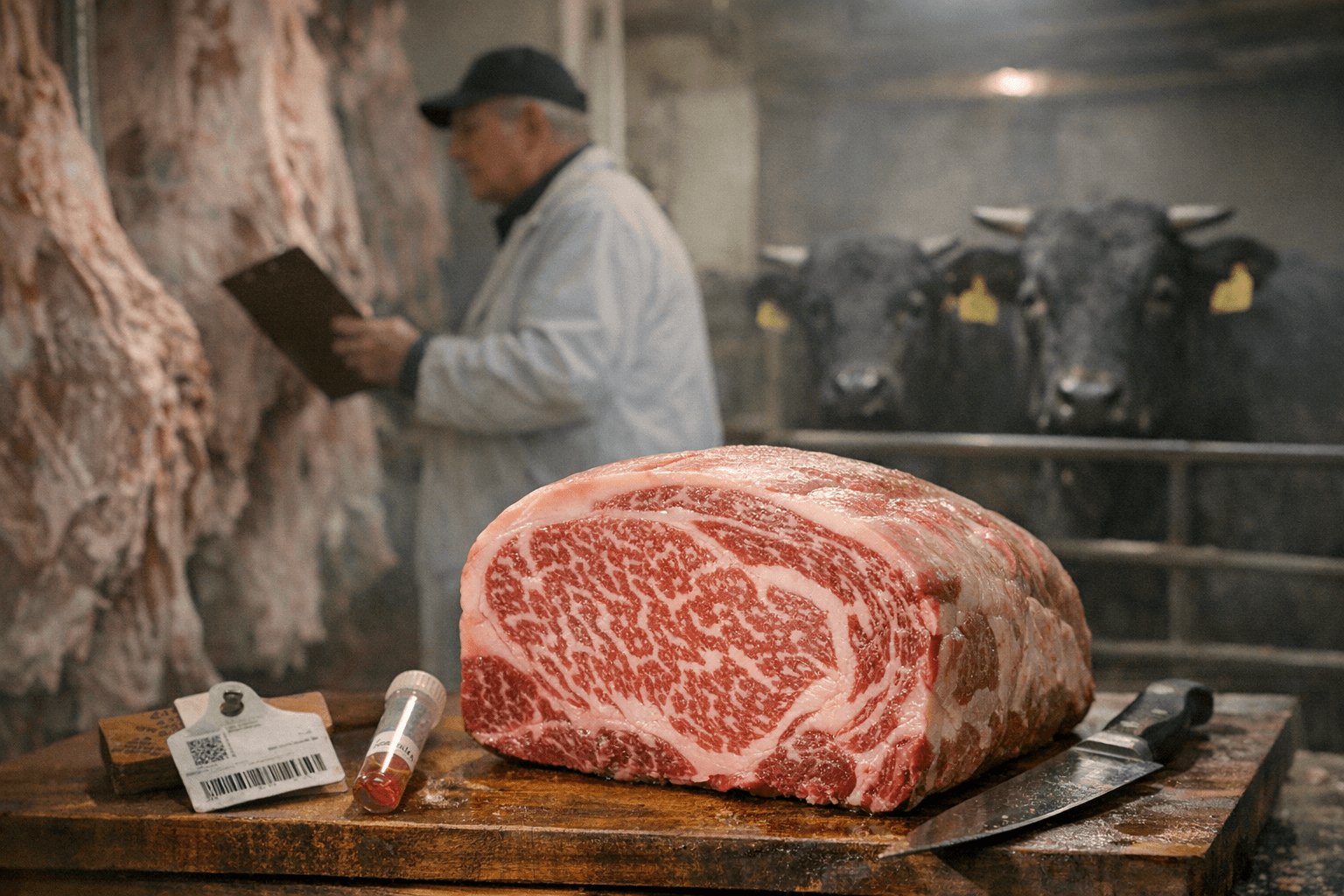
What “Wagyu” really promises
The word “Wagyu” now does two jobs at once: it signals luxury, and it creates confusion. On a menu or butcher label, it may describe cattle genetics, a specific certification, or little more than a marketing style that borrows prestige from Japanese beef.
That ambiguity is exactly why the premium is under scrutiny. In the United States, the familiar USDA grading system still starts with Prime, Choice, and Select, with Prime defined by at least slightly abundant marbling and a place in upscale restaurants. But Wagyu sits beside that system, not neatly inside it, which leaves buyers trying to separate genuine breed claims from softer sales language.
Why the label matters so much
Wagyu has become a big enough category that the naming stakes are real. Recent market estimates place the global Wagyu beef market in the multi-billion-dollar range, with one 2024 estimate near $18.95 billion and another above $21.5 billion. When a market reaches that scale, the label itself becomes part of the product’s value.
The problem is that “Wagyu” does not mean one universally understood thing in the American marketplace. Industry sources commonly divide American Wagyu into fullblood, purebred, and crossbred categories. Those distinctions can change the eating experience, the amount of marbling, and the price dramatically, even when two products are sold under the same broad premium banner.
The standards fight behind the premium
USDA certification rules sit at the center of the debate because the agency says certification programs are often the basis for approving meat and poultry labels that make marketing claims. That matters for Wagyu because the most persuasive label is not the one with the flashiest wording, but the one that can be tied back to a defined program.
USDA’s Certified Beef Programs page now lists an Authentic Wagyu Beef Program, known as G-162. USDA says that program became effective in January 2025, and the program contact is the American Wagyu Association. The structure is important: the government is not just grading carcasses, it is recognizing a certification framework that helps determine what a Wagyu claim can legally and practically mean.
There is also a second layer of control in the older rules. USDA’s G-75 Certified Wagyu Beef schedule, approved July 23, 2008, includes labeling rules for Certified Wagyu and Certified Kobe Beef products. Those rules show that Wagyu has long been managed through formal carcass and import standards, not just through restaurant copy or retail branding.
How American Wagyu developed in the United States
The current argument did not emerge overnight. One history says the first Wagyu were imported into the United States in 1975, while another account says the first export from Japan to the United States came in 1976, with two Black bulls and two Red bulls. The American Wagyu Association was formed in 1990, giving the U.S. industry an organized voice as interest in the breed grew.
USDA also says U.S. producers began bringing Wagyu herds to the United States in 1994 in an effort to create American Kobe-style beef. That detail is key to understanding why the label has become so slippery. The American market was not simply importing an old category intact; it was trying to recreate the flavor and marbling profile of Japanese beef using American production systems.
That history explains why buyers now see a mix of terms that sound similar but carry different meanings. Wagyu can refer to Japanese lineage, American breeding programs, or product claims shaped by a certification schedule. Without close attention, a shopper can easily pay for one idea of authenticity while getting another.
What the new certification programs are trying to fix
The push for clearer labeling reflects the gap between premium branding and verifiable quality. In 2025, the American Wagyu Association introduced USDA-approved Authentic Wagyu programs to help producers prove lineage and give buyers more confidence about what they are buying. Reporting on the rollout said the association had been advocating since 2019 for a more refined system because American Wagyu can exceed Prime standards yet still gets lumped into broad USDA grades.
That tension is why USDA’s G-162 matters. Its materials tie certification to the American Wagyu Association’s live-animal specification and require product labeling to comply with Food Safety and Inspection Service rules. The point is not just to make the label look official. It is to connect the claim on the package to a traceable breeding standard and to federal labeling rules.
USDA’s G-156 Certified Texas Wagyu Beef program shows how specific the system can get. It requires genotypic conformity to the American Wagyu Association live-animal specification and a carcass that is at least U.S. Prime or Choice with a minimum marbling score of Modest00. That is a much tighter claim than a generic “Wagyu-style” promise.
How to read the label like a buyer who wants proof
The simplest way to navigate the category is to separate marketing language from measurable claims. If the label says Wagyu, that alone does not tell you the animal’s genetics, the carcass grade, or whether the product is tied to a certification program.
- A named certification program, such as Authentic Wagyu or Certified Wagyu.
- A genetic or lineage claim tied to the American Wagyu Association specification.
- A carcass grade, such as Prime or Choice, and, when provided, a marbling score.
- A statement that the product complies with Food Safety and Inspection Service rules.
- Clear identification of whether the beef is fullblood, purebred, or crossbred.
Look for specific evidence:
If those details are missing, the premium may be built more on reputation than on verified traits. If they are present, the seller is offering something more concrete: a claim that can be checked against a formal standard.
The bottom line for premium meat claims
Wagyu is not a meaningless label, but it is also not a guarantee on its own. The real question is whether the seller can prove the beef’s lineage, certification, and grade with enough precision to justify the price.
That is why the branding battle matters. The market is large, the premiums are real, and the difference between a true authenticity claim and a soft marketing claim can be worth a lot more than a dinner bill.
This article was produced by Prism’s automated news system from verified source data, official records, and press releases, then run through automated quality and moderation checks before publishing. The system is built and supervised by the people who set the standards it runs under. Read our full AI policy.
Did this article answer your question?

