Wall Street warms to SpaceX ahead of Nasdaq 100 debut
SpaceX entered the Nasdaq 100 after just 15 trading days, a move set to force billions in passive buying even though its first index weight is under 1%.
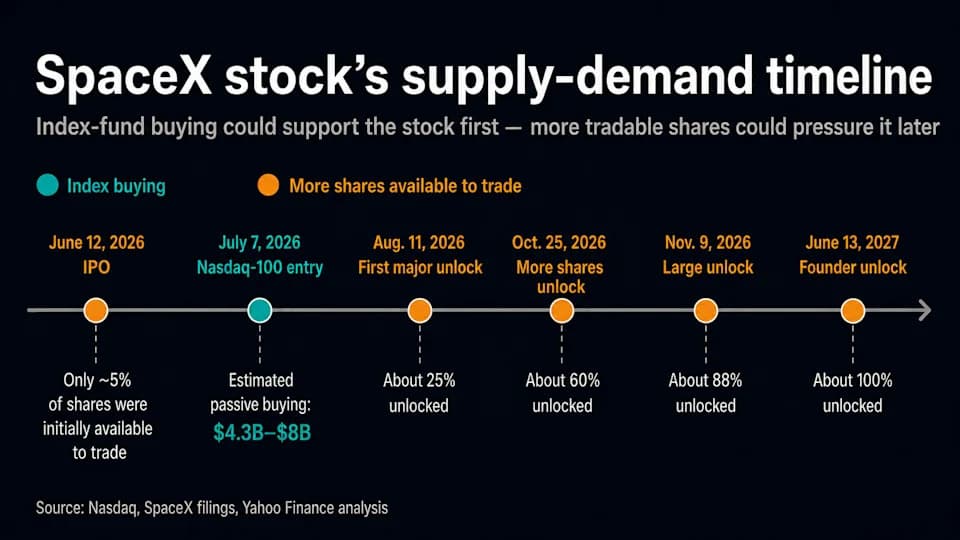
SpaceX joined the Nasdaq-100 before U.S. markets opened Tuesday, setting up automatic buying from index funds and exchange-traded funds that track the benchmark, including large products such as the Invesco QQQ Trust. The stock, which has a small public float, was down 1.2% in early premarket trading even as Wall Street recalibrated for the company’s new place in one of the market’s most closely watched indexes.
The addition matters because the Nasdaq-100 tracks 100 of the largest Nasdaq-listed non-financial companies, and membership carries mechanical demand from passive investors regardless of near-term valuation. Market estimates for the forced buying tied to SpaceX’s entry have clustered around $4.3 billion, with some higher projections depending on how the final float and weighting are calculated. Even so, SpaceX’s initial weight in the index is expected to be less than 1% because so little of the company trades freely.

Nasdaq’s newer methodology made that rapid inclusion possible. The exchange’s updated rules took effect on May 1, after a public consultation that opened on February 2 and closed on February 27. Under the new Fast Entry path, a newly listed company can join the Nasdaq-100 after 15 trading days if it ranks among the top 40 Nasdaq-100 names by market capitalization. SpaceX became one of the first beneficiaries of that change.
The timing was unusually compressed. SpaceX went public on June 12 and reached the index after only 15 trading days, a pace that would have been impossible under the old seasoning rules. That speed has sharpened questions about whether index-rule changes were effectively built for giant new listings and whether the mechanics of benchmark construction are amplifying already concentrated enthusiasm for mega-cap names.
For retirement savers and other ordinary investors, the issue is less about SpaceX’s rockets and satellites than about how much of the market now trades through passive products. When a company with a market value north of $2 trillion is added to a major benchmark, the buying is not driven by analysts deciding the stock is cheap or expensive. It is driven by the index itself, and by the funds that must mirror it.
This article was produced by Prism’s automated news system from verified source data, official records, and press releases, then run through automated quality and moderation checks before publishing. The system is built and supervised by the people who set the standards it runs under. Read our full AI policy.
Did this article answer your question?