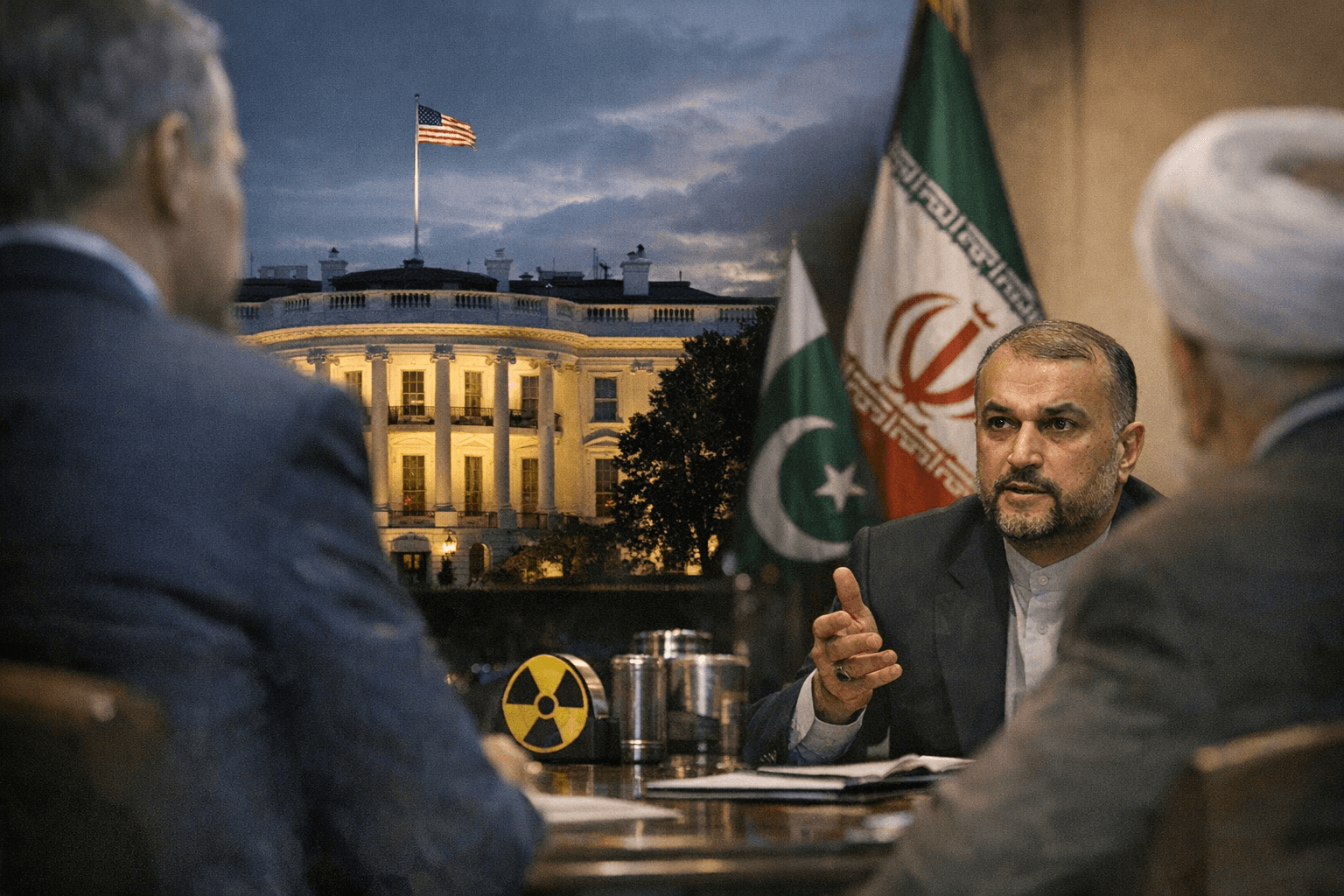
White House and Iran Clash Over Whether Nuclear Talks Are Actually Happening
Iran's foreign minister says Washington's outreach is an "exchange of messages," not negotiations, even as the White House insists talks are "proceeding apace" and eyes a Pakistan meeting.

The White House said talks with Iran are proceeding apace, even after Iran did not immediately accept a 15-point plan offered by the United States to bring the war to an end. Tehran's foreign minister told a different story entirely.
Foreign Minister Abbas Araghchi acknowledged that messages have been exchanged with the U.S. through mediators, but said that Washington's shift in tone amounted to an acknowledgment of failure after previously demanding Tehran's "unconditional surrender." In remarks that underscored the widening gap in public characterizations, Araghchi drew a sharp semantic line: "The fact that messages are being sent and we respond with warnings or state our positions is not called negotiation or dialogue; it is an exchange of messages." He added that any ideas raised in those messages had been "conveyed to top authorities" and that a formal position would be announced if one needed to be taken.
Behind the scenes, Trump administration officials are working to arrange a meeting in Pakistan this weekend to discuss an off-ramp to the war, with current plans having Vice President JD Vance traveling to the country, and possibly other top administration officials, though officials cautioned that the timing is fluid, as is the location and who may attend. Turkey has also arisen as a potential location for the talks, with some officials raising security concerns about a Pakistan visit.
Pakistan has acted as a key intermediary in the current bout of diplomacy between the U.S. and Iran, delivering a 15-point plan proposed by Washington to Iran that addresses issues like Tehran's nuclear ambitions and its ballistic missile program. White House press secretary Karoline Leavitt cautioned reporters about coverage of that plan, saying: "The White House never confirmed that plan. There are elements of truth to it but some of the stories I read were not entirely factual."
The question of who would even sit across the table from Iranian officials has itself become a flashpoint. Iranian representatives have told the administration they do not want to re-enter talks with envoys Steve Witkoff and Jared Kushner. Mediating countries were trying to convene a meeting in Islamabad with Ghalibaf and other officials representing Tehran, and Witkoff, Kushner and possibly Vice President Vance representing the U.S., possibly later this week. Iranian sources cited "zero trust" in both Witkoff and Kushner, who led nuclear negotiations with Iran before the war began. One U.S. source was blunt about the leverage dynamic: "Who the administration decides to send, the Iranians will have to deal with, but it doesn't mean they don't have a preference."
Trump told reporters Tuesday that Vance and Secretary of State Marco Rubio are also participating in talks. Leavitt confirmed the roster, saying: "As the President stated today, Vice President Vance, Secretary Rubio, Special Envoy Witkoff, and Mr. Kushner will all be involved." She separately noted that Witkoff has been in communication "both directly and indirectly with the Iranians."
Iranian officials have told the mediators, Pakistan, Egypt and Turkey, that U.S. military movements and Trump's decision to deploy major troop reinforcements have increased their suspicion that his proposal for peace talks is just a ruse. Around 1,000 U.S. soldiers with the Army's 82nd Airborne Division are preparing to deploy in coming days to the Middle East. Strikes continued across the region Wednesday: a residential area in Tehran was hit by an airstrike, according to the Iranian Red Crescent, and drones struck a fuel tank at Kuwait International Airport, the country's civil aviation authority said.
A White House official said Iran's priority is to stop the bombing and secure a ceasefire, while the U.S. wants to see if the Iranians will make concessions they were not willing to make in previous talks. Israel attacked Iran with Trump's backing last June, days before a planned round of nuclear talks, and three weeks ago the U.S. and Iran reached a tentative agreement in Geneva to continue talks the following week, two days before the U.S. and Israel attacked. With that history now defining the terms of any potential engagement, whether what is happening between Washington and Tehran constitutes talks at all may matter less than whether either side can make them survive long enough to produce one.
This article was produced by Prism’s automated news system from verified source data, official records, and press releases, then run through automated quality and moderation checks before publishing. The system is built and supervised by the people who set the standards it runs under. Read our full AI policy.
Did this article answer your question?