White House says drug price deals could save $529 billion
The White House’s $529 billion claim rests on drugmakers keeping MFN deals and passing lower prices through to patients, insurers and Medicaid.
A half-trillion-dollar savings claim sounds like relief at the pharmacy counter, but the White House’s own numbers hinge on a chain of assumptions: that drugmakers keep signing voluntary deals, that those deals stay in force, and that lower list prices turn into lower out-of-pocket costs for patients.
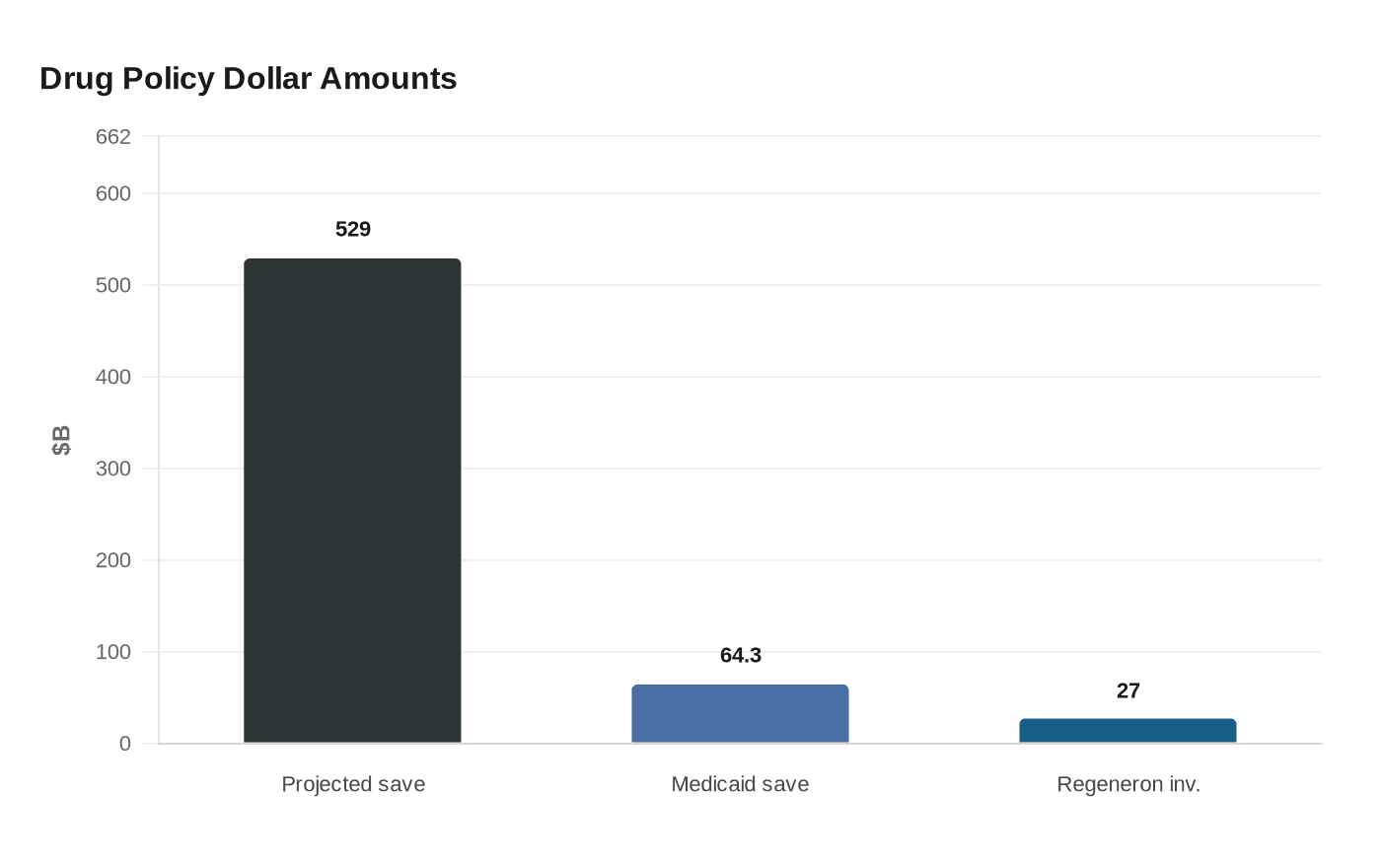
The administration’s analysis projects $529 billion in savings over 10 years if drugmaker agreements pull U.S. prices closer to what the same medicines cost in other developed nations. The pricing strategy is called most-favored-nation pricing, under which companies agree to match the lowest prices paid abroad. White House officials have framed the estimate as the most detailed economy-wide look yet at a core Trump policy, one they argue could affect households, employers and public programs, not just drug company balance sheets.

That projection now sits on top of a pressure campaign that began July 31, 2025, when the White House said letters went to 17 pharmaceutical companies, including AbbVie, Amgen, AstraZeneca, Boehringer Ingelheim, Bristol Myers Squibb, Eli Lilly, EMD Serono, Genentech, Gilead, GSK, Johnson & Johnson, Merck, Novartis, Novo Nordisk, Pfizer, Regeneron and Sanofi. The administration said those 17 firms now represent 86% of the branded drug market, giving the White House leverage, but also making the policy heavily dependent on industry participation rather than a sweeping law.
The clearest consumer example so far came with Regeneron’s deal, announced April 23, 2026. Under that agreement, the cholesterol drug Praluent was set to fall from $537 to $225 for direct-to-patient purchases through TrumpRx. Regeneron also agreed that all new medicines would receive MFN prices for U.S. patients, that every state Medicaid program would get access to MFN prices on Regeneron products, and that the company would invest $27 billion in U.S. research, development and manufacturing by 2029. The White House said the deal made Regeneron the 17th MFN agreement.
Even so, lower prices will not land evenly or instantly. The White House’s own materials say the $529 billion estimate assumes all new drugs are offered at MFN prices, and the underlying deal terms have not been made public. The administration also estimated $64.3 billion in Medicaid savings over 10 years, signaling that much of the gain could show up first in public budgets rather than in family copays. For seniors, employers and taxpayers, the real test is not the headline number but whether the savings reach patients, how much insurers and pharmacy benefit managers keep, and how quickly the discounts spread beyond a few high-profile deals.
The White House has leaned on a familiar argument to justify the push: U.S. brand-name drug prices are more than three times what other OECD nations pay, even after discounts, while the United States has less than 5% of the world’s population and about 75% of global pharmaceutical profits. That imbalance is the backdrop for the deal-making now underway. The harder question is whether pressure on manufacturers can deliver durable relief, or only temporary proof points ahead of the next election.
This article was produced by Prism’s automated news system from verified source data, official records, and press releases, then run through automated quality and moderation checks before publishing. The system is built and supervised by the people who set the standards it runs under. Read our full AI policy.
Did this article answer your question?

