White Label PPC Pricing Models and Reseller Strategies for Agencies in 2026
White-label PPC reseller costs run $750–$4,000+ monthly before your markup; here's how to price it, pick a partner, and protect your margins.
The moment an SEO-focused agency lands its first serious Google Ads request, the math gets uncomfortable fast. You can't realistically hire a full paid media team for one client, but turning down recurring revenue feels equally wrong. That's exactly the gap white-label PPC reseller services are designed to fill, and in 2026 the model has matured enough that choosing the right structure, pricing approach, and partner can meaningfully change what your agency earns.
What the white-label PPC model actually does for your agency
The core appeal is straightforward: a third-party provider runs paid search campaigns under your brand, while your agency maintains the client relationship and pockets the margin between what you pay and what you charge. As one industry guide puts it, "you can expand your offerings, increase recurring revenue, and maintain brand control without committing to full-time payroll." For agencies already running SEO retainers that are fielding consistent requests for Google Ads, Microsoft Ads, and paid social, the reseller model lets you say yes without rebuilding your team.
The comparison to hiring contractors is worth taking seriously. According to Symphonic Digital, a white-label agency is "often more cost-effective in the long run, reducing the time spent on recruitment and training," while a contractor "may have lower upfront costs but can incur additional expenses over time, especially if multiple contractors are needed." That recruitment and onboarding drag is real; anyone who has tried to hire a competent Google Ads specialist in a competitive market knows the timeline and the salary expectations.
The three pricing structures you'll encounter
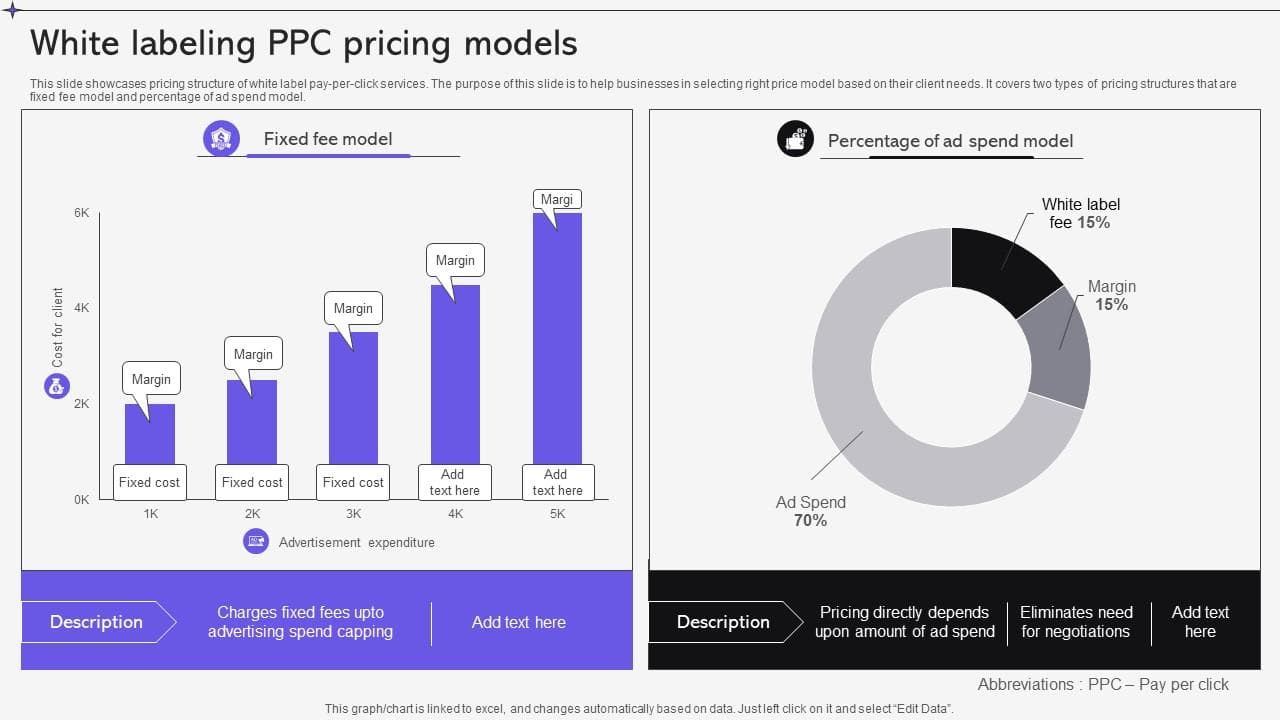
White-label PPC providers typically use one of three billing approaches, and understanding which one you're being quoted changes how you calculate your client-facing price.
The first is a flat monthly fee per account, which gives you predictable costs regardless of how aggressively a client spends. This makes your margin calculations simple and your profit consistent, though it may feel less aligned with client outcomes when spend scales dramatically.
The second is a percentage of ad spend, where your provider cost rises as the client's budget grows. This model aligns provider incentives with performance, but it compresses your margins on larger accounts unless you adjust your own pricing accordingly.
The third is tiered pricing based on spend volume, which layers the two approaches: the provider charges different rates depending on which spend bracket a client falls into. This offers flexibility but can create cost jumps that catch agencies off guard when a client moves from one tier to the next.
Knowing which model a provider uses before you sign lets you build a pricing sheet that actually holds up when client budgets shift.
What reseller costs actually look like
Feedbird's published benchmarks put white-label PPC management for Google and Microsoft Ads in the range of $750 to $4,000 or more per month, with ad spend billed separately. That monthly management fee typically covers campaign setup, ongoing optimization, negative keyword management, and reporting. What it does not cover is creative production or landing page work, so factor those costs in if your clients need them.
For context on where PPC sits relative to other white-label services, the same benchmark data shows white-label paid social (Meta and LinkedIn) running $750 to $5,000 or more per month, full-service SEO at $1,500 to $6,000 or more, and link building at $500 to $4,000 or more. If you're bundling services for a client, these ranges help you build a package cost before applying your markup.
Building your margin into the reseller price
The standard agency practice is to mark up reseller costs by 30% to 70%, depending on how you've positioned your agency in the market. A boutique agency with strong brand equity and white-glove service can justify the upper end of that range; a newer agency competing on price will likely sit closer to 30%. The math is simple in principle: if your provider charges $1,500 per month for PPC management, a 50% markup puts your client-facing price at $2,250. At 70%, that same $1,500 cost becomes $2,550 to the client.
The key is to confirm that your pricing structure leaves enough room after markup for the overhead you're absorbing: account management time, client communication, and any reporting customization you layer on top of what the provider delivers.

Reporting transparency is non-negotiable
The single most important operational requirement to verify before signing with any white-label PPC provider is reporting access. Your agency needs the ability to view live dashboards, audit search terms, and review change history. These aren't nice-to-haves; they're the minimum you need to stay accountable to your clients and catch problems before they become crises.
The guidance here is blunt: "If reporting feels restricted, that's a red flag." Any provider that limits your view into campaign data is a provider whose work you can't verify, which puts you in an impossible position when a client asks why their cost-per-lead doubled.
Questions to ask before you commit to a partner
Beyond pricing and reporting, the operational fit between your agency and a white-label provider comes down to communication. Three questions worth asking directly before you sign anything:
- Will they join client calls if needed?
- Do they provide Slack or email support?
- What is their turnaround time on changes and requests?
A provider that refuses to get on client calls or responds to requests on a two-day lag will create friction that eventually damages your client relationships. The best white-label partnerships work because the provider functions as an invisible extension of your team, not as an external vendor you're constantly chasing.
Setting expectations before problems surface
One area agencies consistently underinvest in is the formal expectation-setting conversation at the start of a reseller relationship. Boostability puts it directly: "Both the white label SEO provider and the reseller must establish clear expectations to have a great relationship." Without that structure in place, the ambiguities that seemed minor during the sales process become genuine disputes later, whether around strategy decisions, pricing changes, or how the provider handles urgent client situations.
This applies whether you're onboarding a white-label PPC partner or expanding into SEO reselling. Document the scope, the turnaround standards, the escalation path, and what happens when a campaign underperforms. A partnership without those guardrails is one bad client month away from becoming a problem.
Expanding beyond PPC: the broader reseller opportunity
White-label PPC is often the entry point, but the reseller model extends across nearly every digital service your clients need. The Feedbird benchmark data covers white-label paid social at $750 to $5,000 or more per month, social media management at $400 to $2,500 or more, content writing at $300 to $3,500 or more, local SEO at $500 to $2,500 or more, and reputation management at $300 to $2,000 or more. Web design projects run $1,500 to $12,000 or more as one-time engagements.
For SEO specifically, pricing follows the competitive intensity of the client's industry. Light local SEO runs $400 to $1,000 per month and covers on-page work and basic tracking. Standard SEO, which includes content, technical work, and a reporting cadence, runs $1,000 to $2,500. Competitive or multi-location campaigns with heavier content, technical, and link-building requirements run $2,500 to $6,000 or more per month.
The practical takeaway is that a well-chosen reseller ecosystem lets your agency quote against much larger competitors. "A reliable white-label PPC reseller becomes part of your growth engine," and the same logic holds for every service category you add. The agency that can confidently price and deliver PPC, SEO, paid social, and content under one roof, without the full-time staff to match, is the agency that wins pitches it would have had to pass on a year earlier.
The white-label model is not a shortcut around building expertise; it's a deliberate structural choice that trades internal overhead for provider dependency. Make that trade carefully, verify your partners thoroughly, and protect your margins from the first proposal you send.
Sources:
Know something we missed? Have a correction or additional information?
Submit a Tip