White supremacists exploit disasters to recruit, reshape image, sow distrust
When disasters strike, extremists move in with supplies, cameras, and propaganda. The warning signs now stretch from Texas to North Carolina.
The new disaster-response gap
When more than 200 tornadoes hit more than 20 states in April, the next emergency on the calendar was already visible: hurricane season. That is the opening extremists keep looking for, when overwhelmed communities need help fast and any outsider offering boots on the ground can seem useful before motives are clear.
Lesley Stahl’s report for 60 Minutes described a pattern now familiar across disaster zones. Militias, conspiracists, and white supremacists arrive in hard-hit places offering assistance, but they also try to sow doubt in government, soften their own image, and gain followers. The danger is not only ideological. It is operational, because the people exploiting the crisis often know how to turn chaos into access, visibility, and trust.
Why disasters attract extremist groups
The Southern Poverty Law Center says disaster recovery areas become public relations opportunities for white nationalists and antigovernment operatives. After Hurricane Katrina, those tactics were on full display. White supremacist White Revolution promoted a “Cartridges for Katrina” scheme that encouraged violence against Black people, and the SPLC documented the all-white Algiers Point militia in New Orleans patrolling the area, detaining and questioning people, and contributing to a climate in which at least 11 people were shot, with Black people targeted by white shooters.
That history matters because it did not stay in the past. The SPLC says the same patterns have repeated in later natural disasters, from racist propaganda to anti-government rumor campaigns designed to slow recovery. The group also warns that climate change is increasing the number and intensity of disasters, which means the number of moments when institutions are stretched thin is growing as well.
What the latest playbook looks like
In the aftermath of Hurricane Helene in September 2024, 60 Minutes reported that outsiders poured into North Carolina, including anti-government far-right groups. Sheriff Lowell Griffin said some of those newcomers wanted to act like a militia, and that weapons were involved. His warning was blunt: a small minority can create chaos and pull local authorities away from real rescue work.
One of the names that surfaced in that reporting was Active Club. Robert Rundo co-founded the group in 2020, and 60 Minutes said it has nearly 90 chapters and has been described by watchdogs as one of the country’s fastest-growing white supremacist networks. Its structure is built for recruitment: combat sports, propaganda, and local chapters that can pull in young white men who may not initially see themselves as part of an extremist project.
Rundo’s own language exposed the intent. He described disaster relief as directly helping “our people” and helping white people. That is the logic of the playbook. Aid becomes identity politics, and identity politics becomes a recruitment funnel.
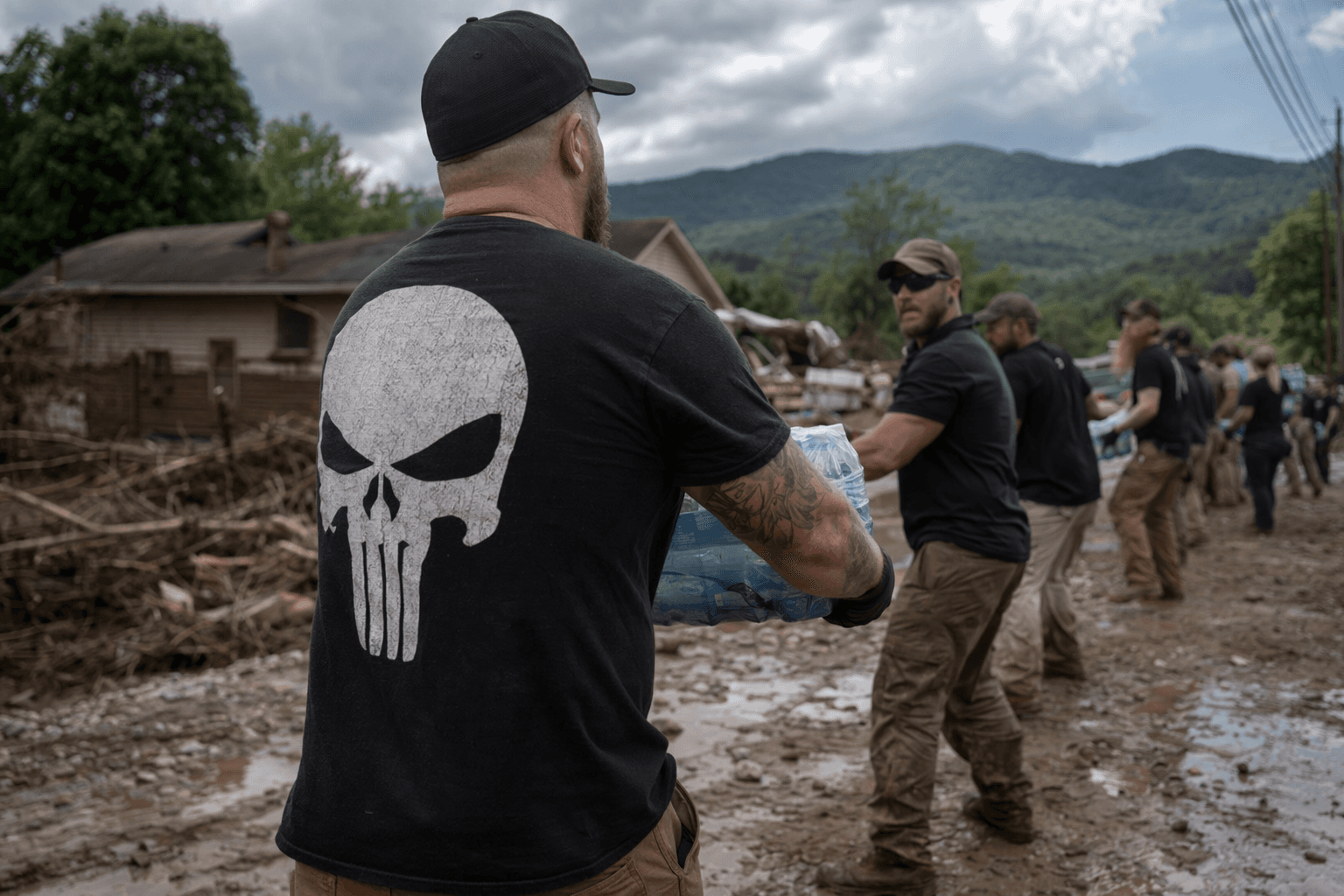
The same pattern showed up again in Texas. The Anti-Defamation League said Patriot Front used the July 4, 2025 Hill Country flooding, which killed at least 119 people and left more than 170 missing, to generate positive publicity under the guise of disaster relief. The group shared footage on July 9, 2025 that was purportedly taken outside Camp Mystic in Hunt, Texas, and leader Thomas Rousseau said the group was “prioritizing the interest of our people.” The ADL also said that material was rapidly amplified by other white supremacist channels, including Active Club accounts, showing how quickly a staged relief effort can become movement media.
The rumor campaign is part of the same operation
Extremist exploitation of disasters does not require a uniform or a truckload of supplies. During Hurricane Helene, PBS reported that false claims spread online that FEMA was withholding aid from Republican victims, that weather-control technology had steered the storm, and that officials planned to bulldoze affected communities and seize land. Local officials said those rumors took time away from recovery work, which is exactly the point: distrust slows the response, and delay creates room for agitators.
For emergency managers, the warning is clear. The most effective disinformation is not always loudest at first. It often arrives packaged as grievance, rumors about favoritism, or false claims that government help is secretly political.
Warning signs when volunteer help arrives
Watch for these signals when outside groups show up after a disaster:
- They arrive with cameras first and supplies second, treating relief as content for social platforms or encrypted channels.
- They speak in tribal language, talking about helping “our people” while implying that other residents, religions, or races do not belong in the recovery effort.
- They bypass local emergency management and try to control access, patrol neighborhoods, or set up their own checkpoints.
- They use militia style branding, coordinated uniforms, or overt security language, especially if weapons are visible.
- They spread claims that government agencies are intentionally abandoning victims, seizing land, or targeting one political group.
- They create segregated spaces or exclusionary aid systems, the kind of racialized relief culture the SPLC documented after Katrina, including a “whites-only” tent camp for refugees.
- They try to recruit on the spot, especially young men, by mixing physical tasks, camaraderie, and political messaging.
Those signs do not prove every volunteer is malicious. But they do show when aid is being used as a front for ideology, surveillance, or recruitment.
How local officials can keep control of the scene
The first defense is administrative, not rhetorical. Credentialing volunteers, assigning them to official staging areas, and requiring coordination with incident command reduces the space where unaffiliated groups can improvise their own authority. That matters because extremist disaster efforts are often small and disorganized, as the ADL notes, but they still can impede trained relief workers and law enforcement while generating footage that travels faster than any sandbag line.
Local leaders also need to name the problem early. When rumors about FEMA, land seizure, or weather manipulation begin circulating, public rebuttals have to be specific, repeated, and tied to recognizable institutions. Disasters create fear; extremists count on that fear to look like certainty. The faster officials protect the facts, the less room there is for the people trying to profit from uncertainty.
The lesson from Katrina, Helene, and the Texas flooding is the same: disaster zones are not only places of physical damage. They are also places where trust can be harvested, reshaped, and weaponized. Communities that recognize propaganda as quickly as debris will be harder to divide when the next storm hits.
This article was produced by Prism’s automated news system from verified source data, official records, and press releases, then run through automated quality and moderation checks before publishing. The system is built and supervised by the people who set the standards it runs under. Read our full AI policy.
Did this article answer your question?