Who is Frankie van Heel, the private force behind Andy Burnham?
Marie-France van Heel has kept her distance from politics, but her Cambridge partnership with Andy Burnham and her executive career now sit close to his national ambitions.
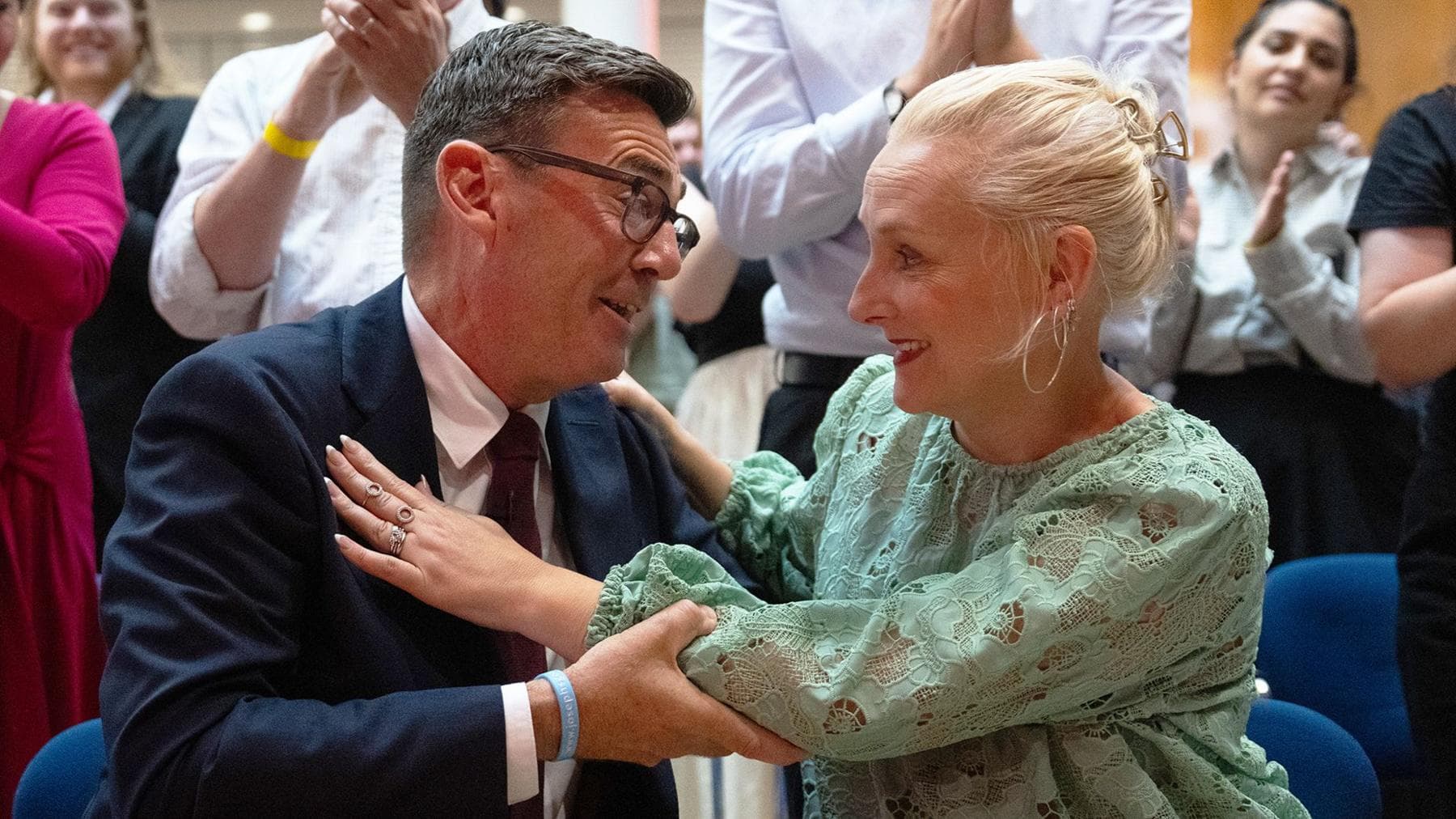
Marie-France van Heel, known as Frankie, is not a ceremonial presence on the edge of Andy Burnham’s career. She is a marketing executive with her own professional track record, and her long relationship with Burnham now matters because his name is increasingly being discussed in national leadership terms. Together for more than three decades, and parents to three children, they offer a portrait of political partnership built long before the current attention.
A Cambridge relationship that predates the spotlight
Burnham met van Heel at Cambridge University, where the pair were studying before either had the national profile they carry today. The relationship has now lasted more than three decades, and they married in 2000, giving the family life a fixed base long before talk of No 10 entered the picture. That longevity is part of why van Heel has become a subject of political interest: she is not a recent addition to Burnham’s public story, but a constant through the years of his rise.
Her own preference has been to stay out of the glare. Coverage has repeatedly described her as private and as someone who deliberately shuns the spotlight, which makes her useful to understand not as a public performer but as part of the structure that surrounds a politician with national ambitions. In practical terms, that kind of steadying presence can shape the rhythm of family life, the boundaries around media exposure and the image of normality a leader tries to project.
A career built well outside Westminster
Van Heel has her own professional identity, and it sits apart from politics. She is described as a marketing executive and has also been linked with charity work, a combination that places her in the world of brand management, public-facing strategy and civic-minded activity rather than party machinery. The Times and The Sunday Times described her as a Dutch-born marketing executive, a detail that adds to the sense that her life story is wider than the role now attached to her husband.
More recent coverage places her as chief customer officer at Be.EV, a senior executive post in the electric vehicle charging sector. That role matters because it suggests she is used to operating in commercial environments where customer behaviour, infrastructure and public trust all intersect, the kind of experience that can quietly inform how a political family thinks about communication and presentation. It also means the public is looking at a spouse who has worked at senior level in her own right, not someone whose identity begins and ends with a politician’s household.
The Blind Date moment that never quite disappeared
The detail that keeps bringing van Heel back into headlines is her appearance on ITV’s Blind Date in 1992. She was already dating Burnham at the time, turning what would usually be an isolated piece of TV nostalgia into a very specific piece of political folklore. In the programme, she chose Will Harris from Surrey, who later became a Conservative Party official, a neat example of how one old television clip now sits inside a much newer political narrative.
The episode has gained new attention because it offers a glimpse of the couple before public life changed everything. Sky News noted that Burnham had to watch an episode of Cilla Black’s dating show from the sidelines, while other coverage recalls that he was already part of van Heel’s life when she took part. The result is a story that keeps resurfacing because it is both ordinary and slightly absurd: a long-term partner, a dating show, and a future front-line politician all folded into one memory.
Why she now matters to Burnham’s public image
The present interest in van Heel is not really about celebrity. It is about the role a long-term spouse can play when a politician’s career moves from local or regional leadership toward the prospect of Downing Street. Some coverage has already framed her as a possible future first-lady figure if Burnham reaches No 10, and The Standard has placed her in the lineage of Victoria Starmer, Samantha Cameron and Cherie Blair. That comparison tells you less about vanity than about expectation: political spouses are often read as signals of temperament, discipline and domestic stability.
Tatler has gone further, describing her friends’ view of her as “beautiful, very gentle, and highly intelligent,” and calling her the “First Lady of Manchester.” Those phrases are obviously stylised, but they show how quickly a private person can be drafted into a public role when the politician beside her is seen as a serious national contender. The key point is not that van Heel is seeking that position, but that her long-standing privacy and her senior career may make her well suited to it if the pressure around Burnham keeps building.
The quiet influence behind the public figure
What makes van Heel politically relevant is the combination of distance and proximity. She has spent years avoiding the performance of politics, yet she has been beside Burnham since Cambridge, through marriage, parenthood and his ascent to one of the most visible offices in Greater Manchester. That gives her a different kind of influence from a campaign aide or media adviser: less formal, but potentially more durable.
If Burnham continues to move closer to national power, van Heel will shape how that power is lived at home and how it is presented outside it. Her record suggests a partner with professional independence, a strong preference for privacy and enough familiarity with public scrutiny to understand its costs. In modern politics, that combination can become part of a leader’s message even when the person carrying it never asks for the role.
This article was produced by Prism’s automated news system from verified source data, official records, and press releases, then run through automated quality and moderation checks before publishing. The system is built and supervised by the people who set the standards it runs under. Read our full AI policy.
Did this article answer your question?